
Micaela Romero can clearly remember the first time her fiancé, Trevor Hendricks, called to tell her he was in solitary confinement. “At first I was calm,” she tells The Progressive. He had been in the hole a week, but had only been placed there because he happened to be nearby when another prisoner was assaulted. “He wasn’t involved, so I thought he’d be out soon,” she explains.
Romero considered herself capable enough to get the situation resolved—she would contact whoever was in charge, explain that a mistake had been made, and get him out. That was in 2016, not long after Hendricks entered the Washington State prison system. Ten years later, she laughs bitterly about how badly she miscalculated her interaction with the state’s Department of Corrections. “I didn’t know how DOC operated,” she says. Hendricks remained in solitary for nine months.
Romero and her fiancé grew up together in Phoenix, Arizona, where their families attended the same church. They had been close friends for more than a decade before their friendship became romantic. Hendricks was the man she loved, her best friend, a presence that had comforted her since childhood. The awareness that he was trapped in a tiny isolation cell was agony to her, corkscrewing through her thoughts endlessly.
Romero’s anxiety sharpened whenever Hendricks didn’t call on time, or missed a call entirely—which was often. “I had to plan my whole life around calls,” she says. “And you can’t plan.”
The unpredictable timing of Hendricks’s calls constantly forced Romero to “walk out of something. Work or a presentation. I had flexibility in my work schedule, but if it came down to not answering or dropping everything, there’s no way I’m not answering.”
Technically, Hendricks’s time out of his cell ran on a schedule, but it often changed at the whim of guards. The couple would plan a date night call and Romero’s phone would never ring. “If he was a few minutes late, my heart would start racing,” she says.
But as stressful as Hendricks’s time in the hole was for Romero, the emotional strain on the couple’s young son was even more intense.
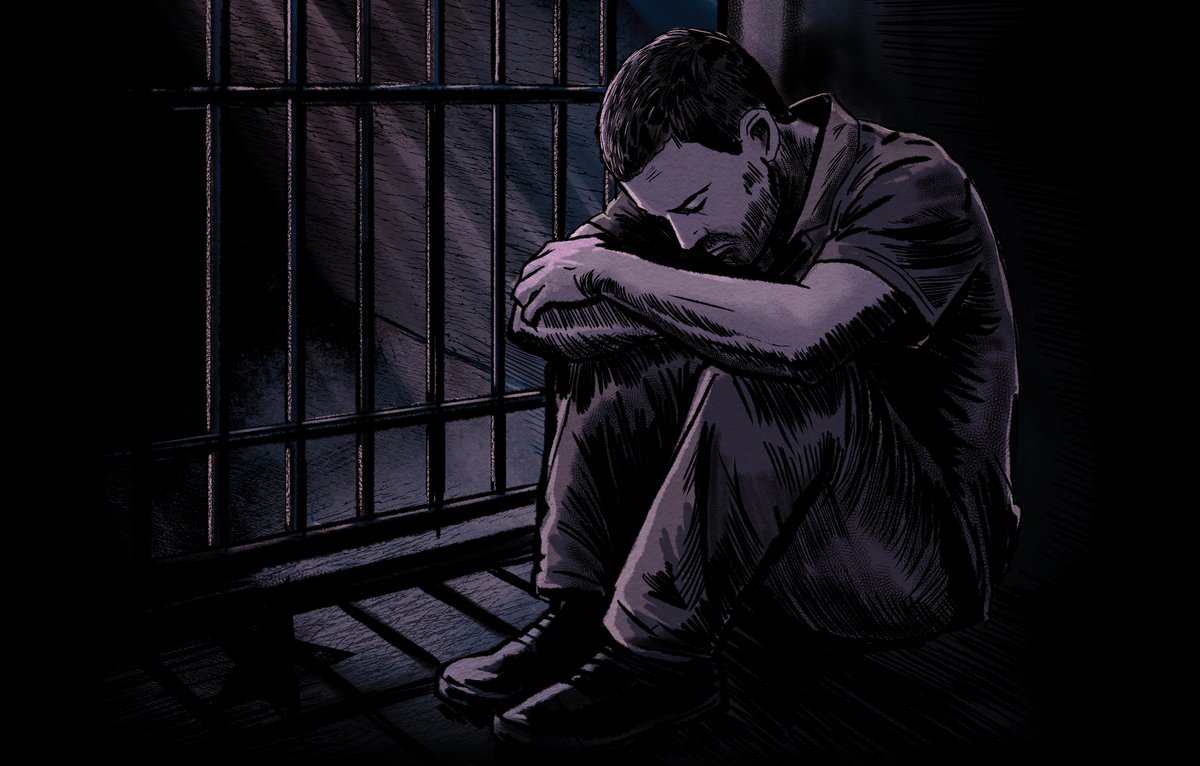
When Hendricks was in the general population, Romero would bring their son to visit him. But visits in solitary confinement units took place inside cramped booths, with the family on opposite sides of a Plexiglas partition, talking through phone receivers. This, Romero knew, would confuse and upset their child, and she refused to put him through it. While Hendricks was in the hole, calls were the only contact he and his son had.
Romero innovated activities the three of them could do together. But more often than not, the arbitrary nature of Hendricks’s phone access sabotaged her efforts. She would plan something—a call before bedtime, a movie night with Hendricks on speaker, semi-present while Romero and their son watched a Disney movie—and then the call would be late, or the connection poor, or his time out would be canceled because of a facility lockdown. The greatest frustration, Romero says, “is not knowing why.”
When prisoners spend time in solitary confinement, the changes they undergo are immediate and severe. Researchers have meticulously documented the psychological damage inflicted in solitary, and news outlets routinely report on the intensity of human suffering there. But even as academics and journalists sound the alarm, the families of solitary prisoners experience trauma that largely goes unnoticed. Powerless to intervene, they are forced to watch their loved ones freefall into mental health crises and physical decline. And when a solitary term ends, it’s up to a prisoner’s family to repair the harm.
In 2015, Teresa Hertz was sitting on a beach in Melaque, Mexico, looking out over a calm, cobalt blue ocean. The day was balmy and serene. Hertz owned and operated a child care center in Bellingham, Washington, and had been working fifty-hour weeks for more years than she could remember. Finally on vacation, she was pressing her toes down into the warm sand, her body just beginning to relax. Then her phone rang.
Hertz’s son, Zack, was in prison in Washington, and had been in solitary confinement for several months. It was not the first time he’d been placed in isolation. Since going to prison in 2008 at the age of nineteen, Zack Hertz had been to the hole more than a dozen times.
On that beach in Melaque, Hertz accepted her son’s collect call and talked with him for an hour, the full amount of time he would be allowed out of his cell that day. Knowing that once the call was over he would be shackled and taken back to a bare cell destroyed her nascent sense of peace.
“It’s so dark and painful,” says Hertz. “I can be in a beautiful place where I should be happy, but I can’t be. It’s ruined. Vacation is never vacation; Christmas is never Christmas. How do you enjoy yourself when your kid’s being tortured?”
The history of solitary confinement in the United States begins with the rise of prison as a means of reform and rehabilitation, driven by Quaker activists in the late eighteenth century. Pennsylvania’s Eastern State Penitentiary—the world’s first penitentiary, opened in 1829 in Philadelphia—kept each prisoner in permanent isolation from human contact. “The idea was if people were locked in cells by themselves they would have no distractions and no choice but to confront their wickedness and repent,” explains Anthony Blankenship, a correctional systems expert at the Washington-based nonprofit Civil Survival. “It was a penitentiary, a place where people became penitent before God. What actually happened was people became violently insane. They would self-harm. They would kill themselves. A lot of them never recovered. It was a catastrophe.”
Charles Dickens toured Eastern State in 1842 and came away deeply disgusted. He published an account of what he had witnessed, describing human beings “buried alive . . . dead to everything but torturing anxieties and horrible despair.” Public outrage spurred court challenges. In its Medley, Petitioner opinion of 1890, the U.S. Supreme Court partially outlawed solitary confinement. But the ruling was narrow, and eventually the use of solitary would expand widely in the 1970s.
Since then, the use of solitary has steadily grown. Today, it is ubiquitous in the thousands of jails and prisons in the United States. More than 120,000 people in this country spend time in solitary confinement each day.
Hertz’s son had a child just before going to prison. In the early years of Zack’s incarceration, she would regularly bring his son to see him. “We visited him at McNeil Island all the time when [his son] was a baby,” says Hertz.
At McNeil Island—the minimum security facility Zack was assigned to after his initial classification in 2008—the visiting room was surprisingly friendly. Zack spent hours with his infant son in a play area stocked with toys. That ended when he went to solitary. Like Romero, Hertz thought the environment too oppressive for a child, the potential for trauma too high. The solitary unit was in a remote corner of the prison grounds, inside a grimy building with clanging steel gates and dirty plastic windows. The mood was grave. There would be no opportunity for Zack and his son to touch, let alone play together. She was not exposing her grandchild to a place like that. Eventually, the bond between Zack and his son faded.
Nothing has emotionally battered Hertz like seeing the changes solitary produced in her son. The longer he stayed in isolation, Hertz says, the more she could hear chaos seeping into his voice. He began to sound desperate, and his desperation slowly dialed up. Hertz mailed crossword puzzles to him, trying to provide him with something that would keep his mind occupied, but the prison returned half of what she sent, citing inscrutable restrictions on incoming mail.
Unable to concentrate on anything, Zack fell into compulsive pacing, walking the eight-foot length of his cell hour after hour. He was skinny to begin with, and pacing stripped his lean frame to the bones. During one three-month term in solitary, he lost a quarter of his body weight.
Some solitary prisoners are better than others at masking their mental health struggles. Micaela Romero’s fiancé, Trevor Hendricks, was particularly adept at this. “Trevor has the ability to compartmentalize and block off his problems from his interactions with his family,” Romero says.
Through her friendships with former prisoners and families who had loved ones in solitary, Romero knew his apparent steadiness was extraordinarily unusual. The seeming disparity in psychological responses is what inspired her—at that point a molecular biology major at the University of Washington (UW)—to conduct scientific research on solitary confinement. “I thought it would be about why some people can withstand time in the hole” while others fall apart, she says.
Romero started working at UW in 2024, as a neural systems and behavior researcher. In her research, ethical rules prevent her from exposing mammals to isolation. “I can’t put mice in solitary for a single day in the lab,” Romero says, “but the Department of Corrections can keep human beings in solitary for years.” So Romero works with bees. “Bumblebees actually make a great model,” she says, because, like humans, they have a highly social nature. So what happens when their social instincts are denied?
In the ZYWang Laboratory at UW, Romero builds bee habitats that approximate the conditions in solitary cells. No contact with the rest of the colony, extremely limited space, twenty-four-hour exposure to fluorescent light. The results are disturbing. “They behave erratically,” she says. “Some of them hide and go dormant. Some of them become aggressive. They buzz at me and slam against the walls. Their locomotion is slower. They lose weight.”
Romero’s work builds upon decades of studies examining the psychological effects of isolation. Stuart Grassian, the Harvard Medical School researcher who pioneered the field of solitary studies in the early 1980s, found that periods of exposure lasting only a few weeks can produce excruciating levels of anxiety, paranoia, hallucinations, and symptoms of obsessive-compulsive disorder, as well as diminished emotional control and a weakened ability to navigate basic decision-making processes.
The sight of Romero’s deranged bees “is shocking,” says Washington State Representative Strom Peterson, a longtime advocate for solitary reform who toured the Wang Lab in September 2025, alongside other state lawmakers and Department of Corrections officials. “It definitely added a sense of urgency” to his effort to pass legislation limiting the use of solitary, Peterson says. “About 85 percent of people currently incarcerated will return to our communities. Inflicting long-lasting, even permanent, trauma on our future neighbors will not increase public safety.”
The outcomes of Romero’s studies always brought her fiancé to mind. She began wondering whether he was suffering more than he let on. Eventually she realized that “Trevor was trying to be calm for me.” But in solitary confinement, she adds, “no one stays the same.”
Zack Hertz was released from the Washington State Penitentiary in February 2015, directly from solitary confinement. Teresa Hertz and her husband picked him up at the gate. It was plain to them, immediately, that he was unwell.
“We tried taking him to a restaurant for breakfast and he couldn’t cope,” Hertz says. There was too much movement, too many strange and startling noises, too much space. Eye contact and human interaction unsettled him. At home, Hertz says, “we took him to a psychiatrist. He was diagnosed with extreme PTSD. We set up a job interview and he panicked right before and didn’t go.”
Lost in his trauma and bewildered by freedom, Zack slid back into heavy drug use, a long-term habit. Within months, he was in prison again. Hertz was furious. “I’m paying taxes to fund this torture chamber,” she says. “No one is getting better in solitary. Everyone gets worse.”
According to David Fathi, director of the American Civil Liberties Union National Prison Project, “We know beyond any doubt that solitary confinement breaks people, and it renders them in many cases simply unable to function in the broader society.” The “catastrophic harm” of solitary, he says, can leave people “unable to live among other humans,” even close family members. Many former solitary prisoners withdraw from all contact with loved ones and self-isolate. “They have essentially ceased to exist as a social creature,” Fathi says, “and that can be devastating to any kind of social relationship, especially intimate relationships like parent-child or with a spouse.”
Trevor Hendricks went home from Washington Corrections Center’s solitary unit in July 2025. All together, he’d spent a total of five years in solitary confinement. Initially, Romero says, there was no indication of the harm solitary had done to him.
“The first hundred days were wonderful,” she says. “He’s the best partner in the entire world. He packs our lunches in the morning. He makes my coffee. He’s the cool dad who plays sports with the neighborhood kids. And inside, he’s falling apart.”
After those three months, the cracks began to show. The colors in Romero’s brightly decorated house overstimulated Hendricks. He dealt with impostor syndrome, the feeling that he didn’t belong in a normal life or deserve loving relationships. He started asking Romero whether he should tell people, upon meeting them, that he was a criminal.
In October, Hendricks went to live with a friend. He emptied a spare bedroom of its furnishings and settled in, comfortable at last in a tiny room with blank walls and a mattress on the floor. On the morning of November 2, Hendricks packed his belongings, loaded them into his car, and walked away. He went missing for thirty hours.
“He wandered into the woods to die,” Romero says, “but he saw something that reminded him of our son and he found his way back out.” The police located Hendricks on the street and took him to the emergency room. From there he was transferred to an inpatient behavioral health hospital.
“This is what solitary confinement is,” Romero says. “Every person in society is impacted by it. Even if you don’t know someone, you still drive down the freeway next to me while I can’t focus. Your tax dollars still go to Medicaid and the cost of mental health. You live among us. You still share space with people who are impacted.”
Zack is out of the hole and living in a minimum custody unit. Teresa Hertz’s dread, however, is as intense and relentless as ever. “The phone for me is a trigger, especially the phone ringing late at night,” she says. “I’m always worried something went wrong.”
Zack is scheduled for transfer to a work release facility this year. He’ll be home not long after that. “My hopes are that he’ll be able to reconnect with his son,” who is now sixteen, Teresa Hertz says. “Above all else, I just want him to be happy. I want him to have a happy life, and to never be in prison again.”
This article was supported by a grant from the Ridgeway Reporting Project, managed by Solitary Watch with funding from the Jacob and Valeria Langeloth Foundation and the Vital Projects Fund.