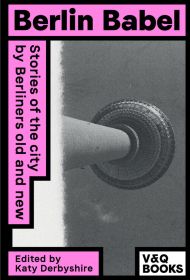

Berlin Babel is an anthology of fourteen short stories translated from eight different languages and edited by Katy Derbyshire. In the introduction she explains that her aim in creating this book was to find writers based in Berlin but originating from a wider selection of countries than is usually represented in English literature – to thereby offer up a sense of the city in fiction from a wider variety of perspectives.
The careful ordering of the stories helps to drive engagement. The anthology opens with The Shadow which tells of a Kurdish woman flying into the city having fled her homeland. She is welcomed and provided with a place to stay yet struggles to cope with all that is happening. She cannot control her emotions, appearing almost hysterical, thereby worrying the cabin staff on her flight. She can barely make herself walk through the airport. It is unclear what she expected and why she is acting this way. She is clearly missing her homeland yet it had grown too dangerous to stay.
The following story, A Rage to Live, is narrated by another new arrival to the city. Again, she is provided with a place to stay and help navigating the procedures she needs to go through, to attain legal permission to remain. The timeline seems to be around the COVID period which adds a further layer of alienation. Unlike the first protagonist, this woman does not flee danger so much as a place she has grown disillusioned with.
Subsequent stories deal with various aspects of freedom. An immigrant acquires a bicycle (the most commonly stolen thing in Berlin). A young girl meets up with friends downtown and learns to adjust her actions to better assimilate, enjoying how this belonging as her true self feels.
There are tales of the jobs that must be accepted when language and qualifications are not recognised. Oft repeated is how much it now costs to rent an apartment, some residents harking back to a past that has taken on mythical status, when Berlin was home to renegade arty types – ‘poor but sexy’ – and squatting was possible, before word got out it was the in-place to be and it turned into something expensively fashionable.
I said I was an immigrant. She said, ‘Who isn’t?’
The city touched me like it didn’t know how to apologise.
We all came here to escape systems.
And made new ones out of tattoos, kinks and playlists.Berlin doesn’t kink-shame. It just watches you drown, politely, silently.
Here you can have whatever you want
and that’s the danger:
the very short distance between wanting and having.
Relationships are rarely happy, characters still seeking that which they hoped to find in Berlin life. Mimi is a particular favourite on this theme, offering as it does a woman who tries to become another by supplanting her.
This middle section of the anthology is strong and, at times, dark in the people portrayed. There are occasional hints of magical realism, or perhaps haunting. The Scaffolding merges the greed of a shady conglomerate with an apartment block requiring a type of matriarch figure, one who may be hounded out but can then somehow be replaced.
Berlin is, of course, awash with the history that has seeped into the sand on which it is built. The Jewish experience is granted a recurring mention but so much more is covered within these pages. Suffering from wars further afield have now poured in. Those trying to move on still hold on to their memories, depicted well in A Colour Incompatible with War. This story also serves to remind that history covers centuries, not just decades.
The later stories can be at times, hard to fathom. Ice in their Laughter was certainly well written but the ending remained opaque. The same could be said for Yellow Plastic.
The final entry rounds off the anthology well. Its setting is almost macabre but with a more ‘Rocky Horror’ vibe than true horror. It brings to the fore the changes in Berlin and how some struggle with its lost hedonism as living there became more expensive. The two young men it features are almost comic but there is a deeper pathos.
After struggling a little with the first couple of stories this proved a satisfying read. It achieves its aim of providing a variety of perspectives on contemporary life in the city. In focusing on its multiculturalism these come across as more realistic than many other depictions.
Berlin Babel is published by V&Q Books.


![All Wrapped Up by Heidi Swain [blog tour]](https://som2nynetwork.com/wp-content/uploads/2026/09/PXL_20250826_093013577.MP_-336x220.jpg)