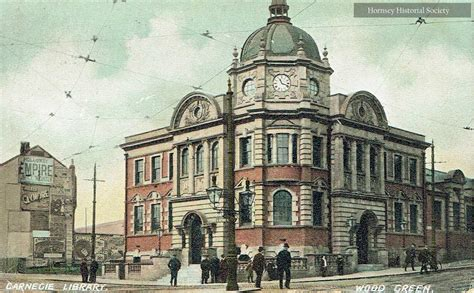
At the foot of Jolly Butcher’s Hill was a busy crossroad, where long-gone tram rails were still embedded in the tarmac. On one corner was the almost-Art-Deco Wood Green Tube station, where a warm nicotine fug seeped out into the damp air.

I followed my mother up the steep stone stairs, through the carved door to the mosaic floor into the library, and then life felt safe again. I could feel the power of the library, the silence, the rows and rows of books and the sense that, for a while, nobody could get at you. Almost like a church, it was, without the hymns and statues. My mother gave me a gentle push, and trotted off up the short flight of steps, through the double doors with their stained glass panels, and into the vast mysterious space where only adults were allowed.
Down the echoing stairs I went, with their green tiled walls, to the basement, where the Junior Library welcomed me with its whispery silence. A subterranean daylight seeped through half-moons of wired glass high along one wall, where the passing feet and pram-wheels created flickering shadows from the outside pavement. But I was here, now, in this calm other world, rarely reached by sunshine. The room was wide and generous, with shelves around all four sides: one wall for my ignored non-fiction, and three satisfactory walls for the fiction, in alphabetically arranged rows.
I recall no enticing prints or paintings hung high on the grey-washed walls. The only glow was over by Non-Fiction where, beyond the impressive set of encyclopaedias, was a table, holding a bubbling tank where tiny fish hid under loops of water-weed. Nearby there were books with pictures, made for children who could not yet read yet. Imagine that?
The books on the fiction shelves were bound in subdued tones of cloth: drab browns, faded blues, weary moss-green, withered rose, with gilt letters sparking on spines here and there. Occasionally, small black images were embossed on the front covers, hinting at the line drawings of the illustrations within. Occasionally, a coloured frontispiece appeared facing the title page. But, for the most part, then, colours came from the pictures that words made in your imagination.
Though the stock was old, that barely mattered; the books on our three shelves at home were old too. Newness was not something that mattered in books, other than the fact that ‘old’ writers like Dickens were revered. Did the book have pages? Yes. That was enough.
The books had probably been purchased when that Junior Library was created, part of the inspired movement for Children’s Libraries and Children’s Librarians pioneered by Eileen Colwell during the Twenties and Thirties, and which received much support, especially from the poet John Masefield, and which also led to Storytelling and Storytime sessions in libraries. But by now that original starting stock was a lot older.

(Oh, just two years? Might just go check on publication waits now . . .)
However, back then, as a quick and early reader, I sped through fiction greedily. I re-borrowed and re-read favourite stories, although now I remember few titles specifically from the library. Black Beauty? Call of the Wild? Christmas Carol? Children of the New Forest? The Silver Skates? Heidi? Arthur Ransome? Where did I come across all of those? My strongest passion was for myths and legends and fairy stories. I loved Andrew Lang’s famous Blue, Yellow, Green and Red Fairy Tale collections, which I borrowed time after time.


That beautiful copper domed library was a huge and significant part of my life, or whoever my self was trying to be just then, but three things happened, at almost the same time.
One: As a very good reader, I was granted an adult ticket, taken to find John Bunyan’s ‘Pilgrims Progress’ among the cavernous adult shelves, and carried it proudly all the way home with me. How or why I seized upon this heavy tome and title as the book my young self needed to read, I do not know, other than my delight in the alliteration of the title. Afterwards, I felt in a sort of limbo, neither of the unfamiliar adult nor the junior library and lost heart. That children’s librarian was probably pleased that I disappeared.

Two: I had another birthday and another school report, All at once, my time at home was strongly directed away from burying my head in books and towards the pages of the Progress Papers for the 11+ Exam booklets. Over and over again. Saturdays disappeared.
Thirdly: The Progress Papers exercises worked. I became a pupil at St Angela’s Convent Grammar School, where I had to learn a whole new culture of homework and subtle religious snobbery, and that there were ‘wrong’ authors and ‘wrong books’.
And we moved away, to another area. So there were no more visits to that Wood Green Public Library. Soon, there could be no more, as the library was transferred to a new, accessible open-plan site within the vast Wood Green Shopping City nearby – for all sorts of valid, rational reasons, I know – and my lovely, copper-domed building was demolished. Please note: in pictures,it doesn’t, look as big as it felt.

Penny Dolan


![All Wrapped Up by Heidi Swain [blog tour]](https://som2nynetwork.com/wp-content/uploads/2026/09/PXL_20250826_093013577.MP_-336x220.jpg)