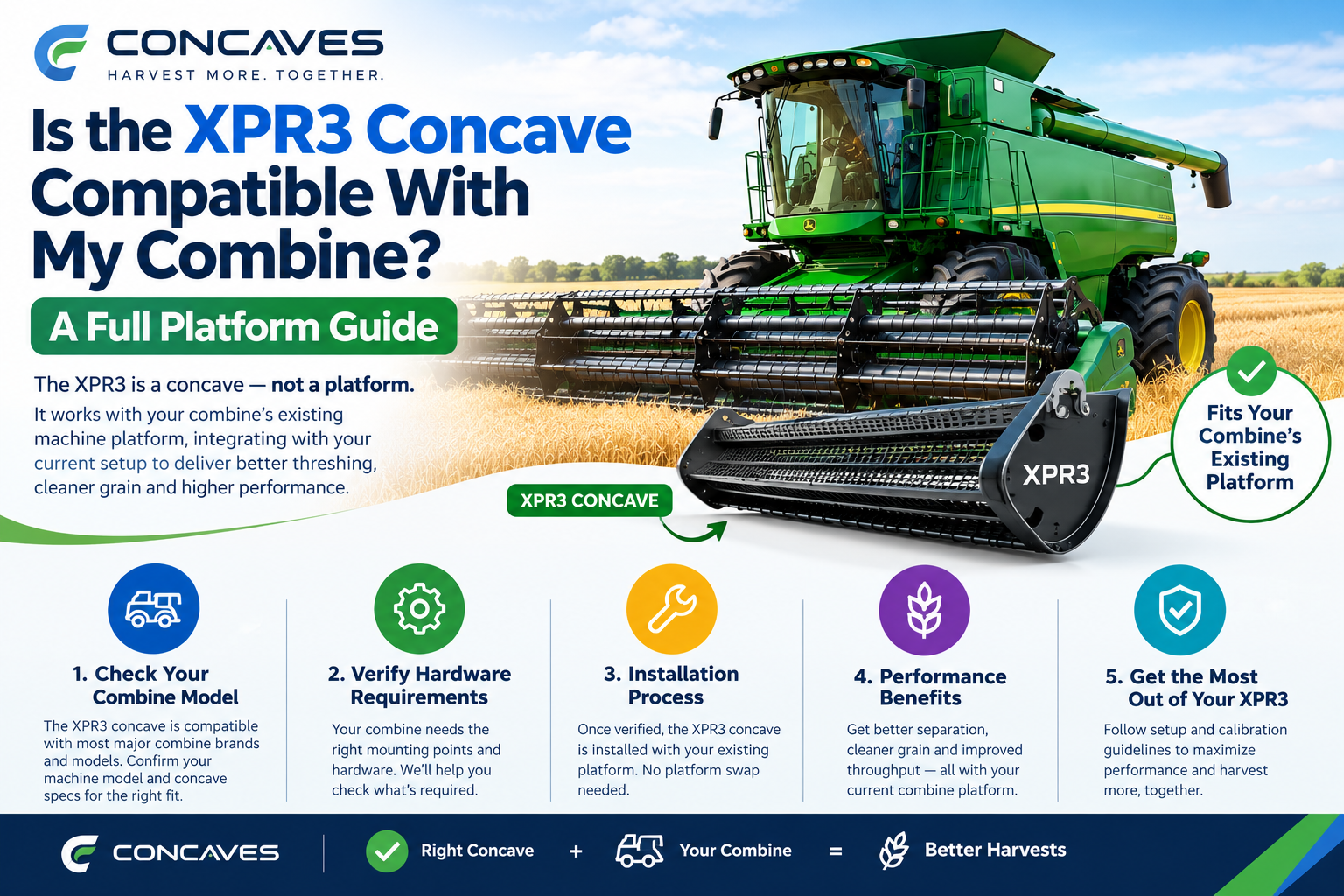
Harvest is rolling across the Corn Belt right now, and if you’re like most operators mid-season, you don’t have time to guess whether an aftermarket part will bolt up to your machine. Every fall, the same question lands in the Estes inbox: “Will the XPR3 actually fit my combine, or is this another concave system built for one brand and marketed to everyone else?” It’s a fair question, because a lot of aftermarket concaves are engineered around a single OEM platform and then loosely adapted – sometimes poorly – to fit others.
This guide settles the question of XPR3 compatibility once and for all. We’ll walk through exactly which combine brands and model series the XPR3 Concave System fits, how the fitment differs by platform, and what to check before you order. If you run John Deere, Case IH, New Holland, or Fendt, you’ll know by the end of this article whether the XPR3 belongs on your machine.
Quick answers before you read on:
- The XPR3 fits John Deere S-Series (S650–S790) and X9 combines, plus legacy STS-Series (9650–9870)
- Case IH Axial-Flow combines from the 1680 through the 9240 and current 240 Series are covered
- New Holland CR Series (Twin Rotor) and Fendt IDEAL Series rotor combines are also compatible
- It’s a true all-crop system — no covers, no bands, no swapping parts between corn, soybeans, and wheat
- Fitment is rotor-combine specific; conventional walker combines aren’t part of the XPR3 lineup
What Is the XPR3 Concave System, and Why Does Compatibility Matter?
The XPR3 is Estes Performance Concaves‘ flagship aftermarket threshing and separation upgrade, built around a patented concave bar and the Xtreme Separation Grate. Instead of swapping covers or bands when you move from corn into soybeans or wheat, the XPR3 is engineered as a single, no-swap system that handles the crop mix most American grain farms actually run.
That “all-crop” design only works if it’s engineered correctly for the rotor geometry of your specific combine. A concave bar that’s a perfect fit for a John Deere S780 won’t necessarily thresh the same way in a Case IH Axial-Flow rotor housing. This is exactly why XPR3 compatibility is platform-specific — Estes builds distinct concave configurations for each brand’s rotor architecture rather than selling one generic part and hoping it fits.
Which Combine Brands Work With the XPR3?
XPR3 compatibility currently spans four major combine manufacturers, covering the rotor machines that run the majority of large-scale American grain operations. Here’s how fitment breaks down by brand.
Is the XPR3 Compatible With John Deere Combines?
Yes. The XPR3 is built for John Deere’s S-Series lineup — S650, S660, S670, S680, S685, S690, and the S760 through S790 — along with the X9 Series (X9 1000 and X9 1100). Estes also supports the legacy STS-Series combines (9650 through 9870), which are still common on used and mid-life machines across the Midwest. If you’re running a green rotor combine bought in the last decade, or a well-maintained STS unit from the 2000s, XPR3 compatibility almost certainly covers it.
Does the XPR3 Fit Case IH Axial-Flow Combines?
Yes. Case IH’s single-rotor Axial-Flow design has been in continuous production since 1977, and Estes builds XPR3 configurations spanning that heritage — from the 1680 through the 9240 and into the current 240 Series flagship machines. Because Axial-Flow combines share a consistent single-rotor threshing concept across generations, XPR3 compatibility extends across a wide model range, whether you’re running an older 88 Series machine or a newer Flagship unit.
Can I Run XPR3 Concaves on a New Holland CR Series Combine?
Yes. New Holland’s CR Series uses Twin Rotor threshing technology, and the XPR3 is engineered to work within that dual-rotor housing. New Holland operators running CR6.90 through CR10.90-class machines fall within XPR3 compatibility, giving Twin Rotor owners the same no-swap, all-crop advantage that John Deere and Case IH operators get.
Is the XPR3 Available for Fendt IDEAL Combines?
Yes. Fendt’s IDEAL Series — including the Single Helix IDEAL 7 and the Dual Helix IDEAL 8, 9, and 10 — is covered under XPR3 compatibility as well. Fendt has grown its North American dealer footprint steadily since IDEAL launched here in 2018, and Estes built out platform support to match, so operators running these AGCO-built machines aren’t left choosing between OEM concaves and nothing else.
How Do I Know Which Concave Configuration My Combine Needs?
Brand-level compatibility is the first check, but model year and rotor type matter too. Before ordering, confirm three things:
- Your exact model number — not just “John Deere” or “Case IH,” but the specific model (S680 vs. S790, for example) since rotor housing dimensions differ across a model lineup
- Single vs. dual rotor configuration — Fendt’s IDEAL 7 runs a single Helix rotor while the IDEAL 8–10 run dual rotors, and New Holland’s Twin Rotor design requires a different fitment than a single-rotor Case IH or John Deere machine
- Whether you’re running factory or previously modified concaves — a combine that’s already had aftermarket concaves installed sometimes needs different hardware than one still running OEM parts
Estes’ dealer network verifies XPR3 compatibility against your VIN or model plate before shipping, which is worth doing even if you’re confident about your model — a five-minute call beats a returned shipment during harvest.
XPR3 vs. Stock OEM Concaves: How Do the Platforms Compare?
| Factor | Stock OEM Concaves | Estes XPR3 Concaves |
|---|---|---|
| Brand Coverage | Single manufacturer only | John Deere, Case IH, New Holland, Fendt |
| Crop Flexibility | Covers/bands needed per crop | One system, all crops, no swap |
| Threshing Surface Area | Standard OEM coverage | 135% more surface area |
| Rotor Loss (per acre) | 2–5 bushels lost | Near-zero rotor loss |
| Ground Speed | Limited by threshing capacity | 2–3 mph faster sustainable speed |
| Separation Grate | Standard wire or finger grate | 143-disrupter-finger Xtreme Separation Grate |
What Are the Pros and Cons of Upgrading to XPR3 Concaves?
Pros
- Confirmed XPR3 compatibility across four major combine brands means one vendor relationship regardless of your fleet mix
- All-crop design eliminates mid-season downtime spent swapping covers or bands
- 135% more threshing surface area supports meaningfully faster ground speed without sacrificing separation
- Standard concaves commonly leave 3–5 bushels per acre in the field to rotor loss; the XPR3’s separation grate is built to address that gap directly
- Works across a wide span of model years within each brand, so it’s not limited to only the newest machines
Cons
- Upfront cost is higher than a basic OEM concave replacement, though most large operations recover the difference within a season
- Fitment is rotor-combine specific — conventional straw-walker machines aren’t part of the current XPR3 lineup
- Installation still requires confirming exact model and rotor configuration rather than a blind universal fit
- Dealer verification adds a step before shipping, which matters if you’re ordering during a tight harvest window
What Mistakes Do Farmers Make When Checking Concave Compatibility?
- Assuming brand-level compatibility means any model works. Confirming “John Deere” isn’t enough — an S650 and an X9 1100 have different rotor housings, and ordering without your exact model number risks a mismatch.
- Ignoring single vs. dual rotor differences. Farmers moving from an IDEAL 7 to an IDEAL 9, for example, sometimes assume the same concave setup carries over, when the rotor configuration actually changed.
- Ordering based on an old brochure or a neighbor’s setup. Model lineups shift across years — a used STS combine bought secondhand may need a different configuration than what the previous owner ran.
- Skipping dealer verification to save time. A quick model-plate check before ordering prevents a mid-harvest shipping delay, which costs far more time than the verification call itself.
- Assuming a modified combine needs the same parts as a stock one. If your machine already has aftermarket concaves or a prior rebuild, the fitment can differ from a factory-original combine of the same model.
Frequently Asked Questions
Does XPR3 compatibility include used and older combine models?
Yes, within limits. John Deere’s legacy STS-Series (9650–9870) and Case IH’s early Axial-Flow models starting at the 1680 are both covered, so a well-maintained used combine isn’t automatically excluded. What matters is the specific model and rotor type, not just the age of the machine.
Can I run the XPR3 if I switch between corn, soybeans, and wheat on the same combine?
Yes — that’s the core design intent. The XPR3 is built as a true all-crop system, so you’re not stopping mid-harvest to swap covers or bands when you move between crops on the same machine.
Does XPR3 compatibility differ between single-rotor and twin-rotor combines?
Yes. New Holland’s CR Series and Fendt’s IDEAL 8–10 use dual-rotor architecture, while John Deere and Case IH machines (along with Fendt’s IDEAL 7) run single-rotor designs. Estes builds separate configurations to match each rotor type correctly.
How do I confirm my exact combine qualifies before ordering?
Have your model number and, ideally, your VIN or model plate ready when you contact an Estes dealer. They’ll verify your specific machine against current XPR3 compatibility before processing the order, which avoids fitment issues during a busy harvest window.
Is the XPR3 available for conventional straw-walker combines?
No. The current XPR3 lineup is built for rotor combines — single or dual rotor — across the four supported brands. It isn’t engineered for conventional walker-style threshing systems.