What to Do When You’ve Sinned


I hope you love the products and resources I recommend here at A Little R & R. Just so you know, it is possible that I get a commission and collect income from the links on this page. As an Amazon Associate I earn from qualifying purchases. Click here for more info.
What do you do when you’ve sinned?
We’ve all been there.
Maybe it was something you never intended to do. Maybe you knew exactly what you were doing—and you did it anyway.
And now you’re sitting there wondering:
“What do I do now?”
Fear tells you that you’ve gone too far.

The enemy tells you that you’re the only Christian who could possibly have messed up this badly.
But Scripture gives us a different response.
When David sinned, he didn’t hide from God. He brought his sin into the light.
In Psalms 38–40, we see a pattern of repentance, dependence, restoration, and renewed obedience that gives us a practical picture of what to do when we’ve sinned.
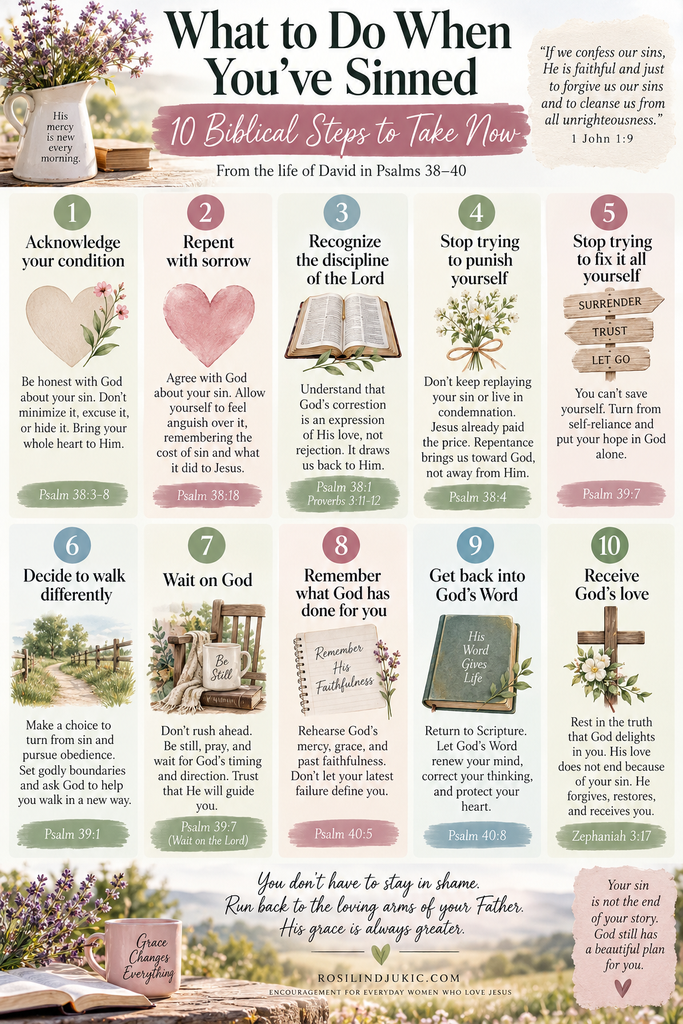
What Should You Do When You’ve Sinned?
1. Acknowledge your sin honestly
2. Repent with genuine sorrow
3. Receive God’s correction
4. Stop trying to punish yourself
5. Turn to God as your salvation
6. Resolve to walk differently
7. Wait on God
8. Remember and testify of His mercy
9. Delight in God’s Word
10. Receive God’s love
I Know What It Feels Like to Be Trapped in Sin
I was there in 2000.
I was backslidden in Bible school.
I know, right?
Craziest place on earth to be backslidden, but there I was sitting in the main auditorium of Christ for the Nations Institute, trying to worship, but unable to get there.
Because I knew that if anyone else knew my secrets, I’d be kicked out and sent home.
One hot, muggy day I sat out on the back steps of the building where I worked and wept. I felt horrible about the shambles that was my Christian walk.
But I couldn’t seem to get free from the trap I was in.
I felt stuck in this downward spiral – and I had no idea how far down it would take me. It scared me to think about what was at the bottom of this horrible ride I was on!
Thankfully, God rescued me just a couple of months later!
It wasn’t until years later that I came to fully understand the love and grace of God in those moments – even that day when I sat outside of work weeping.
Even then, God’s grace was at work, chipping away at the hard exterior that I had allowed to grow over my heart.
I didn’t need to learn how to punish myself for my sin. I needed to learn how to return to God.
And that’s what I eventually began to understand from Scripture.
What Can David Teach Us About What to Do After We Sin?
Psalms 38–40 give us a picture of David responding to sin with honesty, repentance, dependence on God, renewed obedience, waiting, testimony, delight in God’s Word, and receiving God’s mercy.
1. Acknowledge Your Sin Honestly
Psalm 38 opens with a long account of David’s condition.
- He feels the weight of his sin
- He is exhausted and weak
- He is sorrowful
- He has open sores
- His illness – whatever it is – is foul-smelling
David’s condition was more than just emotional and spiritual; he also had a physical illness that was the result of his sin.
David spares nothing from God. He openly acknowledges his condition.
The first step to repentance from our sin is looking openly and honestly at where we are and where our sin has led us.
If we skip this crucial step, we’ll never fully repent.
We must reject the temptation to make light of our condition, rationalize away the seriousness of our actions, or cherry-pick words that make our sin seem somehow less sinful.
You cannot repent from something you refuse to acknowledge.
- Stop minimizing it.
- Stop rationalizing it.
- Stop blaming everyone else.
- Stop rewriting what happened.
- Bring it honestly before God.
Ask yourself:
What exactly did I do?
What was happening in my heart?
Who was affected by my actions?
What am I tempted to minimize or excuse?
2. Repent With Genuine Sorrow
“For I will declare my iniquity; I will be in anguish over my sin.” Psalm 38:18
Conviction leads us toward God.
Shame tells us to hide from Him.
When we fully acknowledge our condition and refuse to let ourselves soften the blow of our sin, our heart can repent with sorrow.
Allowing ourselves to feel the anguish of our sin is critical, because that emotion will eventually lead us to a righteous hatred of that sin.
But even more, it enables us to feel what God feels for us in our present condition.
It allows us to feel what God felt when His only Son hung dying on the cross while bearing the burden of our sin. When we feel that anguish, we gain an understanding of just how serious sin truly is.
Sin isn’t just “making a mistake”.
A mistake is something that goes wrong while we are in the process of doing something right.
Sin is the bad result of our wrongful actions in the first place.
“I agree with God about my sin, turn from it, and turn back toward Him.”
3. Receive God’s Correction
“I was mute, I did not open my mouth, because it was You who did it.” Psalm 39:9
David understood his suffering through the lens of God’s correction.
God’s correction isn’t evidence that He has abandoned you. Scripture presents God’s discipline as something connected with His love.
Discipline differs from punishment in this regard: discipline is a consequence given as a loving gesture to remind us of the importance of obedience to the Lord.
It is the painful result of us bucking against the boundaries He has set to teach and train us to be faithful disciples of Jesus Christ.
Punishment is a public flogging or mocking of one who has done wrong.
God punishes His enemies, but disciplines those He loves.
“My son, do not despise the chastening of the LORD, nor detest His correction; For whom the LORD loves He corrects, just as a father the son in whom he delights.” Proverbs 3:11-12
4. Stop Trying to Punish Yourself for Your Sin
“Sacrifice and offering You did not desire; my ears You have opened. Burnt offering and sin offering You did not require.” Psalm 40:6
When we realize the seriousness of our sin, our tendency is to swing from the one extreme of rationalizing away its seriousness to the other extreme of trying to make atonement with our own actions.
Rather than repenting and then trusting in the blood of Jesus to atone for our sin, we begin to inflict punishment on ourselves by flogging ourselves verbally.
Rather than sitting in God’s presence and allowing Him to wash us clean of our filth, we avoid His presence; we keep our distance with our head down in shame.
We will never prove to God the depth of our sorrow by trying to make atonement for our sin, avoiding Him, and sulking.
Sometimes we even tend to try to prove to God how sorry we are by:
But God already knows our heart.
His blood was shed so that we don’t have to do these things.
Jesus already paid for what we cannot pay for.
5. Stop Trying to Fix Everything Yourself
“Make haste to help me, O Lord, my salvation!” Psalm 38:22
Maybe you’re like me: once I’ve admitted my dire circumstances, I go into planning mode. I will sit down and make a list and plan how to get myself out of the mess I’m in.
Planning and list-making are incredibly therapeutic for me.
But when it’s my sin we’re talking about, this kind of therapy is a trap. Soothing my wounded heart with my own plans for salvation is very dangerous because it circumvents the salvation of God.
Not only that, it’s deceptive.
The enemy would love nothing more than for me to fall right into the same trap he fell into, assuming he was greater than God.
Sometimes repentance requires us to surrender not only our sin, but also our desperate attempts to control the consequences.
A sinner who has fully repented is a sinner who is keenly aware of the fact that he is utterly incapable of extricating himself from his current position.
Salvation is only in God, and any attempt of our own to save ourselves will only dig ourselves a deeper pit.
6. Decide to Walk Differently
“I said, ‘I will guard my ways, lest I sin with my tongue; I will restrain my mouth with a muzzle, while the wicked are before me.’” Psalm 39:1
You may think that this step contradicts the previous one, but here is why it doesn’t:
Once we have fully repented and openly received the cleansing salvation of God, we must decide in our heart to walk differently.
If you know what led you into sin, don’t simply pray that you’ll resist it next time. Ask God to show you what needs to change.
But with this very important caveat:
We must acknowledge that we can’t do this on our own; we need the grace of God to enable us to live righteously.
The danger in not doing step 5 is that we are prone to live independently of God, to rely on our own wisdom and abilities to get us out and keep us out of danger.
Only God can do that.
And only the grace of God enables us to live righteously. None of us has the ability to keep God’s law; that’s why Jesus had to come to earth and die!
We have God’s law in the Old Testament, but we’re so flawed that we can’t even go one day without breaking His law – inadvertently or purposefully.
And that’s where God’s grace comes in.
It gives us the power to rise above our flaws, reject temptation, and live the righteous life He’s called us to.
7. Wait on God Instead of Rushing Ahead
“I waited patiently for the Lord; and He inclined to me, and heard my cry.” Psalm 40:1
What does waiting on God look like after you’ve sinned?
Don’t make major decisions from a place of shame.
Don’t run away from God.
Don’t try to fix everything overnight.
Sit with Him.
Pray.
Listen.
Let Him lead you.
I love the imagery of the Hebrew word for “wait”, which is qavah.
It means to bind together by twisting, as you would twist a rope. It reminds me of the verse, “And a threefold cord is not quickly broken.” Ecclesiastes 4:12
But what does it mean to wait upon God?
It can mean that we sit in prayer, silently waiting to hear His voice – linger.
It can mean that instead of acting hastily on a decision, we wait for His wisdom – expect.
It can mean remaining in His presence until we feel the peace we need – hope.
In each context of waiting on God, something supernatural happens; our life becomes more tightly intertwined with Him as we grow stronger in our Christian walk.
8. Remember What God Has Done for You
“I have proclaimed the good news of righteousness in the great assembly; indeed, I do not restrain my lips, O LORD, You Yourself know.I have not hidden Your righteousness within my heart; I have declared Your faithfulness and Your salvation; I have not concealed Your lovingkindness and Your truth from the great assembly.” Psalm 40:9-10
There is incredible power in our testimony.
Even Revelation 12:11 says, “And they overcame him by the blood of the Lamb and by the word of their testimony”
Our testimony is a powerful weapon to defeat the enemy, and defeating the enemy here is vital because it establishes our victory!
Do not think for a moment that after repenting and embracing the salvation of God, resolving to live righteously by grace, and then waiting on God, the enemy will just lie there and say, “Man, it’s really too bad that I lost that one.”
No!
He’s going to come back harder and stronger to try to defeat you. You need to have a strategy. You need to have your weapons ready, and one powerful weapon is your testimony!
Daily rehearse your testimony to your own heart and take every opportunity to share it with others.
You deliver a fatal blow to the enemy each and every time you do.
Remember your testimony.
Then: Don’t let your latest failure become the only thing you remember about yourself.
9. Get Back Into God’s Word
“I delight to do Your will, O my God, and Your law is within my heart.” Psalm 40:8
David loved God’s law – or, in today’s terms, God’s Word. All throughout the Psalms, we read about David’s love for God’s law.
Many times, when we’ve sinned, we avoid God’s Word out of guilt and condemnation.
That’s because God’s Word is trying to do what God designed it to do: lead us back to the One who will forgive and restore.
When we’ve sinned, the best thing we can do is to open God’s Word, let it expose us to God’s holiness, and then let Him renew and restore us.
10. Receive God’s Love
“Do not withhold Your tender mercies from me, O LORD; let Your lovingkindness and Your truth continually preserve me.” Psalm 40:11
Whenever we’ve been disciplined by God, it is important that we open our hearts to fully embrace the love He has for us.
Don’t hold yourself back.
After you’ve confessed your sin, repented, received God’s correction, stopped punishing yourself, surrendered your attempts to save yourself, and committed to walk differently, there is one more thing you need to do:
He disciplines those He loves. His discipline is only a sign that you’re a true daughter of God.
And just as any parent who lovingly disciplines their child, afterward embraces them and assures them of their love, God wants to embrace you and assure you of His love.
After you’ve confessed your sin, repented, received God’s correction, stopped punishing yourself, surrendered your attempts to save yourself, and committed to walk differently, there is one more thing you need to do:
Let God love you.
In Zephaniah, we read an urgent call to repentance. God is going to come and judge the world – including Jerusalem – because of their idolatry and corruption.
Through Zephaniah, God speaks strongly – He doesn’t hold back in describing the depth of His wrath against His people.
But then He speaks a promise to those who fully repent: “The Lord your God in your midst, The Mighty One, will save; He will rejoice over you with gladness, He will quiet you with His love, He will rejoice over you with singing.” Zephaniah 3:17
Your sin is serious.
But God’s mercy is real.
Your failure matters.
But it does not have the final word.
You Don’t Have to Run From God
Maybe you’re reading this because you sinned yesterday.
Maybe it happened this morning.
Maybe you’ve been carrying shame over something you did years ago.
Maybe you knew it was wrong—and did it anyway.
Don’t run from God. Run toward Him.
David didn’t hide his sin from God. He brought it into the light.
And you can do the same.
Your sin is not a reason to stay away from God. It is a reason to return to Him.
Get these verses as a free set of Bible verse cards when you click here or on the image below.
Get access to my entire Resource Library of over 100 resources without having to opt in when you join my Resource Library (available also on Buy Me a Coffee). These resources include: journals, workbooks, worksheets, Bible verse cards, bookmarks, and more!