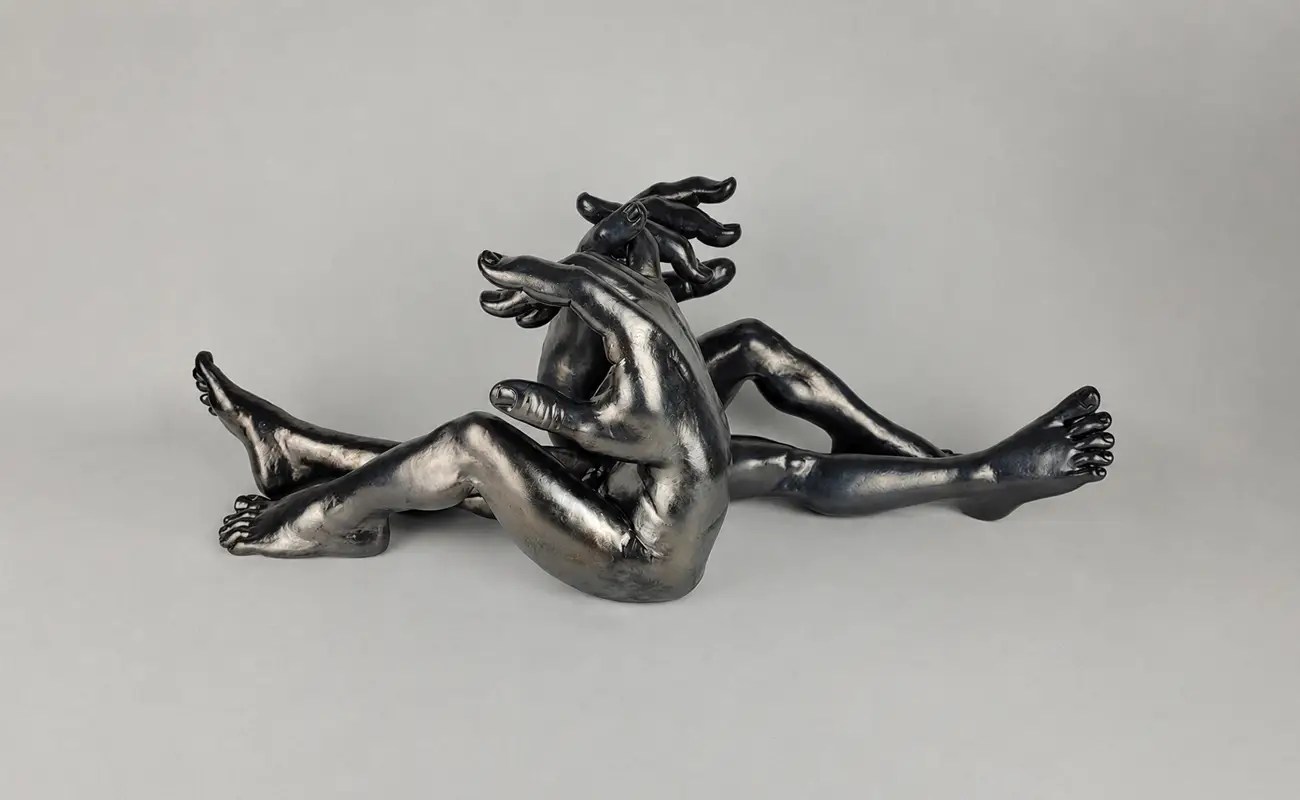
“Our differences unite us.”
The Body as a Vocabulary of Human Connection
Orlando Basulto approaches sculpture as a language built from the human body. The Cuban-Canadian visual artist works across metal, wood, concrete, clay, resin, and found objects, drawing on his studies in visual arts, art therapy, and ceramics. Classical anatomical observation remains central to his practice, yet his figures rarely function simply as representations of physical form. Hands, feet, limbs, torsos, and gestures become active carriers of meaning, expressing relationships between individuals and addressing larger questions of discrimination, equality, migration, diversity, and belonging.
This emphasis on humanity gives Basulto’s work its recognizable character. He describes his style through the connection between “homo” and “hand,” linking the human being with the body’s capacity to act, touch, give, and receive. A hand can caress or protect; it can support another person, offer assistance, or reach outward. In his sculptures, such gestures become a visual discourse about coexistence. Rather than treating difference as separation, Basulto uses bodily relationships to suggest that difference can become a basis for connection.
His perspective has developed through both artistic education and lived experience. Art therapy contributed to a practice attentive to human behavior and emotional communication, while ceramics and visual arts gave him a broad technical foundation. These influences meet in sculptures where recognizable anatomy can shift into symbolic or unexpected configurations. Bodies merge with objects, architectural supports, animals, hearts, balloons, and mechanical forms. Physical reality remains visible, but Basulto alters its logic so that the body can communicate psychological and social tensions beyond literal representation.

Orlando Basulto: Classical Anatomy in a Contemporary Language
Basulto openly identifies Renaissance masters and Auguste Rodin as important artistic influences. Their attention to anatomy, modeling, gesture, and expressive physicality informs his own close observation of the human figure. Classical and Mannerist traditions provide points of reference, particularly in the treatment of bodies as structures capable of conveying emotion through posture and movement. Yet Basulto redirects those historical foundations toward contemporary concerns, fragmenting and recombining anatomy rather than presenting the body primarily as an idealized whole.
This transformation is particularly apparent in his use of hands and limbs as independent protagonists. A fragment can embrace, balance, struggle, support, protect, or reach, allowing a single gesture to imply an entire relationship. Proportions change and bodies enter improbable arrangements, sometimes forming circular structures or joining with objects that disrupt anatomical expectations. The result can move rapidly between tenderness and discomfort. Humor also enters these combinations, but its purpose extends beyond visual amusement. Strange encounters between bodies and objects can expose vulnerability, dependence, desire, or the need for connection.
Basulto describes his artistic discourse as anthropocentric, placing human experiences and behaviors at its center. The values he repeatedly returns to are contribution, tolerance, support, and creation. That ethical focus gives coherence to his varied materials and sculptural strategies. Whether working with clay, resin, metal, concrete, or wood, he is interested in what physical form can say about the ways people live together. Technical realism therefore operates alongside poetic distortion. The recognizable body offers an immediate point of entry, while transformation pushes the viewer toward questions of identity, coexistence, and responsibility.

Strength and Fragility Held in Suspension
Among Basulto’s recent sculptures, Ambivalence carries particular personal significance. He jokes that the most important work is always the latest because he invests importance in every piece, regardless of scale. Yet Ambivalence stands apart for the way it addresses what he sees as the conditions of the Anthropocene and the unsettled rhythm of contemporary life. The sculpture focuses on duality, uncertainty, and the difficulty of making clear decisions when competing realities exert pressure at the same time.
For the work, Basulto combines copper and clay, selecting materials whose contrasting qualities allow him to manipulate the viewer’s perception of visual weight. His intention is to create an optical encounter in which strength and fragility appear simultaneously. The sculpture suspends these opposing sensations rather than resolving them, making instability part of its meaning. That tension closely reflects his broader approach: bodies, materials, and symbols often occupy uncertain positions where apparently contradictory states can coexist.
Opposition appears elsewhere in his practice through dark and light bodies, paired figures, divided or stitched forms, and structures recalling yin and yang. These visual contrasts connect directly with his interest in diversity, equality, reconciliation, and coexistence. Difference is not erased to produce harmony. Instead, Basulto makes contrast visible and allows separate elements to depend upon, answer, or counterbalance one another. His fragmented anatomy functions almost like a bodily syntax. A hand can operate as a voice, a limb as a relationship, and an incomplete body as an image of both individual identity and collective interdependence.

Orlando Basulto: Ritual, Presence, and Monumental Ambition
Basulto’s studio day begins before he opens his eyes. He says that by morning he already has a plan for how work in the shop will begin, even though those plans frequently change once the day is underway. Beneath that flexibility sits a consistent personal ritual. Meditation and mindful presence come first, followed by lighting incense and saying his prayers. Only after those actions does he feel prepared to begin working. The routine introduces concentration and intention before the physical demands of sculpture take over.
That sense of conscious presence corresponds with the humanistic concerns running through his work. Basulto does not separate formal experimentation from the values he wants sculpture to communicate. His combinations of carefully modeled bodies, altered proportions, found objects, and contrasting materials create encounters that can be playful, intimate, unsettling, or absurd. Yet these shifts consistently return attention to people and their relationships with one another. Migration, vulnerability, support, equality, and inclusion are not presented as detached concepts. They are given physical form through touch, balance, proximity, division, and dependence.
Many projects have already taken shape during Basulto’s career, but one ambition remains unrealized: creating a monumental sculpture. The desire is a natural extension of a practice already concerned with bodily scale, structural relationships, and the expressive possibilities of physical presence. Enlarging that language would allow the gestures that define his work to occupy a different relationship with viewers and surrounding space. For an artist who sees hands as symbols of giving, receiving, protecting, and supporting, monumentality offers the possibility of making those gestures physically commanding while retaining the questions of fragility, difference, and human connection that have shaped his practice.