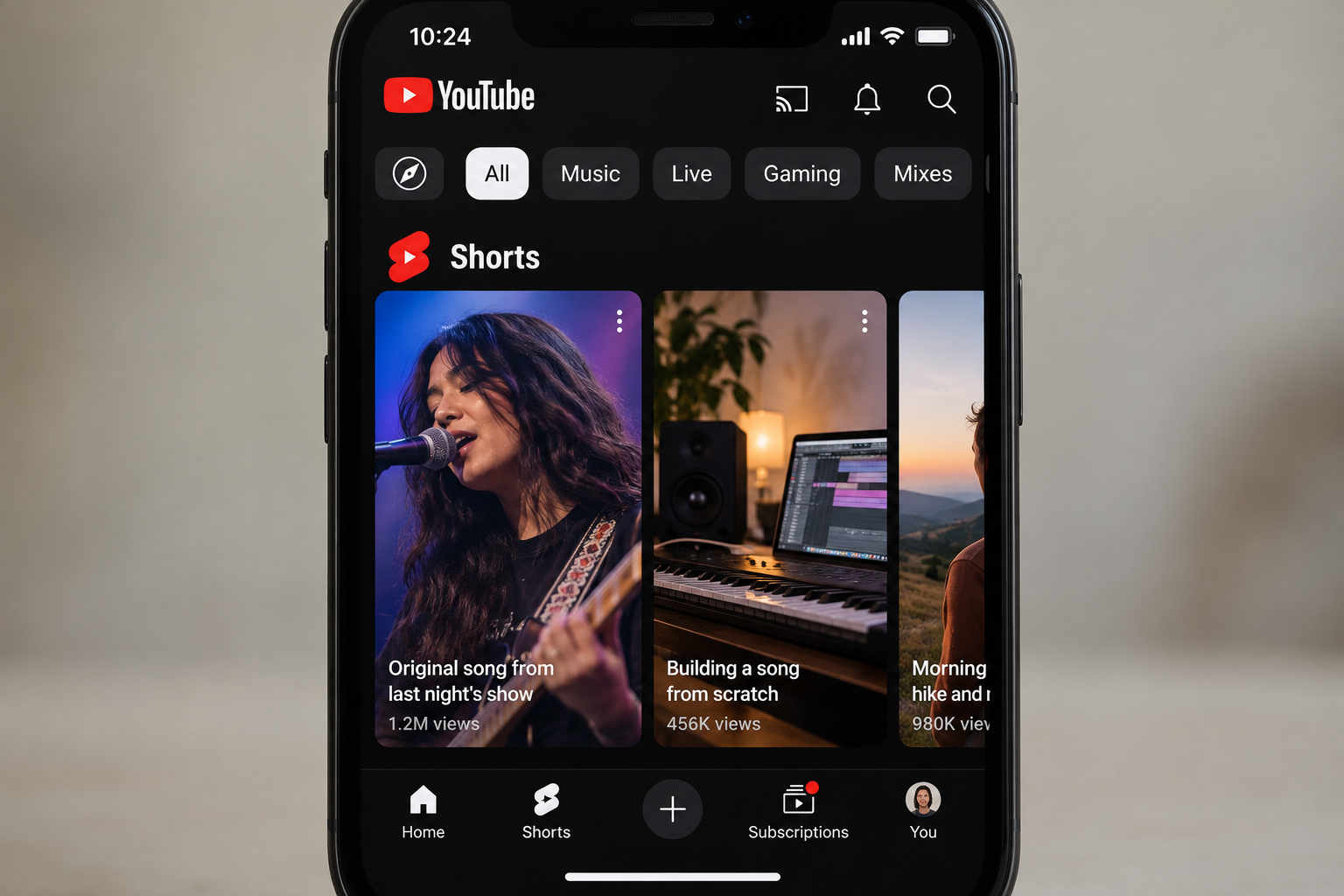
YouTube is changing how videos are recommended in its Shorts feed, placing greater emphasis on original content while reducing the visibility of channels that primarily repost material created by others. The October 1 announcement could affect how musicians, labels and music marketers use short-form video to reach new audiences.
In Brief
- YouTube announced changes to its Shorts recommendation system on October 1, 2026.
- Channels that primarily repost other creators’ videos without substantial additions may receive less distribution in the Shorts feed.
- Original commentary, distinctive editing and storytelling can still make reused footage eligible for recommendations.
- Minor technical changes and template-based edits are unlikely to satisfy YouTube’s expectations for originality.
- The announcement concerns video recommendations, not a new copyright prohibition or a blanket ban on reused clips.
- The changes could affect music promotion strategies that rely on reposting artist footage, performances and other existing video content.
In an announcement published through its official creator community, YouTube said it was updating its recommendation systems to give greater priority to original videos and limit the reach of material uploaded by accounts that contribute little or nothing of their own.
The company says its recommendations are informed by billions of signals, including viewing history, subject interests and engagement. The latest adjustment introduces a more explicit emphasis on originality, particularly when evaluating channels that aggregate videos produced by other creators.
For musicians and music companies, the announcement raises questions about promotional practices that have become common across short-form video platforms. Artist footage, concert clips, music video excerpts and interview segments are frequently republished by fan accounts, entertainment pages and promotional channels, sometimes with only minor changes.
Those practices may now face greater scrutiny within YouTube’s recommendation system.
What YouTube Is Changing
The update is directed primarily at channels built around republishing other creators’ videos without adding substantial original material.
According to YouTube, channels identified as primarily aggregating or re-uploading existing videos without significant changes are likely to receive less distribution in the Shorts feed.
The company is encouraging creators who incorporate third-party footage to contribute their own commentary, editing or storytelling rather than simply modifying the original video’s appearance.
That leaves room for commentary channels, educational videos, reactions and other formats that build something new around existing material.
A creator analyzing a concert performance, for example, could incorporate excerpts while offering original observations about the arrangement, musicianship or production. A channel that simply republishes the same performance with a different crop or caption would have a harder time demonstrating a substantial contribution.
YouTube has not published a formula for determining how much original material is required. It also has not disclosed the relative importance of originality compared with other recommendation signals or provided a precise rollout schedule.
As a result, the announcement establishes the direction of the change without making it possible to predict exactly how an individual video or channel will perform.
Why Reposted Clips Matter in Music Promotion
Short-form video has become an important part of music marketing, with artists and labels using clips to introduce recordings, highlight live performances and encourage listeners to explore full-length releases.
The distribution of those clips frequently extends beyond an artist’s official accounts.
Fan pages may share moments from concerts or interviews. Entertainment accounts repost music-related videos to audiences interested in particular genres or performers. Promotional services may distribute variations of the same footage through multiple channels.
These activities can introduce music to viewers who would not otherwise encounter an artist’s official content. However, they can also create feeds filled with repeated versions of the same material, sometimes with little indication of where the original video came from.
YouTube’s update appears intended to reduce that kind of duplication while giving creators who produce or substantially develop their own videos a better opportunity to reach viewers.
The potential consequences for music marketing are not yet clear. A fan account that publishes original commentary about an artist may be treated differently from one that primarily uploads unmodified concert clips, but YouTube has not described how its systems will evaluate every type of music-related content.
Similarly, the company has not explicitly explained how the change will apply to authorized promotional partners that repost material with an artist’s permission.
Permission to use a video and originality within a recommendation system are separate questions. A channel can have authorization to publish footage without necessarily contributing the kind of original material YouTube says it wants to prioritize.
Originality Is Becoming a Distribution Issue
YouTube already maintains policies addressing reused and repetitive content, particularly in connection with channel monetization.
Its existing rules distinguish between material that incorporates meaningful commentary or creative changes and content that largely duplicates work published elsewhere.
The October announcement extends that emphasis into the recommendation process, where visibility can influence audience growth regardless of whether a channel participates in YouTube’s monetization programs.
That is an important development for creators whose businesses depend on attracting viewers through algorithmic recommendations.
A video does not need to violate copyright law to receive limited distribution. Recommendation systems make decisions about what audiences are likely to find useful or engaging, and platforms can adjust those systems independently of copyright enforcement.
Conversely, adding commentary or creative editing does not automatically establish that someone has the legal right to use another person’s footage or music.
YouTube’s announcement should therefore not be interpreted as a change to copyright ownership, licensing requirements or the availability of its copyright enforcement tools.
The company has not announced new penalties or copyright strikes associated specifically with this recommendation update.
What It Means for Independent Artists
For independent musicians who already create their own short-form videos, the change may be encouraging, although YouTube has not promised increased reach for every original upload.
Artists commonly publish rehearsal footage, studio sessions, live performances, behind-the-scenes material and videos explaining the creative process behind a song.
These formats generally provide material created by the artist or their team rather than relying on content collected from unrelated accounts.
They also offer opportunities to develop a recognizable identity beyond the recording itself. A performance clip can demonstrate musicianship, while a studio video can reveal how a track was constructed or why a particular production decision was made.
The update does not mean artists need to abandon promotional editing or reuse footage from their own catalogs. YouTube’s announcement specifically focuses on channels that primarily republish other creators’ material without substantial changes.
However, independent artists who employ third-party clipping services or promotional accounts may want to examine how those services operate.
Some music promotion strategies involve distributing identical or lightly modified videos through multiple accounts in an attempt to increase exposure. If those accounts rely heavily on reposted material, they may become less effective under the revised recommendations.
Artists should also distinguish between a promotional service’s claims about potential views and evidence that its content reaches genuine, interested listeners.
A large number of impressions does not necessarily translate into sustained listening, ticket purchases or a growing audience.
What About Fan Accounts and Music Commentary Channels?
The announcement does not necessarily threaten every account that publishes videos about music it did not create.
Music commentary, criticism and education frequently involve references to existing recordings and performances. Reviewers may use brief clips to discuss production techniques, while creators covering music history may incorporate archival footage into original narratives.
YouTube’s guidance explicitly recognizes commentary, editing and storytelling as ways creators can add value to existing material.
The question is how clearly those contributions distinguish a new video from its source.
Accounts that primarily repost interviews, performances or music videos without analysis or other substantive additions appear more exposed to reduced recommendations.
For fan communities, the consequences may depend on the balance between original discussion and repeated uploads. A channel built around artist news, commentary and fan-created material is different from one that functions mainly as an archive of copied clips.
Nevertheless, YouTube has not released detailed criteria explaining how it will classify borderline cases. Creators will need to assess the effects through their own performance data as the changes take effect.
Will the Changes Improve Music Discovery?
One potential outcome is that original artist videos and music commentary receive more attention relative to accounts distributing duplicate footage.
That could benefit musicians who invest time in creating distinctive videos, particularly if viewers begin encountering fewer repeated uploads of material already circulating elsewhere.
However, originality is only one factor in YouTube’s recommendation system. Viewer behavior, subject relevance and engagement will continue to influence which Shorts appear in individual feeds.
There is also a possible trade-off for emerging artists.
Fan accounts and third-party promotional channels can help music spread beyond an artist’s existing audience. If some of those accounts lose distribution, artists may have fewer opportunities to benefit from the secondary circulation of their content.
The outcome will likely depend on whether original artist uploads and more substantial fan-created videos can replace that exposure.
For now, YouTube has not released performance data demonstrating how the update has changed recommendations or music discovery. Claims that original artists are already receiving a measurable boost would be premature.
A Shift Away From Reposting as a Growth Strategy
YouTube’s October update reflects a growing concern among video platforms about the volume of repetitive material competing for viewers’ attention.
For the music industry, it places additional emphasis on the difference between creating a video and simply redistributing one.
Labels, managers and independent artists have increasingly treated short-form video as a marketing channel, often experimenting with different accounts, formats and promotional partners to expand the reach of a release.
The revised recommendation system does not eliminate those options, but it may reduce the effectiveness of strategies built primarily around reposting existing footage.
Artists who produce their own videos, develop recognizable creative formats and work with partners contributing original commentary or storytelling may be better positioned to adapt.
The longer-term effect will depend on how aggressively YouTube applies its originality criteria and whether the changes produce measurable differences in audience discovery.
For now, the announcement establishes a clear priority: YouTube wants its Shorts feed to feature more content that creators have genuinely contributed to, rather than repeated copies of videos already available elsewhere.