
Debt agreements rarely stay the same from issuance to maturity. As businesses grow, refinance existing borrowings, negotiate with lenders, or respond to changing economic conditions, debt agreements are frequently amended. Those amendments might include changes to interest rates, maturity dates, payment schedules, principal balances, or even the addition or removal of covenant requirements.
From an accounting perspective, not every amendment is treated the same. The first question isn’t simply what changed, it’s whether the amendment represents a continuation of the existing debt or the replacement of one debt instrument with another.
The distinction is critical because it determines how the transaction is accounted for under US GAAP. Depending on the nature of the amendment, the borrower may either continue accounting for the existing debt with updated terms or derecognize the original liability and recognize a new debt instrument altogether.
Making the wrong determination doesn’t just affect the current period. It can impact interest expense, debt balances, deferred financing costs, gains or losses on extinguishment, future amortization, and ultimately the financial statements for years after the amendment occurs. Understanding how to distinguish a debt modification from a debt extinguishment is therefore one of the most important analyses performed when accounting for amended borrowing arrangements.
Why does it matter how the amendment is treated?
It’s easy to look at an amended loan agreement and assume the accounting simply follows the new legal terms. In reality, US GAAP requires you to determine whether the amendment represents a modification of the existing debt or an extinguishment of the original obligation before any accounting entries are recorded.
That conclusion drives nearly every aspect of the accounting treatment.
If the amendment qualifies as a debt modification, the original debt remains on the books. Rather than recognizing a new liability, the borrower adjusts the carrying amount of the existing debt for certain fees and costs, recalculates the effective interest rate when appropriate, and continues recognizing interest expense over the remaining life of the instrument. The debt is viewed as the same borrowing with revised contractual terms.
If the amendment is instead considered a debt extinguishment, the accounting changes significantly. The original debt is removed from the balance sheet, any remaining unamortized issuance costs or discounts associated with that debt are recognized immediately in earnings, and a new debt instrument is recorded based on the amended agreement. Economically, the borrower may have worked with the same lender, but from an accounting perspective, the original borrowing no longer exists.
This distinction can have a meaningful impact on a company’s financial statements. The classification affects:
- Interest expense recognized over future reporting periods
- Whether deferred financing costs continue to be amortized or are written off immediately
- Whether a gain or loss on extinguishment is recognized
- The carrying amount of the debt liability
- Future effective interest calculations
- Key financial ratios and debt covenant calculations
Because the accounting outcomes are so different, US GAAP provides specific guidance to help entities determine which treatment is appropriate. For most debt amendments involving the same lender, that evaluation centers around the 10% Test, which compares the present value of the remaining cash flows before and after the amendment to determine whether the economic substance of the borrowing has changed enough to be considered a new debt instrument.
What is a debt modification?
A debt modification occurs when the terms of an existing borrowing arrangement are changed, but the changes are not significant enough to be considered the replacement of the original debt instrument. In other words, while certain contractual terms may change, the debt is still viewed as the same obligation from an accounting perspective.
Debt modifications are common throughout the life of a loan. A lender and borrower may agree to adjust the interest rate, extend or shorten the maturity date, revise the payment schedule, modify financial covenants, or change other contractual provisions as business needs evolve. These amendments don’t automatically create a new debt instrument. Instead, the borrower must evaluate whether the changes are substantial enough to require extinguishment accounting.
When an amendment is accounted for as a debt modification, the existing liability remains on the balance sheet. Rather than derecognizing the debt and recording a new borrowing, the borrower continues accounting for the original instrument while incorporating the revised contractual terms. Depending on the nature of the amendment, debt issuance costs, lender fees, and the effective interest rate may need to be updated, but the underlying debt continues uninterrupted.
A modification is viewed as a continuation of the original financing arrangement rather than the creation of a new one.
What is a debt extinguishment?
A debt extinguishment occurs when an amended borrowing arrangement is considered substantially different from the original agreement. Although the borrower may still be working with the same lender, the economic substance of the transaction has changed enough that US GAAP treats it as the payoff of the old debt and the issuance of a new debt instrument.
Unlike a modification, an extinguishment requires the borrower to remove the existing liability from the balance sheet. Any remaining unamortized debt issuance costs, discounts, or premiums associated with the original borrowing are recognized immediately in earnings as part of the extinguishment accounting. A new debt liability is then recorded based on the terms of the amended agreement, and a new effective interest rate is established going forward.
Debt extinguishment accounting can have a significant impact on both the income statement and balance sheet because it accelerates the recognition of certain costs that would have otherwise been amortized over the remaining life of the debt. As a result, determining whether an amendment should be treated as a modification or an extinguishment is one of the most important judgments made when accounting for amended debt agreements.
** Scope Note: The 10% test discussed below applies to the term debt. Revolving credit facilities are evaluated differently under ASC 470-50 and are not subject to the same present value comparison described in this article.
What is the 10% test?
Once you’ve determined that a debt agreement has been amended, the next step is deciding whether those changes are significant enough to require extinguishment accounting. For amendments between the same borrower and lender, US GAAP provides a quantitative framework known as the 10% Test.
The purpose of the 10% Test is to evaluate whether the amended debt instrument is economically different from the original borrowing. Rather than focusing solely on the legal changes within the agreement, the test compares the economics of the original debt to the amended debt by analyzing the present value of the remaining cash flows.
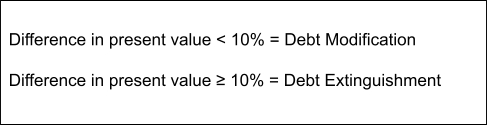
If the difference between the present value of the original remaining cash flows and the amended remaining cash flows is 10% or greater, the amendment is considered substantially different. The original debt is extinguished, a new debt instrument is recognized and extinguishment accounting is applied.
If the difference is less than 10%, the amendment is generally treated as a debt modification. In this case the existing debt remains on the balance sheet, and the borrower continues accounting for the original instrument using modification accounting.
At a high level, the decision framework looks like this:
Simple example: The 10% test
Assume a company has a loan with a remaining present value of $1,000,000. The loan is amended, and after discounting the revised remaining cash flows using the original effective interest rate, the present value of the amended debt is $1,075,000.
Because the difference is 7.5%, which is less than the 10% threshold, the amendment would generally be accounted for as a debt modification.
If instead the present value of the amended cash flows were $1,125,000, the difference would be 12.5%. Since the change exceeds the 10% threshold, the original debt would be derecognized and the amendment would be accounted for as a debt extinguishment.
While the concept sounds straightforward, accurately performing the calculation requires understanding which cash flows should be included, how lender fees are treated, and which discount rate should be used. Those details are where many accounting errors occur.
How does the 10% test work?
The 10% Test is fundamentally a present value comparison. Rather than comparing principal balances or total payments, the analysis compares the present value of the remaining contractual cash flows before and after the amendment.
The calculation is performed using the original effective interest rate (EIR) from the existing debt instrument as the discount rate. This ensures the comparison isolates the impact of the amended contractual terms rather than changes in current market interest rates.
When performing the test, the amended cash flows generally include principal repayments, contractual interest payments, and qualifying fees exchanged between the borrower and lender that are directly related to the amendment. Third-party fees, such as legal costs paid to outside advisors, are excluded from the calculation because they do not represent cash flows exchanged between the borrower and lender.
The following examples illustrate how relatively small changes can produce very different accounting outcomes.
Example 1: Debt modification (
Original Debt:
- Remaining principal: $1,000,000
- Remaining term: 5 years
- Interest rate: 6%
- Principal due at Maturity: $1,000,000
- Current carrying amount: $1,000,000
Amendment:
- Interest rate reduced from 6% to 5.8%
- Maturity extended from 5 years to 6 years
- Annual interest payments become $58,000
- Borrower pays a $10,000 fee directly to the lender
- Principal remains due as a balloon payment at the end of year six
- Annual Interest Payment = Principal x Interest Rate
- 1,000,000 x 5.8% = $58,000
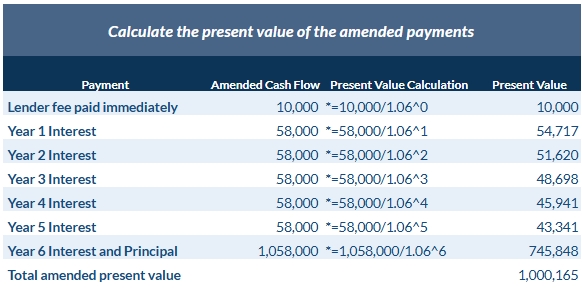
Calculation:
- Original Present Value: $1,000,000
- Amended Present Value: $1,000,165
- Difference: $165
Calculate the Percent Difference:
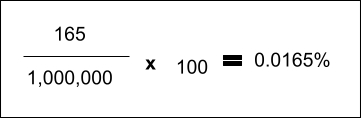
Result: Since the difference is less than 10%, the amendment is accounted for as a debt modification. The original debt remains outstanding, and the borrower continues accounting for the existing liability under the revised terms.
Example 2: Debt extinguishment (greater than or equal to 10%)
Now assume the lender agrees to substantially restructure the borrowing.
Original Debt:
- Remaining principal: $1,000,000
- Remaining term: 5 years
- Original effective Interest Rate: 6%
Amendment:
- Principal increases to $1,150,000
- Maturity extended by 10 years, resulting in a 15-year remaining term
- Interest rate increases from 6% to 8.5%
- Borrower pays $20,000 in lender fees at closing
- Principal is repaid at the end of year 15
- Annual Interest Payment = Principal x Interest Rate
- 1,150,000 x 8.5% = $97,750
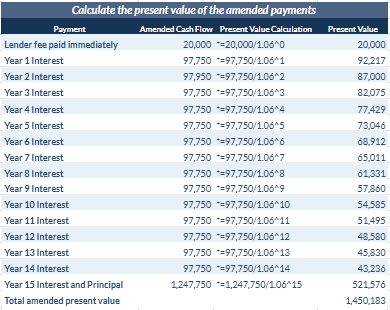
Calculation:
- Original Present Value: $1,000,000
- Amended Present Value: $1,450,183
- Difference: $450,183
Calculate the Percent Difference:
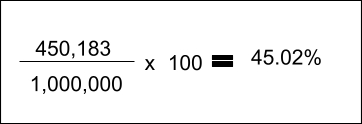
Result: Because the difference exceeds the 10% threshold, the amendment is considered substantially different. The borrower derecognizes the original debt, recognizes a new debt instrument, writes off any remaining unamortized issuance costs associated with the original borrowing, and applies extinguishment accounting going forward.
Variable-rate vs. fixed-rate debt
One of the most common questions after determining whether an amendment is a modification or an extinguishment is how the accounting differs for fixed-rate and variable-rate debt. While the 10% Test is used to evaluate whether an amended debt agreement is substantially different, the type of interest rate associated with the borrowing can affect how the debt is accounted for after that determination has been made.
Fixed-rate debt
With fixed-rate borrowing, the contractual interest rate remains constant throughout the life of the loan. Because the future cash flows are known, any amendment that changes those cash flows may require the borrower to calculate a new effective interest rate if the amendment is accounted for as a debt modification.
Rather than recording a new debt instrument, the borrower continues accounting for the existing liability. The carrying amount of the debt is adjusted for applicable lender fees, and a revised effective interest rate is calculated so that the updated carrying amount is amortized over the remaining life of the debt using the amended contractual cash flows.
Variable-rate debt
Variable-rate debt operates differently because future interest payments fluctuate as market rates change. Common benchmark rates include SOFR, Prime, or other variable reference rates.
When a variable-rate borrowing is modified, the accounting generally does not require calculating a new effective interest rate solely because the benchmark interest payments continue to reflect movements in the contractual variable rate while modification accounting is applied based on the amended terms.
This distinction is important because changes in market interest rates are already expected within a variable-rate borrowing. Those routine fluctuations alone do not create a debt modification or extinguishment.
How does the effective interest rate change?
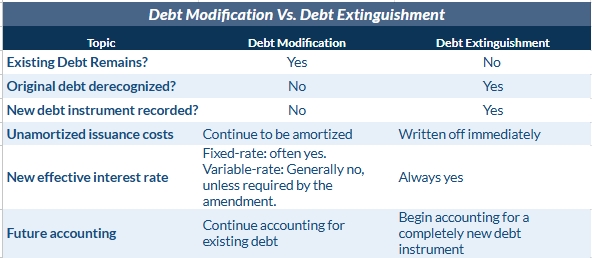
The effective interest rate is one of the biggest accounting differences between a debt modification and debt extinguishment.
Debt modification
When an amendment is accounted for as a modification, the original debt remains outstanding. The accounting objective is to continue amortizing the existing debt over its remaining life while reflecting the amended contractual terms.
For fixed-rate debt, this often means calculating a new effective interest rate. The revised EIR incorporates the adjusted carrying amount of the debt, including applicable lender fees, and allocates interest expense over the remaining term based on the amended cash flows.
For variable-rate debt, however, a new effective interest rate is generally not established simply because the benchmark rate changes. Future interest expense continues to adjust as the underlying reference rate changes, consistent with the contractual terms of borrowing.
Debt extinguishment
When an amendment is treated as a debt extinguishment, the accounting starts over.
The original debt is derecognized, any remaining unamortized issuance costs are recognized immediately in earnings, and a new debt instrument is recorded.
Because a new debt has been recognized, a new effective interest rate is always established based on the terms of the new borrowing. That new EIR is then used to recognize interest expense prospectively over the life of the replacement debt.
Unlike a modification, there is no continuation of the previous debt instrument or its historical effective interest rate.
Additional considerations for debt modifications and extinguishments
While the 10% Test is the primary quantitative assessment for determining whether an amendment is a debt modification or extinguishment, it is not the only consideration. Certain changes to a borrowing arrangement may require additional analysis based on the facts and circumstances surrounding the transaction.
One of the most important questions to ask is whether the borrower is still dealing with the same lender. If an existing debt arrangement is refinanced with a different lender, the transaction is generally accounted for as a debt extinguishment, regardless of the outcome of a hypothetical 10% Test. This is because the original borrowing has been legally settled and replaced with a new obligation owed to a different creditor.
For this reason, the 10% Test is typically applied only when an existing debt agreement is amended or exchanged between the same borrower and the same lender.
Other qualitative factors
Even when the same lender remains involved, accountants should evaluate whether the overall substance of the arrangement has changed.
Questions to consider:
- Has the legal borrower changed?
- Has substantially all of the debt been replaced with a new instrument?
- Were significant rights or obligations added or removed?
- Were debt terms fundamentally restructured beyond routine amendments?
- Does the amendment represent a continuation of the existing borrowing, or is it effectively a new financing arrangement?
Ultimately, the accounting should reflect the economic substance of the transaction rather than just its legal form. Combining the quantitative results of the 10% Test with a thoughtful qualitative assessment helps ensure the amendment is accounted for appropriately under US GAAP.
Journal entries
Once you’ve determined whether an amended debt agreement is a modification or an extinguishment, the final step is recording the appropriate accounting entries. While the exact journal entries will vary depending on the facts of each transaction, the following examples illustrate the most common accounting treatments discussed throughout this article.
Debt modification journal entry
When an amendment is accounted for as a debt modification, the existing liability remains outstanding. The borrower continues accounting for the original debt while adjusting the carrying amount for applicable lender fees and applying the appropriate modification guidance.
Example: Borrower pays $15,000 of lender fees

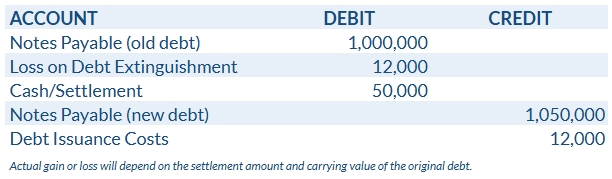
Debt extinguishment journal entry
When an amendment is considered substantially different, the original debt is derecognized and a new borrowing is recognized.
Example:
- Original debt balance = $1,000,000
- Remaining unamortized issuance costs = $12,000
- New debt issued = $1,050,000
Writing off remaining debt issuance costs journal entry
One of the most significant differences between a modification and an extinguishment is the treatment of remaining debt issuance costs. When debt is extinguished, any remaining unamortized issuance costs associated with the original borrowing are recognized immediately in earnings. The entry below is a component of the extinguishment journal entry shown in section 2 above and is presented separately for illustration only. It is not an additional write-off.

Ongoing interest recognition journal entry
Following the amendment, interest expense continues to be recognized using the appropriate effective interest rate.
Modification: Interest expense is recognized using the applicable modification

Extinguishment: Interest expense is recognized using the new effective interest rate established for the replacement debt.
Summary
Debt amendments are a common part of managing financing arrangements, but determining the correct accounting treatment requires more than simply reviewing the amended agreement. By understanding the differences between debt modifications and extinguishments, applying the 10% Test appropriately, evaluating qualitative considerations, and recognizing the resulting accounting implications, organizations can ensure their debt is accounted for accurately and in accordance with US GAAP. Taking a structured approach to each amendment helps promote consistency, improve financial reporting, and reduce the risk of accounting errors.

Related articles