Managing a startup’s finances has never been more software-driven.
Founders now have access to tools for banking, payroll, spend management, bill pay, cap table tracking, revenue recognition, sales tax, treasury, AI-assisted bookkeeping, and real-time reporting. In theory, this should make startup finance easier than ever.
In practice, many founders and finance teams are still asking the same questions every month:
- Are the books actually closed?
- Can I trust the financials?
- Why does the cash balance not match what I expected?
- Are we tracking R&D costs correctly?
- Can I send these numbers to investors?
- Will tax season turn into another cleanup project?
That is the real issue in 2026.
Most startups do not have a shortage of finance tools. They have a shortage of process, review, and accountability around those tools.
A company might have Mercury, Ramp, Gusto, Stripe, Carta, QuickBooks, Puzzle, Rillet, Anrok, and a dashboard. But if no one is reviewing the balance sheet, reconciling revenue, checking payroll entries, tracking tax-sensitive expenses, and explaining what changed month over month, the company still does not have a finance function.
It has software.
At ShayCPA, we work with startups across stages, and we see this pattern often: the finance stack looks modern, but the month-end close process is still fragile. The goal should not be to collect the most tools. The goal should be to build a stack that supports clean bookkeeping, tax-aware accounting, investor-ready financials, and a consistent monthly close.
The earlier version of this post focused on building the right fintech stack by stage, including pre-seed, seed, and Series A recommendations across accounting, banking, payroll, spend management, revenue recognition, sales tax, and cap table tools.
For 2026, the conversation needs to go one step further:
The right tools only matter if they produce reliable financials.
If your startup has the tools but still does not have reliable monthly financials, ShayCPA can help build the accounting process behind the stack through our startup accounting and monthly close support.
The finance stack should support the close, not replace it
A fintech stack is the group of platforms your company uses to manage finance operations. That can include accounting software, payroll, banking, spend management, accounts payable, accounts receivable, sales tax, cap table tracking, and reporting tools.
The right stack depends on your company’s stage, business model, team size, revenue complexity, and reporting needs.
But before choosing another tool, founders should ask a more basic question:
Can our current finance stack help us close the books accurately and on time each month?
If the answer is no, another tool may not solve the problem.
The issue may be workflow. It may be ownership. It may be poor integrations. It may be a lack of review. It may be unclear accounting policies. It may be that the company has outgrown founder-led bookkeeping or basic transaction coding.
A good finance stack should help the company produce reliable monthly financials, maintain clean records, support tax compliance, and give leadership better visibility into the business.

Start with outcomes, not tools
Instead of starting with the question, “Which tools should we use?” founders should start with the financial outcomes they need.
A strong startup finance stack should support:
| Finance need | What the stack should help manage |
| Cash visibility | Banking, treasury, credit cards, burn rate, runway |
| Clean bookkeeping | Transaction coding, reconciliations, chart of accounts, monthly close |
| Payroll accuracy | Employee payroll, benefits, contractors, payroll liabilities |
| Spend control | Approvals, cards, reimbursements, vendor payments |
| Revenue clarity | Stripe, invoicing, SaaS billing, deferred revenue, revenue recognition |
| Tax readiness | R&D costs, 1099s, sales tax, state activity, Section 174 support |
| Investor reporting | Monthly financials, variance explanations, KPIs, board materials |
The mistake many startups make is building the stack tool by tool instead of workflow by workflow.
Adding a spend management platform may give you better card controls. But if the accounting system is not set up correctly, the chart of accounts is messy, and no one reviews the balance sheet monthly, the financials may still be unreliable.
The same is true with payroll, revenue recognition, and sales tax tools. The software can help, but it still needs to fit into a broader accounting process.
The new layer: ChatGPT, Claude, and AI coworkers
In 2026, the startup finance stack is no longer limited to traditional fintech tools.
Founders and finance teams are increasingly using AI tools such as ChatGPT, Claude, Claude Cowork, Claude Code, and other AI coworkers alongside their accounting systems, payroll platforms, banks, spend tools, and reporting dashboards.
That matters because AI is no longer just a writing assistant. These tools can help with analysis, document review, data cleanup, workflow support, research, formulas, and drafting explanations. For startup finance teams, that can be powerful.
An AI coworker may help:
- summarize financial statements
- draft variance explanations
- clean CSV exports from banks or spend platforms
- write spreadsheet formulas
- compare vendor spend month over month
- help document accounting workflows
- draft board-report commentary
- summarize customer contracts for accounting review
- assist with R&D cost documentation
- identify unusual transactions for human follow-up
- help founders ask better questions about burn, runway, and spend
But this creates a new risk: founders may confuse better analysis support with a finished accounting process.
An AI coworker can help you understand the numbers. It should not be the final owner of the numbers.
A founder can upload a P&L to ChatGPT or Claude and ask for insights. That may be useful. But if the underlying books are not reconciled, the balance sheet has not been reviewed, payroll entries are wrong, revenue is not tied out, or R&D costs are misclassified, the AI will simply help analyze unreliable data.
That is why the finance stack still needs a monthly close process.
The better question is not:
Can AI help me analyze my financials?
The better question is:
Are the financials clean enough for AI, investors, tax advisors, and the founder to rely on?
At ShayCPA, we see AI as part of the modern finance workflow. It can speed up research, analysis, documentation, and review. But it does not replace the need for accounting judgment, tax awareness, and a consistent monthly close.
The strongest finance stacks in 2026 will be AI-enabled, but human-reviewed.
Pre-seed: keep it simple, but start clean
At the pre-seed stage, founders usually do not need an overly complicated finance stack.
The goal is not to build a full finance department. The goal is to create a clean foundation.
At this stage, companies usually need:
- a business bank account
- basic accounting software
- a payroll provider if employees are being paid
- a cap table platform
- a clean way to track founder expenses and reimbursements
- basic documentation around contractor payments
- a system for tracking R&D-related costs if technical development is underway
For many early-stage companies, QuickBooks Online may be enough. Some companies may evaluate tools like Puzzle, Xero, FreshBooks, or Wave depending on their needs and budget. The right answer depends on how complex the business is and whether the company is already generating revenue, hiring employees, or preparing for fundraising.
At pre-seed, the biggest risk is not usually choosing the “wrong” tool. The bigger risk is ignoring the basics.
Founder expenses get mixed with company expenses. Contractors are paid without clean documentation. R&D costs are not tracked until tax time. Bank accounts and credit cards are not reconciled consistently. The company waits until year-end to clean up the books.
A simple finance stack is fine. A sloppy finance process is not.
Seed stage: move from bookkeeping to monthly close
The seed stage is often where the finance function starts to feel different.
The company may now have revenue, employees, contractors, investors, payroll, credit cards, software subscriptions, sales tax questions, R&D activity, and recurring reporting needs.
This is the point where startups often outgrow casual bookkeeping.
At this stage, the finance stack may include:
- QuickBooks Online, Puzzle, or another accounting platform
- Mercury, Rho, JPMorgan Chase, or another banking partner
- Ramp, Brex, Rho, BILL, or another spend management and AP tool
- Gusto, Rippling, Justworks, Deel, or another payroll platform
- Carta or another cap table platform
- Anrok, Avalara, Numeral, Taxwire, or another sales tax solution if needed
- Stripe, Chargebee, Tabs, or another revenue or billing tool depending on the business model
But again, the tool list is only part of the story.
The real question is whether the company has a monthly close process.
A seed-stage company should begin building a recurring monthly rhythm:
- bank and credit card reconciliations
- payroll review
- vendor and contractor review
- revenue reconciliation
- AP and AR review
- prepaid and accrual review
- balance sheet review
- R&D cost tracking
- sales tax awareness
- monthly financial statements
- open-items follow-up
The goal is no longer just “keep the books updated.” The goal is to produce financials the founder can actually use.
This is often the stage where startups move from casual bookkeeping to a real monthly close. If that sounds like where your company is today, ShayCPA can help through our startup accounting and monthly close support.
Series A and beyond: build investor-ready finance operations
By the time a startup reaches Series A or beyond, the finance stack usually needs to become more sophisticated.
The company may have more employees, more revenue complexity, more departments, more investors, more compliance obligations, and more pressure to report quickly and accurately.
Some companies may still be able to operate on QuickBooks Online with the right process and controls. Others may begin evaluating platforms like Rillet, Campfire, NetSuite, or other systems depending on scale and reporting needs.
This is also where revenue recognition and reporting discipline become more important. A company with subscription revenue, usage-based pricing, implementation fees, or complex customer contracts needs more than transaction coding. It needs an accounting process that can support the way revenue is actually earned and reported.
At this stage, the monthly close should start to look less like bookkeeping and more like a finance operating system.
The company should know when the books are closed each month, who owns each part of the close, which accounts are reviewed, what estimates or accruals are being used, how revenue is being recognized, whether R&D costs are being tracked properly, whether the balance sheet is clean, and what changed from the prior month.
This is also where outside accounting support can be especially valuable for companies that are not ready to build a full internal finance team, but still need reliable reporting discipline.
Integration is not the same as accuracy
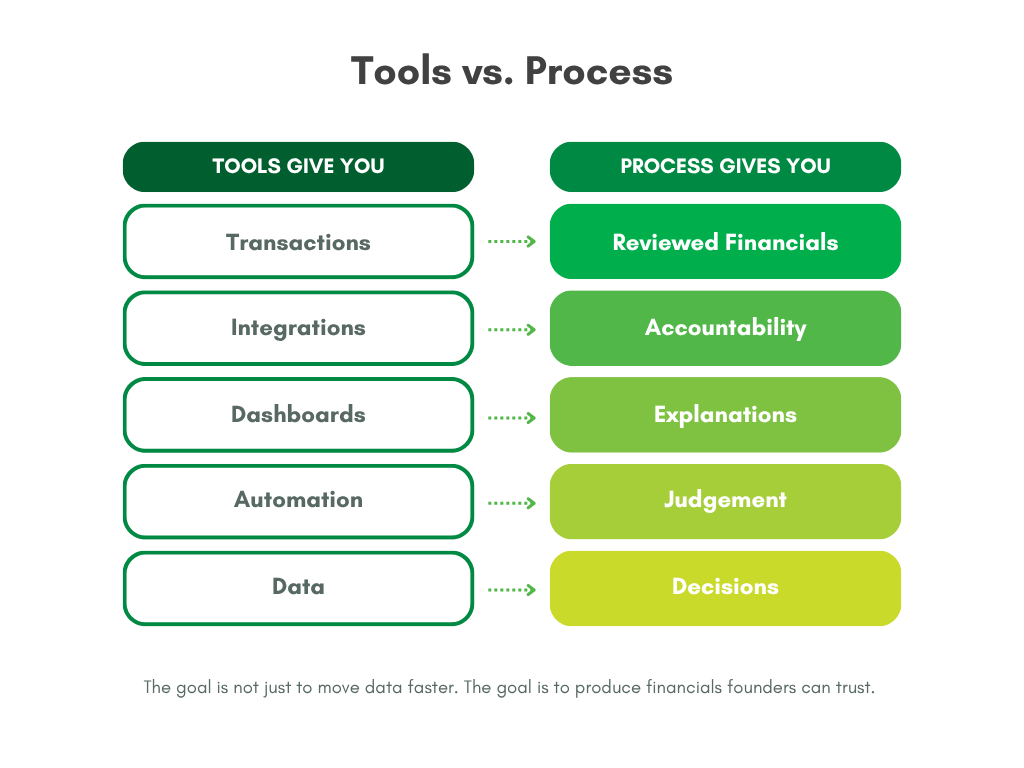
Integrations matter. They help data move between systems and reduce manual work.
But founders should not confuse integration with accuracy.
Just because a transaction flows from one platform into another does not mean it is coded correctly. Just because payroll syncs into QuickBooks does not mean payroll liabilities are reviewed. Just because Stripe data flows into an accounting system does not mean revenue is recognized properly.
Automation can move data. It does not automatically create accounting judgment.
AI can also speed up the close. It can help categorize transactions, surface exceptions, draft explanations, and make reporting easier to interpret. But it does not automatically understand your company’s tax position, investor expectations, revenue policy, R&D credit support, state tax exposure, or whether your balance sheet accounts make sense.
For example, AI may help categorize software, contractor, payroll, or cloud computing costs. But someone still needs to understand whether those costs are relevant for R&D credit documentation, Section 174 tracking, or financial reporting.
AI can support the close. It should not own the close.
A quick finance stack audit for founders
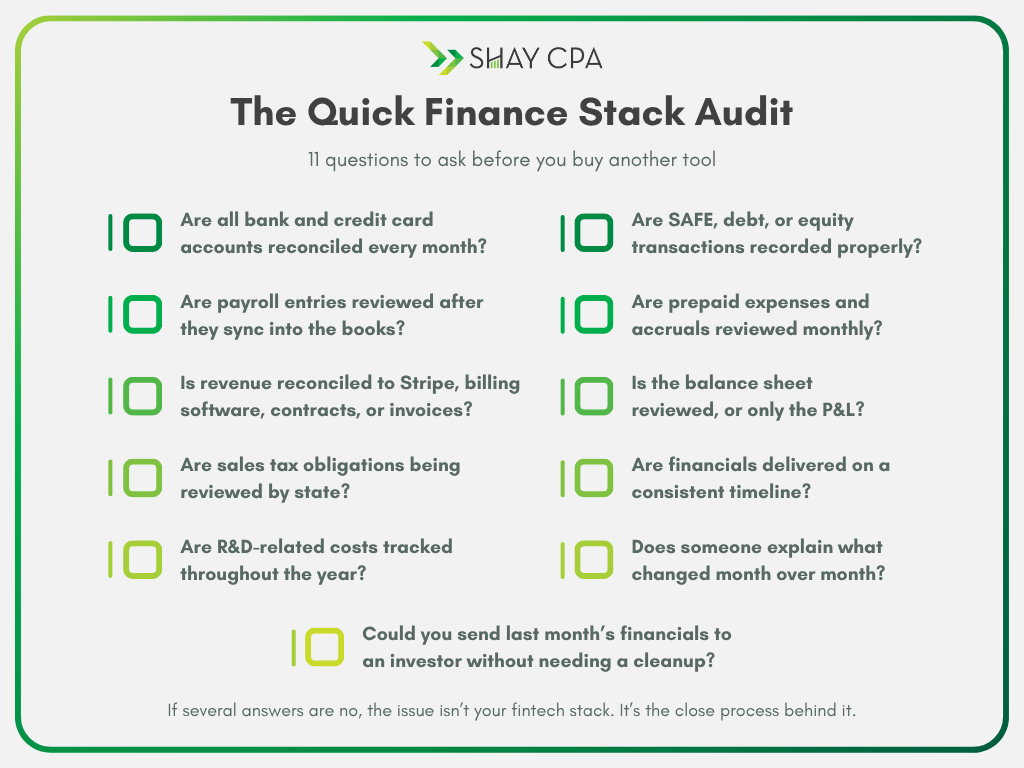
If you are unsure whether your current stack is working, ask these questions:
- Are all bank and credit card accounts reconciled every month?
- Are payroll entries reviewed after they sync into the books?
- Is revenue reconciled to Stripe, billing software, contracts, or invoices?
- Are sales tax obligations being reviewed by state?
- Are R&D-related costs tracked throughout the year?
- Are prepaid expenses and accruals reviewed monthly?
- Are SAFE, debt, or equity transactions recorded properly?
- Is the balance sheet reviewed, or only the P&L?
- Are financials delivered on a consistent timeline?
- Does someone explain what changed month over month?
- Could you send last month’s financials to an investor without needing a cleanup?
If the answer to several of these questions is no, your issue may not be your fintech stack.
Your issue may be that the stack is not connected to a reliable month-end close process.
The ShayCPA view
The right finance stack should make the accounting process easier, cleaner, and more useful.
But tools alone do not create financial discipline.
At ShayCPA, we help startups choose, implement, and work within finance tools in a way that supports monthly bookkeeping, tax-aware accounting, financial statement preparation, and scalable finance operations.
Our view is simple:
ChatGPT and Claude can help founders ask better questions about their financials. ShayCPA helps make sure the financials are worth asking questions about.
Your fintech stack should help your company close the books, understand the numbers, and stay ready for tax, investors, and growth.
That requires the right software. It also requires the right accounting process behind it.
Build a finance stack that actually closes the books
Better tools can help your startup move faster. But tools alone do not create reliable financials.
ShayCPA helps startups build tax-aware bookkeeping and month-end close workflows behind the finance stack, so founders can trust the numbers, stay ready for tax compliance, and prepare for investor conversations with more confidence.
If your company is using modern finance tools, dashboards, ChatGPT, or Claude, but still does not have a dependable monthly close process, we can help.
Get month-end close support from ShayCPA. Build a Better Monthly Close – contact us today.
Disclaimer:
The content provided on this blog is for general informational purposes only and does not constitute professional accounting, tax, or legal advice. Reading or accessing this material does not create a CPA-client relationship, nor should it be construed as a substitute for individualized guidance from a qualified professional. While we strive for accuracy, Shay CPA PC makes no warranties—express or implied—about the completeness, reliability, or timeliness of the information, and we expressly disclaim liability for any errors or omissions. You should not act or refrain from acting based on any blog content without seeking the advice of a qualified CPA or other professional who can address your specific circumstances. Links to external resources are provided for convenience only and do not imply endorsement. Shay CPA PC is under no obligation to update this content and disclaims responsibility for decisions made in reliance on it.