Did you know that, contrary to popular belief, acting is a skill? Like any skill, that means you can get better at it with practice. However, unlike a lot of other skills out there, practicing acting isn’t as straightforward as just doing it.
What does just doing it even mean when it comes to acting? Is it reading Uta Hagen, rehearsing a monologue, or shouting and rolling around on the floor for three hours? (Yeah, I had to do that a lot in drama school). If you’re getting started as an actor, you might be bewildered about where to start. You also probably don’t have a heap of time on your hands. These days, who does?
In today’s article, I’m going to help you design a daily routine that is short and sharp and you can do just about anywhere; no drama school necessary and only a little bit of rolling around on the floor required.
How to Become a ‘Good Actor’
What does a good actor look like? You have to know what good is to get good. Here’s a great example of good acting given to me by my acting tutor.
If you’re a beginner actor, imagine yourself as a box, like the image on the left. The box is your capacity to inhabit a character. The ball in the middle is your potential; where that character springs from. It’s your energy, your imagination, your emotional world and your spiritual world.

When we inhabit a character as a beginner actor, it’s like the image on the right. You can see the ball starts jumping all over the place but it’s confined to the shape and the size of the box. This represents what Declan Donnellan calls “blocked acting”. We often get in the way of ourselves as beginner actors because we either have an idea about what we think good acting is, or we’re self-conscious, or we don’t know what we’re actually doing when we act.
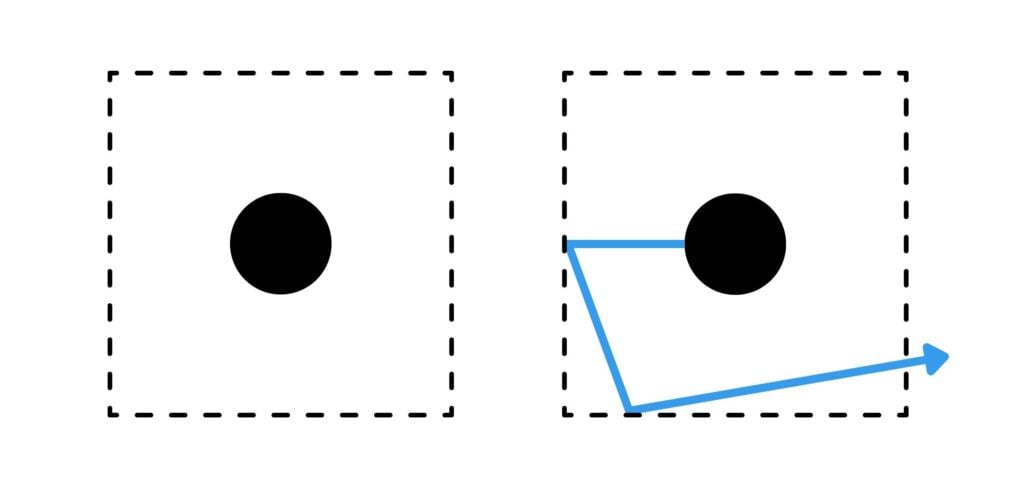
Now, as we start to practice and get good, we start to look more like the left. Then, what happens when we inhabit a character is like the image on the right: the ball can escape! This represents moments where the best acting comes from: uninhibited curiosity and playfulness. That’s ultimately what any good actor is trying to achieve.
By practicing regularly, we’re aiming to put more gaps in the box; you can’t get rid of it completely but create enough gaps so that even when you do run into blocks, the ball will eventually find a way out.
Pretty abstract, I know, but hopefully that gives you some idea of what we’re working towards. Now, onto the routine.
How to Structure a Daily Acting Routine
There are three main components to any good acting routine: voice, body and mind.
Daily Vocal Routine for Actors
The days of the silent film are behind us; long may the voice reign supreme. Since the Ancient Greeks started their freaky festivals of Dionysus, and long before that when we figured out how to make sounds that represent things by the light of a fire in a dark cave, the voice has been essential to our way of storytelling. A good voice isn’t just necessary for voice over or stage, either. How many films have you seen recently where you struggle to make out what the actor is saying? The idea that naturalism is quiet infuriates me. Your voice is one of the most powerful tools you have and you only get one, so we need to take proper care of it and make it the best it can be.
Daily Movement Routine for Actors
If you’re wondering what goes on behind the doors of just about any drama school, it’s yoga. Or some version of it. One of the most important things beginner actors need to train is awareness of their bodies. Knowing how your body moves and what it’s capable of is essential to uninhibited performance. More technically speaking, a healthy body is flexible and strong, which gives you greater range with characters. Take Puck from a Midsummer Night’s Dream – imagine if he had a bad back? An interesting choice, maybe, but not as exciting to watch as the spry, smart-ass pixie that he is.
Daily Mindfulness Routine for Actors
Remember the ball in the box? Your mind isn’t just where you do all your thinking, it’s your wellspring of imagination and emotion, energy and intention. It’s where all the nuance that makes you human comes from. And much like the body and the voice, your mind is a muscle that can be trained.
Integrating Voice, Body, and Mind
I’ve broken up our routine into the three components above for the sake of simplicity but it’s very important to remember that by practicing we’re trying to get all three working together. They are not and should not be treated as separate entities. While it might seem like we’re training them independently of one another, they all influence one another: without good awareness of your body, you can’t achieve a free voice and without a free voice you can’t achieve an engaged mind. Remember this and remind yourself of it throughout your entire acting journey.
Step-by-Step Daily Routine for Actors
Alright, let’s get down to brass tacks. Make sure you’ve got some space to move around and ideally a bit of privacy; acting practice is weird to watch and hard to explain.
Voice Practice (10 minutes)
Step One: Muscle Release (3 minutes)
Trace down from your temples to where your jawbone meets your skull. Take the hard edge of both hands and press them into that spot either side and make little circles for about a minute. This will probably hurt a fair bit when you get started so go very slowly and gently.
Next, run your hands down your face, giving yourself a big pat and think about releasing your jaw. Be gentle and don’t force anything, you’re just giving your jaw a bit of loving encouragement to let go of any tension. Do that a handful of times.
Now onto the tongue. Keeping your mouth closed, make big circles with your tongue, trying to stretch it into every little nook and cranny of your mouth. Make 10 circles in one direction, then 10 back the other way, then 6, then 2, then 1. As soon as your finished, open your mouth, press the tip of your tongue into your bottom teeth, push it forwards and look up. You should feel the stretch somewhere in the back of your tongue.
While we’re with the back of our tongue, release the stretch and work your thumbs into the underside of your jaw, about where you think the back of your tongue is. Keep reminding your tongue to release; it sounds bizarre but by thinking “release the tongue” you’ll subconsciously make tiny adjustments that loosen up any tension.
Why are we doing this?
We hold a lot of tension in our jaws and tongues, often without even realising it. When we’re young, we imitate the way our family and friends speak and unless you’re exclusively hanging out with speech pathologists or professional actors, you’ll pick up some unhelpful tension. Doing a muscle release like this every day opens up our voices and allows sound to move more freely.
Step Two: Wake Up the Resonators (2 minutes)
Start tapping your face with your fingers. Spend some time on your forehead, your cheeks, your neck, your chest and the sides of your torso. Do this for about a minute then give the same spots a good rub. Add in a gentle hum while you’re at it, too.
Why are we doing this?
Your voice resonates in your bones when you speak. By giving all those bony spots a good tapping and a good rubbing, you’re more likely to engage them when you’re speaking. By bringing awareness to our chest and our sides, we’re also encouraging our lungs to expand into them more freely.
Step Three: Now for some Sound (5 minutes)
Have a yawn. A big, full-body yawn and let out all of the sound you can manage. Feel all of that space in the back of your mouth? Try and keep that there for the rest of this step. Now for some sirens. Start with a very soft hum, moving up in pitch until you’re as high as you can go, then down again to the lowest note you can manage.
Sidenote: Don’t push anything here, if you’re straining or your throat feels scratchy, you’re going too far.
Open up from a hum into an “ahh” sound, then some “oohs” and finally some “ees”.
Now for some lip trills. Press your lips together and blow some raspberries, moving up and down your vocal range as before. If you struggle with this, try pushing your cheeks together with your fingers.
Why are we doing this?
Gentle, occluded sounds (like humming and lip trilling) are amazing for your voice. It’s very hard to damage your voice when making these sounds and they give your vocal folds a nice massage. Check out my article about maintaining good vocal health for some more specific tips on keeping your voice in good nick.
Cheat code: I use an app called WarmMeUp which is available on the app store for about $9.99. It creates a new vocal warmup for you every day and takes the mental effort out of planning a warmup.
Body Practice (5 minutes)
Step One: Full Body Scan (1 minute)
This is a very simple exercise that doubles as a standing meditation. Stand up, plant your feet about a hip width apart, let your arms hang by your sides and close your eyes. Start to notice the way your weight is distributed, how you’re balanced, how you’re breathing, if you’re tensing any muscles. Don’t change any of it, just notice it. This is the body you’re working with today. It’s different from yesterday and it will be different tomorrow. However it feels today is perfect.
Why are we doing this?
I recently wrote an article about feeling self-conscious when we act. It’s one of the top killers of good performance and it often starts with the body. A bit of tension in your left hand can grow into over-awareness and uncertainty very quickly when you’re performing. You might start thinking things like “Why is my left hand so tense? I should relax it. Okay it’s relaxed but now I’m furrowing my brow, relax. Oh man, why is it so hard to relax? Can they tell I’m not relaxed? JUST ACT RELAXED!” By learning to meet our bodies where they are on any given day, at any given moment, we can start to treat anomalies, like tension, with curiosity rather than judgement.
Step Two: Spinal Roll (1 minute)
If this is your first spinal roll, how I envy you. Stay standing, blink your eyes open and start to roll your chin to your chest then try to curl over one vertebrate at a time. Let your arms dangle and stop once you’re hinging at the hip. Breathe here for a moment and notice how this shape changes your breath. Then, roll back up, one vertebrate at a time. Repeat a couple of times.
Why are we doing this?
We often neglect a whopping 50% of our bodies: our backs. Out of sight, out of mind, I suppose. A fully engaged performance requires your full body. Take, for example, your lungs. Your lungs are three-dimensional and expand into your back. Imagine what happens to your voice and your mind if you’re only breathing at half-capacity.
Step Three: Energise (3 minutes)
Let’s turn it up to eleven. This section is open to whatever you want but it has to be something high energy. You could dance, do some shadowboxing, push ups, go for a run; anything that will get the blood pumping.
Why are we doing this?
There’s a little something called “via negativa”. It’s a pretty dense philosophical approach to life but in the context of acting, it’s about making the work easy for ourselves by tiring out the part of our brain that says “that was bad”. When we’re out of breath, sweating and getting all the good feelings from exercise, we don’t think as much about “giving a good performance”, whatever that means, and focus more on the present moment.
Mind Practice (15 minutes)
Preparation
Before you start this daily routine, pick a monologue, any monologue. Actually, pick two and make sure they’re quite different e.g Puck from a Midsummer Night’s Dream and Biff from A Death of a Salesman. Make sure you’ve read both plays, do that in your own time, too. You want to have two new monologues to work on each month. This way you’ve got some text to dig into and you’ll have a couple of audition monologues up your sleeve for when you need them.
Step One: Just Do It (2-4 minutes)
Launch into one of your monologues. Don’t think about it, just go for it; if you still need the script in front of you, that’s fine, just don’t stop and don’t overthink it.
Why are we doing this?
It’s amazing how quickly we can get stuck in a very specific way of doing things. If I had a dollar for the amount of times I’ve read a monologue once and got stuck doing it the same way forever, I’d be living in luxury in the Bahamas. By coming at your pieces straight after energising, you’re giving yourself the best shot at performing authentically. If you’re feeling sad, do it sad. If you’re feeling glad, do it glad. If you’re feeling mad, do it mad. This creates fertile ground for discovery.
Step Two: Write it Down (1 minutes)
Now grab a pen and paper, start a timer for 1 minute and write down anything that came up that you found surprising or interesting. It doesn’t have to make sense, and in fact you might not even remember most of what happened, just see what you do remember by writing it down.
Step Three: Dropping In (5 minutes)
Lie on your back and close your eyes. Now speak your monologue, slowly and deliberately and try to resist the urge to perform. Go line by line and stop to speak out any images or thoughts that pop up as you. Here’s a transcript of when I did this exercise using the most famous and most overdone monologue in theatre history:
“To be or not to be. To be… to be… what is it ‘to be’? What is it like to be alive? Is it just electricity and sensation? Blood and guts? Thoughts? What are thoughts and feelings anyway, are they also just electricity? Or… well, what’s the alternative? Not… to be? For all of that to go away, to vanish just like that, into thin air. Whoa, that’s scary. Is it? Maybe it’s peaceful? How can we know for sure?” Get the idea?
Why are we doing this?
You’d be surprised at how good your first instinct with characters is, but you need to train it. “Dropping in” is a way of teaching yourself to identify what’s coming up for you in the moment and the reason I like it so much is because it gets you away from ideas of the “right way” to do a monologue. The more you do this, the more layers you’ll add to your performance without even noticing.
The next time you run your Mind Practice (the next day) switch to your other monologue.
Wrapping Up
You’ve probably heard the old adage about it taking 10,000 hours to master a skill. Unfortunately, it’s very difficult to find 10,000 hours to put towards acting; you have to squeeze practice in between your job, your social life, your love life and everything that comes with being a person in the modern world. Fortunately, acting doesn’t and shouldn’t be what you live and breathe; in my opinion. When you’re starting out, focus on training your awareness and your instinct and always remember that acting isn’t that serious; the more fun you have doing it, the better you’ll be.
Hope this helps. See you around the traps!