All about our political imagination workshops with Mushon Zer-Aviv
“If there’s one thing to remember: the future does not exist. There are always futures.”
That was Mushon Zer-Aviv’s central message in Forging Anti-Fascist Futures, a political imagination workshop series we hosted with him in January and April.
When we asked participants why they wanted to join the workshops, they told us they needed this. They shared about wanting to break the exhaustion of survival loops, to find strategic paths forward, to radically imagine a just world with like-minded folks. One participant said, “It’s hard for me to imagine that people globally can be united and stand up against all injustice. But I’m here.” That “but I’m here” carried weight.
The fascist turn is a global phenomenon. But so is the fight against it. Fascist leaders drag their countries to wars together. The participants of these workshops, joining from across the U.S., Brazil, Germany, Palestine, Israel, and beyond, showed there is room for collaboration between those fighting against them as well.
Mushon was leading the workshops from Tel Aviv where he’s been organizing for peace through unimaginable darkness. He shared a quote from Rebecca Solnit’s Hope in the Dark that has made a critical distinction for him between hope and optimism when imagining futures:
“Hope locates itself in the premises that we don’t know what will happen, and that in the spaciousness of uncertainty is room to act.”
As Mushon put it, hope isn’t in the light; it’s in the dark. Our fears are in the dark too, which is why we’re afraid of it. But Solnit is telling us that the unknown is where we find room to act. The workshops were an exercise in training our ability to see in the dark — to map the space of possibilities that is not necessarily visible under the lamplight of certainty.
The future isn’t a single timeline we’re heading toward. It’s a wide-open landscape of possibility. And right now, in many moments of crisis, the question isn’t whether the future will change. It’s whose vision of the future will win. Political imagination is our capacity to envision what we make possible and win together.
Read on for more from Forging Anti-Fascist Futures, including:

What We Did Together
Part 1: Future Screenshots
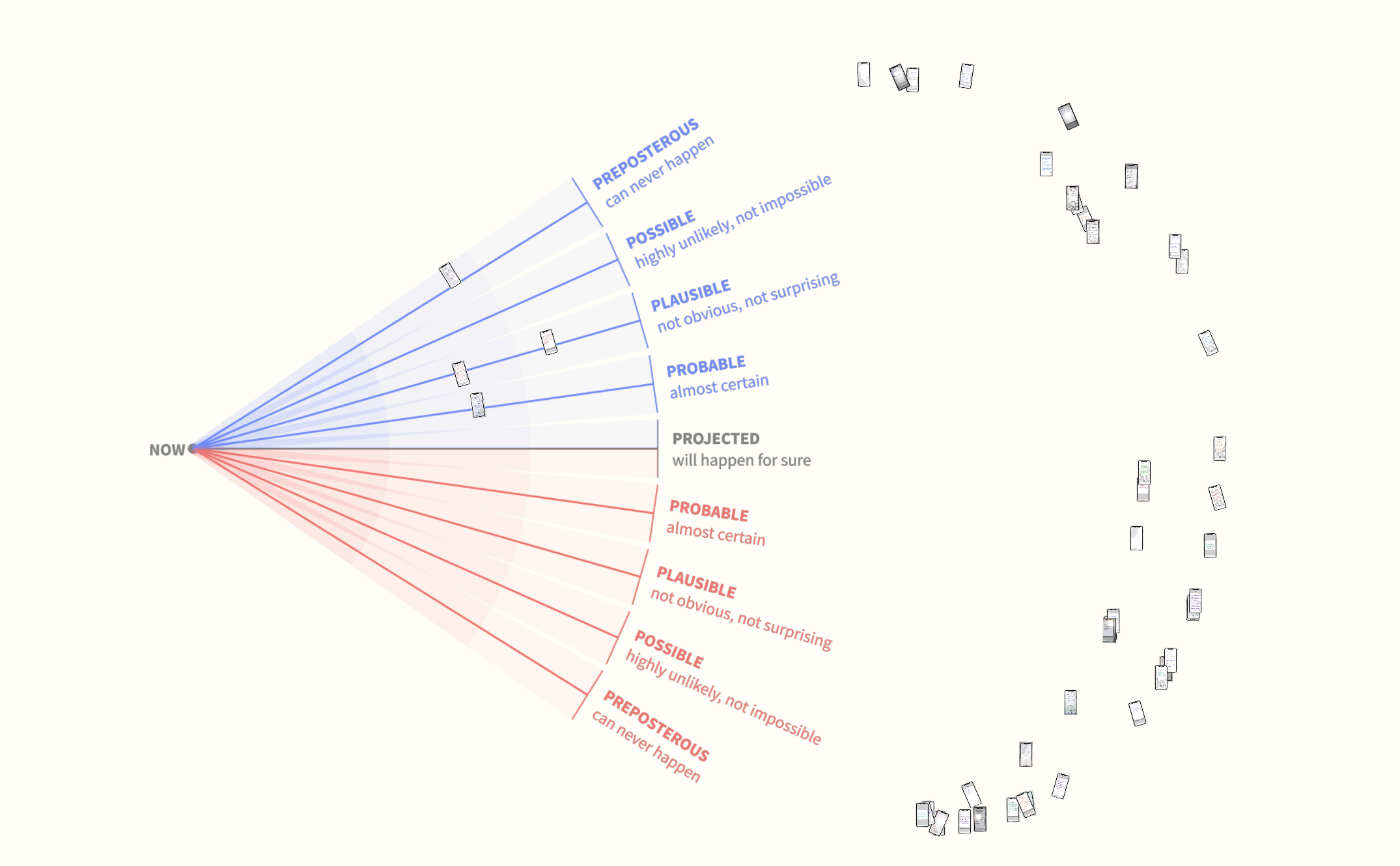
Part 1 of the series, Future Screenshots, took place in January and in April (due to popular demand!). Future Screenshots was a method to challenge the present, stretch our political imagination, and inspire co-resistance and transformative activism. Participants learned a method for designing fictional screenshots — imagined images of the future that look like they appeared on someone’s screen. The methodology was simple: imagine it appearing on someone’s screen, and choose one of many screenshot templates to sketch it. A Future Screenshot could look like a chat, a map, a headline, or an AI prompt–offering a glimpse of a future that’s probable, possible, or even preposterous. The aim was to use these imagined futures as tools to clarify what’s possible in the present, challenge the status quo, and build stronger solidarity and co-resistance.
In Future Screenshots, participants:
- Generated multiple Future Screenshots (from hopeful to dreadful, and everything in between)
- Mapped them on the online Futures Cone (projected / probable / plausible / possible / preposterous)
- Noticed how people react to different futures, and what those reactions reveal
- Briefly bridged back to the present

“Really great workshop…I could have easily listened another hour to the discussion we had going today.” – Future Screenshots workshop participant
The futures people imagined were wide-ranging — sometimes hopeful, sometimes harrowing, and sometimes both at once.
A participant from Gaza imagined a future where hotels in Gaza were fully booked because of Israeli-Palestinian cross-cultural summer camps. They shared something many of us didn’t know: in 1999, when they were in first grade, this had actually been real. Their family couldn’t find a hotel room because so many Israelis were vacationing there. A future grounded in an actual past — evidence that what once existed can exist again.
A Palestinian participant imagined a chat with a government officer: “I’m so happy to inform you that we managed to adopt the fourth child.” The officer responds, “Congratulations, so proud of you and happy for you. A girl or a boy?” On the surface, it reads as a private, personal moment. But they explained that watching children in Gaza become orphans over the past two years had made them dream of adopting at least one — and that current systems make it nearly impossible. “It’s very political for me,” they said, “that we can’t do this today.”
An imagined social media post about going to a free doctor’s appointment, getting gender-affirming hormone therapy prescribed on the spot, and picking up the free prescription was also shared.
Someone else shared a breaking news notification: “All people with melanin are no longer citizens. The administration will begin deporting all non-white people to an undisclosed location immediately.” When asked how likely this was, their first instinct was “it’s already happening.” The room sat with that.
After sharing a preferred future — “Worth the fight! Human interests prevail!” — a participant put it plainly: “My baseline is incredibly catastrophic, and if I live in the prevent space, I don’t get out of bed. So I need to project the future that I want to have.”

Part 2: What For?
Part 2 of the series, What For?, took place in April. What For? focused on applying Future Screenshots to strategic action and was designed for teams collaborating on a campaign, project, or initiative. Mushon guided groups through an action-oriented process that moved from imagined futures to concrete questions, prioritized opportunities, and real next steps. The central question throughout was “What for?” — used not as a challenge but as a compass to help teams translate scattered ideas into shared strategic direction and clarify where to focus their energy.
In What For?, participants:
- Generated Screenshots of the present, of future success, of failure, and of inaction
- Extracted “How Might We” questions from those futures and clustered them by theme
- Mapped priorities along the dimensions of energy and time
- Left with concrete, actionable next steps for their work

The What For? workshop pushed participants further, from imagining futures to mapping what they could actually do about them. Working in small groups organized around shared concerns (including voting rights, feminist liberation, debt and material autonomy, cultural organizing, democracy and depolarization), participants created screenshots of the present they wanted to change, the future if they succeeded, the future if they failed, and the future if they did nothing.
That last prompt — what if we do nothing? — turned out to be one of the most powerful. Mushon shared that in past workshops, this question had actually led organizations to cancel projects they’d been planning for months. By asking who else could do the work, and whether they were better positioned to do it, teams sometimes discovered they were more needed somewhere else entirely.
From the screenshots, participants extracted “How Might We” questions — reframing overwhelming problems into actionable possibilities and mapped them on affordance charts by energy and time. The goal: find what’s actually in our hands, what we can do through others, and what’s currently out of reach but worth monitoring.
Mushon was candid about activist culture and the romance of big fights: “It’s known to be a problem with activists — it’s a part of our identity to fight big fights. And sometimes we look at ourselves fighting the fight, and we see the romanticism of not giving up on these huge struggles.” He paused. “I actually think we should try harder. We should succeed. We should work on things that we can actually have impact on.”

What’s Next?
By the end of the Forging Anti-Fascist Futures, the work was already carrying forward. Participants exchanged contact information and even scheduled plans to continue their work together. We will be following up with participants to see how their work progresses.


Resources
Learn even more about Part 2 of Forging Anti-Fascist Futures from Mushon Zer-Aviv’s essay on Medium: What For? Applying Future Screenshots to Strategic Action
Want a focused strategy session tailored to your team and your specific context? We know from experience that these sessions save substantial time, energy (and money). Most importantly, they lead teams towards strategic clarity and creative action. Contact us for more information.
Thank you to ALBI Fund for their support of Forging Anti-Fascist Futures.
About Mushon Zer-Aviv
Mushon Zer-Aviv is a designer, writer, educator, and activist based in Tel Aviv. His work often involves mapping and way-finding through physical, digital, and political landscapes. Mushon is a board member of the Israeli/Palestinian peace movement A Land For All – Two States, One Homeland. He is a senior faculty member at Shenkar College and an alumnus of Eyebeam – art and technology center in New York.

Sign up for our newsletter and follow us on Instagram, LinkedIn, and/or Bluesky to stay up to date on all things artistic activism — and be the first to hear about our future events.