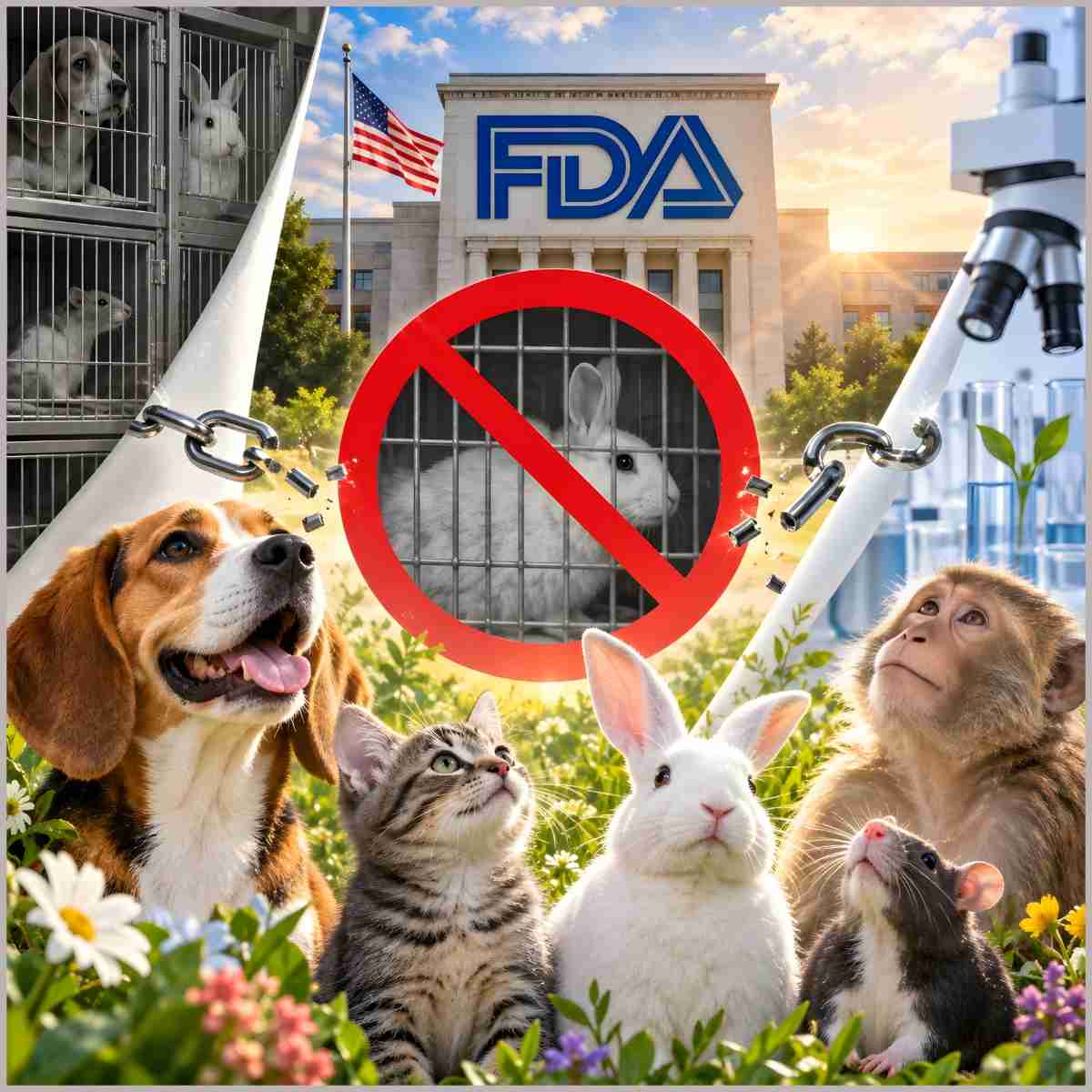

Compliance with FDA Modernization Act 2.0 comes only after FDA Modernization Act 3.0, compelling compliance, has already passed U.S. Senate & House of Representatives
WASHINGTON D.C.––The U.S. Food & Drug Administration [FDA] on September 21, 2026 issued a long delayed “direct final rule,” it announced, “that updates regulations to clarify that non-animal methods can be used where appropriate for testing the safety of drugs and biological products intended for human use.”
The FDA announcement came with the Donald Trump administration under pressure from Congress through passage of both U.S. Senate and House of Representatives versions of the FDA Modernization Act 3.0, yet to be reconciled and ratified by both, which would have compelled the FDA to produce the “direct final rule.”

Something for marchers to celebrate
The FDA announcement also came 11 days after the conservative anti-vivisection organization White Coat Waste embarrassed the White House by exposing the failure of Robert F. Kennedy Jr., appointed by Trump to head the U.S. Department of Health & Human Services, to fulfill repeated Trump administration promises to reduce dog and cat use in federally funded biomedical research.
(See Dogs & cat use in labs is up under Trump/Kennedy, says White Coat Waste.)
The FDA announcement further came with a two-week “March to Abolish Animal Testing” traversing a 207-mile route from Albany, New York to the Marshall BioResources headquarters in North Rose, New York within five days of conclusion.
(See Can 15-miles-a-day march on the Erie Canal save Marshall Farms beagles?)

Removes “language that could suggest that animal testing is the only acceptable way to generate safety information”
The “direct final rule,” the FDA said, “replaces terms like ‘animal tests’ and ‘animal studies’” in regulatory language “with the terms ‘nonclinical tests’ and ‘nonclinical studies.’
“Related terms, including “preclinical” and “in vitro,” are also replaced. The rule defines ‘nonclinical test’ and ‘nonclinical study’ in line with the Food & Drug Omnibus Reform Act of 2022,” which included the FDA Modernization Act 2.0, a priority bill for many animal advocacy groups that ended the 1938 federal mandate requiring animal tests for every new drug before the drug entered human clinical trials.
The new “direct final rule,” the FDA continued, “removes language that could suggest that animal testing is the only acceptable way to generate safety information for regulatory decisions in products intended for human use. It does not eliminate or prohibit animal studies, change evidentiary standards, or impose new costs or requirements on drug developers.”
The FDA also announced the launch of an online database “featuring 25 specific uses of New Approach Methodologies that might be used in place of animal tests.”

(Beth Clifton collage based on Tami Drake Facebook photos.)
“We’ve been pushing this action”
Responded Animal Wellness Action and Center for a Humane Economy president Wayne Pacelle, “We’ve been pushing this action since we passed the FDA Modernization Act 2.0. And we passed 3.0 in the House and Senate,” Pacelle reminded.
“It finally all came together.”
Pacelle and Tamara Drake, research and regulatory policy director for the Center for a Humane Economy, recalled in a blog posting that the FDA Modernization Act 2.0 “removed a statutory barrier that had, for 84 years, mandated animal testing in drug development,” but the FDA slow-walked implementation, in steps not announced until April 2025, December 2025, and March 2026.
The March 2026 FDA “guidance,” Pacelle and Drake explained, “addressed one of the most important questions facing drug developers: what evidence the FDA needs to determine that a new method is fit for a particular regulatory purpose.”
“The FDA’s new rule,” Pacelle and Drake assessed, “accomplishes nearly all the specific regulatory modernizations called for in the House [version of the FDA Modernization Act 3.0] and makes additional conforming changes of its own.
“One more small action by Congress and the president on 3.0 will punctuate these epic gains,” Pacelle and Drake concluded.

“Substantial implications for millions of animals”
Humane World for Animals president Kitty Block and Humane World Action Fund president Sara Amundson agreed in a jointly signed blog post that the new FDA “direct final rule” will “eventually have substantial implications for millions of animals used in testing.
“Because the U.S. is the world’s largest pharmaceutical market,” Block and Amundson wrote, “what the FDA does has consequences for animals in laboratories all over the world.
“Over the last few years,” Block and Amundson recounted, “we have seen major shifts away from using animals in experiments throughout the U.S.

“Ambiguity”
“But despite this momentum, those of us who have been dedicated to ending animal testing and research have been very aware of ambiguity in the very language that regulates and directs testing that, in effect, slows or even prevents tangible progress away from animal testing.
“The FDA has been a locus for some of this ambiguity,” Block and Amundson observed.
“On the one hand, the agency was encouraging companies to shift away from using animal testing data when submitting drugs for approval,” Block and Amundson acknowledged.
“But at the same time, the industry was hesitant to make this shift because the FDA’s own regulations still suggested that the agency required data from animal tests in certain situations to approve new drugs.”

“New NIH spending on dog testing at pharmaceutical companies”
A variety of Donald Trump administration appointees have promised policy changes leading to huge reductions in animal use for biomedical research, including Robert F. Kennedy Jr., who as Secretary of Health & Human Services has the three major agencies involved in animal-based biomedical research under his authority: the FDA, the Centers for Disease Control & Prevention, and by far the biggest, the National Institutes of Health.
The September 10, 2026 publication of MAHA Betrayed, however, a downloadable 29-page report from White Coat Waste, exposed “more than $225 million in National Institutes of Health (NIH) funding supporting dog and cat experiments,” since Kennedy’s appointment, much of it “new spending that began during the current Trump administration,” a White Coat Waste media release summarized.

(Beth Clifton photo/collage)
“Approximately 44% of the total identified since Secretary Kennedy took office — more than $98 million — consists of new NIH spending on dog testing at pharmaceutical companies,” White Coat Waste added, backing up the allegation with line item details including grant numbers, titles, institutional names, grant starting and ending dates, species involved, and the amount of money for each grant.
Please donate to help our work:
More related posts:
Discover more from Animals 24-7
Subscribe to get the latest posts sent to your email.