

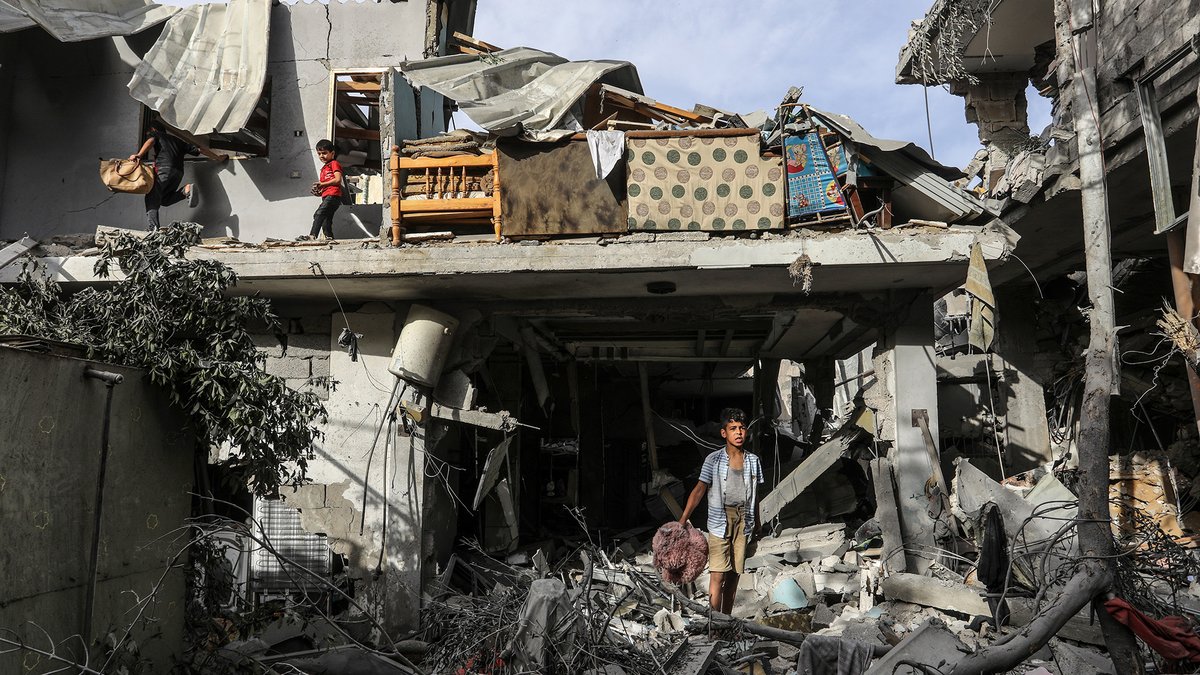

Mahmoud Abu Saada and his family moved into the Al-Saada building on Al-Sinaa Street in southwestern Gaza City one month ago, hoping to escape the hardships of tent life. But in the early morning of September 16, the six-story structure—which provided refuge for approximately 100 displaced people—collapsed on top of them, killing Mahmoud, his wife, and their six children.
According to Gaza’s Ministry of Health, twenty-one Palestinians were killed, and forty-five others sustained injuries of varying severity. Gaza’s government media office confirmed that the building was directly struck by Israel on October 9, 2023, in the early days of Israel’s bombardment of the strip.
Israel Defense Forces denied striking the building in a post on X. The Gaza government media office rejected Israel’s denial, writing in a statement cited by Anadolu Ajansi that “the bombardment targeted the building’s foundations and its first and second floors, causing severe and deliberate structural damage to its infrastructure and main foundations.” It continued, stating that “this previous and concentrated bombardment was the real and direct cause of the building’s complete collapse.”
The tragedy once again highlights the dangers facing Gazans living in buildings decimated by Israeli bombardment. But the lack of alternative housing and a severe shortage of tents has left many with nowhere else to go.
“My son Mahmoud and his family were displaced in a tent in Al-Mawasi, but they were struggling to live in the tent because of the high temperatures and the spread of insects and rodents. So, they left and moved into Al-Saada Building,” Umm Mahmoud Abu Saada, mother of Mahmoud Abu Saada, tells The Progressive. The only rent they could afford was in the Al-Saada Building, she says.
Umm Mahmoud recalls receiving a phone call from relatives who told her the building had collapsed. The family waited anxiously for news from the rescue teams, hoping Mahmoud and his family would be pulled out alive. But their wait ended in tragedy. Mahmoud and his family were found dead underneath the rubble.
Gaza’s Civil Defense crews faced considerable difficulties during rescue operations at Al-Saada Building. Rescuers could hear people calling for help from beneath the rubble, but the lack of adequate equipment hindered the teams’ efforts to reach and extract those trapped.
The tragedy faced by Mahmoud’s family and the many others living in the Al-Saada building was not caused by the collapse alone. It began when they were forced to choose between the harsh conditions of displacement in a tent and the dangers of living in a damaged building without an affordable, available alternative.
In Al-Shati refugee camp, west of Gaza City, twenty-four-year-old Amal Tafesh lives with her family in a home damaged during the war. On October 9, part of their roof collapsed.
“Since the beginning of the war, we haven’t left our home,” Tafesh says. “We stayed despite all the danger and the risks.”
She recalls October 13, 2023, when the bombardment intensified in Al-Shati camp. According to Tafesh, Israeli tanks entered the camp and began firing mortar shells at homes. One shell struck the roof of their house.
The damage worsened after a neighboring six-story building was bombed, sending pieces of concrete and a column crashing onto the top floor of Tafesh’s four-storied home. The impact destroyed an interior wall and cracked the walls and floors. This year, stones began falling from the walls and staircase before the roof eventually collapsed.
Tafesh says the collapse happened suddenly while the family was sitting inside. The living room ceiling fell all at once, filling the house with dust. Her cousin and his family, who were inside the living room at the time, were pulled from beneath the rubble without injuries, she says.
Tafesh estimates around thirty people currently live in the building, which increases her fears for the residents’ safety. Amal and her family have remained in the house because they have nowhere else to go. She explains that neighboring homes are suffering similar damage.
“When we think about leaving the building, we ask ourselves: ‘Where are we supposed to go?’ There are no tents around us,” she says.
Very few buildings in Gaza remain intact.
Mahmoud Bassal, spokesperson for Gaza’s Civil Defense, warns of further building collapses, telling The Progressive that the structural damage caused by Israeli attacks has left more than 2,000 buildings at risk of falling. Gaza’s Public Works and Housing Ministry estimates that number to be around 3,000. Bassal says that these buildings pose a direct threat to the tens of thousands of Palestinians living in them due to the severe shortage of tents and other shelters.
According to Bassal, Civil Defense authorities face a recurring dilemma when they ask residents to evacuate buildings at risk of collapse: Many residents demand alternative accommodation before leaving, but the agency lacks the resources to provide suitable shelter.
Bassal says authorities have assessed the available tents and found that, according to Civil Defense’s estimates, organizations operating in Gaza collectively have fewer than 1,000 tents. The approaching winter will worsen the risks of this shortage, bringing frigid temperatures, wind, rain, and flooding to displaced families. Limited land in adequate condition to erect shelters makes it extremely difficult to evacuate residents from dangerous buildings.
“Since the collapse of Al-Saada Building, we have warned the residents of more than 500 buildings to evacuate these damaged structures,” he says.
Humanitarian organizations in Gaza—like ANERA and ACTED—are deciding how best to help families living in worn-out tents while also finding shelter for people whose homes risk collapse with extremely limited resources.
Less than a week after the Al-Saada building collapsed, Gaza’s government media office announced an emergency plan to evacuate and demolish 255 structurally unsafe buildings. The Ministry of Public Works and Housing will lead this effort, with help from other government ministries and international organizations. But major challenges include a lack of funding and a blockage from the Israeli military agency, COGAT, which refuses entry of heavy equipment and reconstruction materials that would aid in rescues and rebuilding infrastructure.
Bassal calls on the international community to act urgently to provide suitable alternative housing so the Civil Defense and other relevant authorities can evacuate the structures that pose an imminent threat to people’s lives.
Thousands of Palestinians in Gaza are facing an impossible reality. Buildings can collapse at any moment; there are not enough tents to shelter everyone. The lack of alternatives is forcing people to remain living beneath cracked ceilings, knowing that doing so could cost them their lives.


