


Using the video, Das began talks with the British Army and brought the sport to the military. Doggedly determined to grab every opportunity by the scruff of its neck, Das drove from Birmingham to Sandhurst (a five hour round trip) after work, twice a week, every week, to teach the sport. “My wage was going to Kabaddi,” he said, explaining that he was spending half his income bringing the sport to schools and universities. In 2004, he formed the English Kabaddi Association and brought an English men’s team to the first ever Kabaddi World Cup (they reached the quarter finals, beating Malaysia and Korea in the process). Later, he would spend his weekends (and pay packets) flying from Luton to Bergamo to teach an emerging Italian Kabaddi team before doing the same in Poland, Holland and Germany, almost singlehandedly creating enough teams to start the European Kabaddi Cup in 2007.
For Das, Kabaddi is special because of its accessibility. “You don’t need any equipment or to spend money to get a taste of it. It’s also a very intelligent sport, where you have to become a decision maker in 30 seconds. It’s beautiful,” he says. Sunandan sees things similarly. “Kids can play it. Adults can play it. There’s no kit required. Whereas when Sumo was on – well, not everyone can do Sumo. We were always in touch with schools helping them set up teams.” And for Sunil, Kabaddi is all about camaraderie. “It’s more than just a game. It demands supporting each other, unity and teamwork,” she says.
In 2014, back in India, the Pro Kabaddi League (PKL) was formed, featuring clubs from across the country. It’s seen the sport become a more professional outfit, with mega sponsorships and elevated production levels. This year, the PKL is expected to reach an audience of 400 million globally, roughly 70% of the IPL’s reach. It’s seen players like Pardeep Narwal – who currently plays for the Bengaluru Bulls – become household names. It’s gripped India for good.
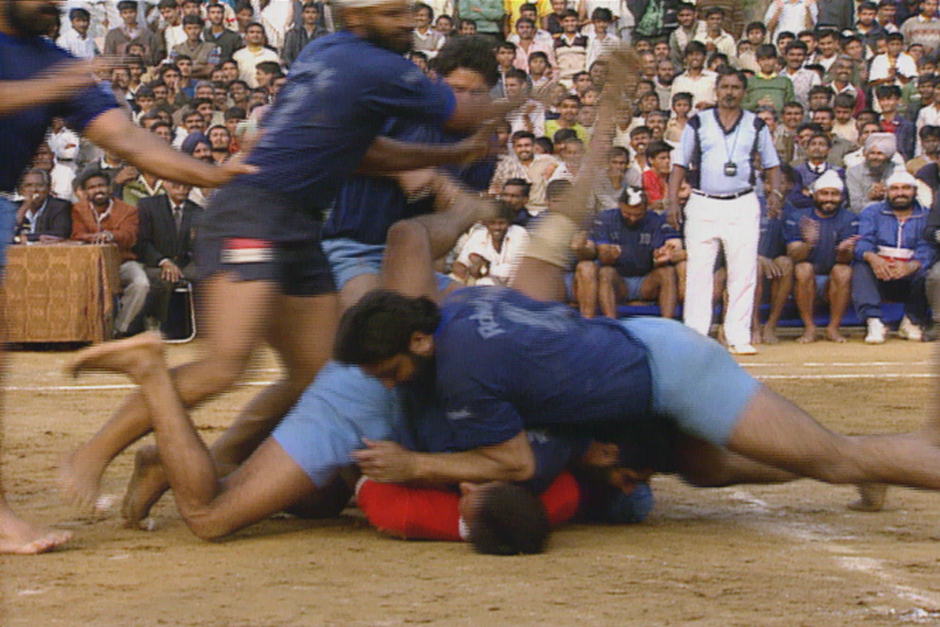
The PKL is a far cry from the original grassroots Kabaddi. Perhaps, most notably, Kabaddi’s iconic chant to prove you’re holding your breath was scrapped. Instead, raids are now timed at 30 seconds. It’s also moved “maidan to mat” and become an indoor sport held in sleek arenas. Sunandan misses some elements of the traditional format. “It doesn’t have the same rustic feel that the original Kabaddi had, with the dust flowing and the chalk being drawn by hand and the audience jumping up and down on seats that are about to break any minute,” he says. This kind of circle Kabaddi is still played via the English Kabaddi Federation, with stop-offs throughout the season in the likes of Hayes, Leicester and Bradford. It takes place on rough-and-ready grass pitches, with topless men flinging fists into bruised torsos, cheered on by non-league-football style crowds.
Equally, though, the new professional standard has helped move the sports forwards. Back in the UK, Kabaddi is once again being broadcast, this time exclusively online via BBC iPlayer, which is showing matches from the British Kabaddi League (of course, as usual, Das is behind it). The public broadcaster even made a documentary about Das, celebrating his unsung work in the community. “They called me the Kabaddi Daddy,” he laughs. And there’s still space for the sport to take new forms; last year, the inaugural World Beach Kabaddi Championship took place (the hosts Iran beat Pakistan).
But one issue, last year, caused a line to be more figuratively drawn in the sand. In August 2023, a tournament in Derby erupted into a vicious mêlée between rival gangs armed with machetes, guns, baseball bats and swords. Several men were seriously injured and seven of the perpetrators were jailed for almost 40 years in November last year. Das laments the incident and makes the distinction between this and the more controlled version he has promoted. “We had such a huge [PR] problem. Because that’s circle Kabaddi. It took me 30 years to bring [rectangular] Kabaddi to this level. The name is the same but is it Kabaddi? No, it’s drugs and violence. We’re not interested in it,” he says. Instead, he emphasises that professional Kabaddi is about respect. “Nobody would ever dare to speak angrily to an official.”
And, crucially, it’s about bringing people together rather than setting them against each other. “Racism is everywhere. But in Kabaddi, there’s no racism. You have Hindus and Muslims and Sikhs and Chinese and Africans [on the same teams]. You have every religion playing together. It’s a diverse sport,” Das says. “If they play and talk to other communities, they can exchange their views” (Channel 4 explored this through Kabadasses in 2011, a sitcom about two friends trying to set up a multi-racial English Kabaddi team).


