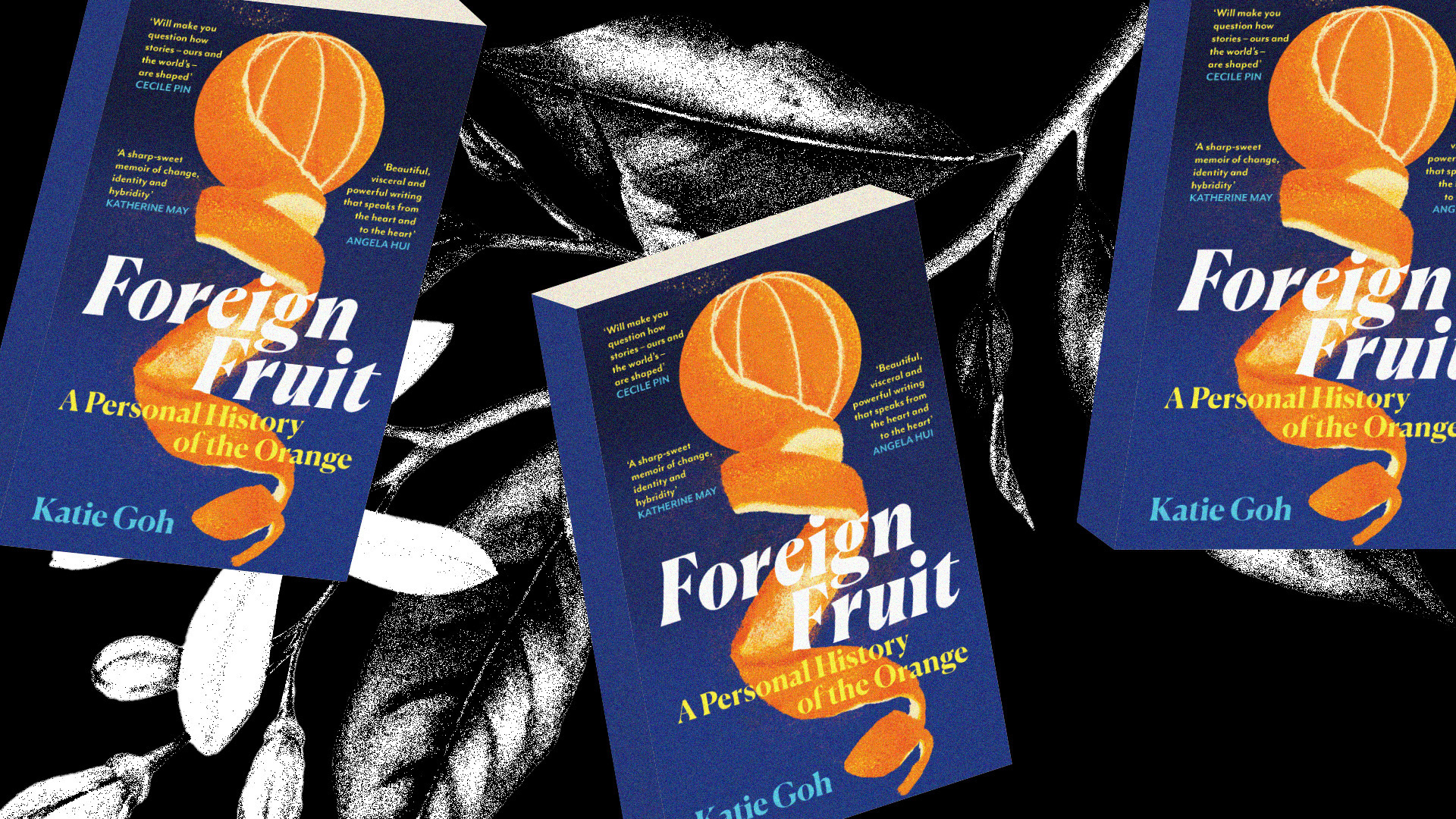
Let’s start with the title of the book Foreign Fruit. I guess, even in the name itself, it feels like such a loaded title that’s deeply personal to you.
Wow, we’re straight in the deep end already. Yeah, you’re right. I kept thinking, ‘Am I the foreign fruit? Trying to make it in an alien environment?’ At the end of the day, it’s a book about oranges, but it was important for me to capture the other side of the book, which is so much about my heritage, especially as a queer woman of East and South East Asian descent, through different times where I felt ‘foreign’ or ‘exotic’. The orange is such a mundane fruit and an object that a lot of us would pick up and take for granted. I suppose in the book, I wanted to ‘other’ the orange a little bit and turn it into this foreign, cringe, beguiling object that moved from China along the Silk Roads to Europe and America. I wanted people to think a little bit differently about something so common. Plus, alliteration is always nice, and the title has stayed like that since the proposal.
Foreign Fruit is described as a ‘hybrid memoir’, which combines memoir, history of the orange, and cultural analysis. How did you approach structuring the book to weave these different threads together?
I’ve always been interested in personal writing that tackles historical big-picture writing but also takes the self into account. I guess, for me, it began with Covid. At that time, there was a sharp rise in Anti-Asian racism and hate crimes. I was looking into finding a way to write about that as a person of mixed race heritage in the UK and how that feels connected to the world and things like diaspora, history and violence. The orange became a useful metaphor and a way of framing how meaning changes and how something can transform over time. I was interested in finding a way to write about yourself that moves beyond the framework of very basic identity politics that are really common in magazines, online articles and newspapers. It’s the sort of writing I used to do a lot of, actually, very topical things – why racism is bad or these black and white moments – but it just flattened people’s experiences. The orange tells us about history, the way it’s moved across the world and also bigger issues like globalisation, climate change and migration. I wanted to capture that hybridity and not feel like I had to segment things into categories. To me, it is what it feels like to be a person in the world. Not one thing is separate from the other, but how it’s a mixture of these things weaving together. This was my attempt at trying to capture that feeling.
Exactly, I feel that as a person of colour, we’re constantly wary of only getting the space to talk about identity, race and pain through a very specific lens. It’s almost this tick-box trauma-mining tightrope.
I did a lot of that style of writing when I first started out as a journalist. I don’t feel like I’m above it at all, but it’s so sad, like, at that time, it was the only way to get into newspapers and magazines. I think that says a lot about the industry more than the individual writers wanting to write about these things.
Considering this, were you wary of sharing intimate details of your life? Especially the moments of seeing your family for the first time after Covid. Was it particularly challenging or cathartic to write these reflective moments?
Yeah, it was emotional to write, but it was also kind of important as well. I really want to capture my experiences, put memories down on paper and have the space to revisit. I don’t think anyone in my family is really angry about it, but I don’t think I’ll go back to our family village for a long time in the future. But it felt special to be more intimate and tender.