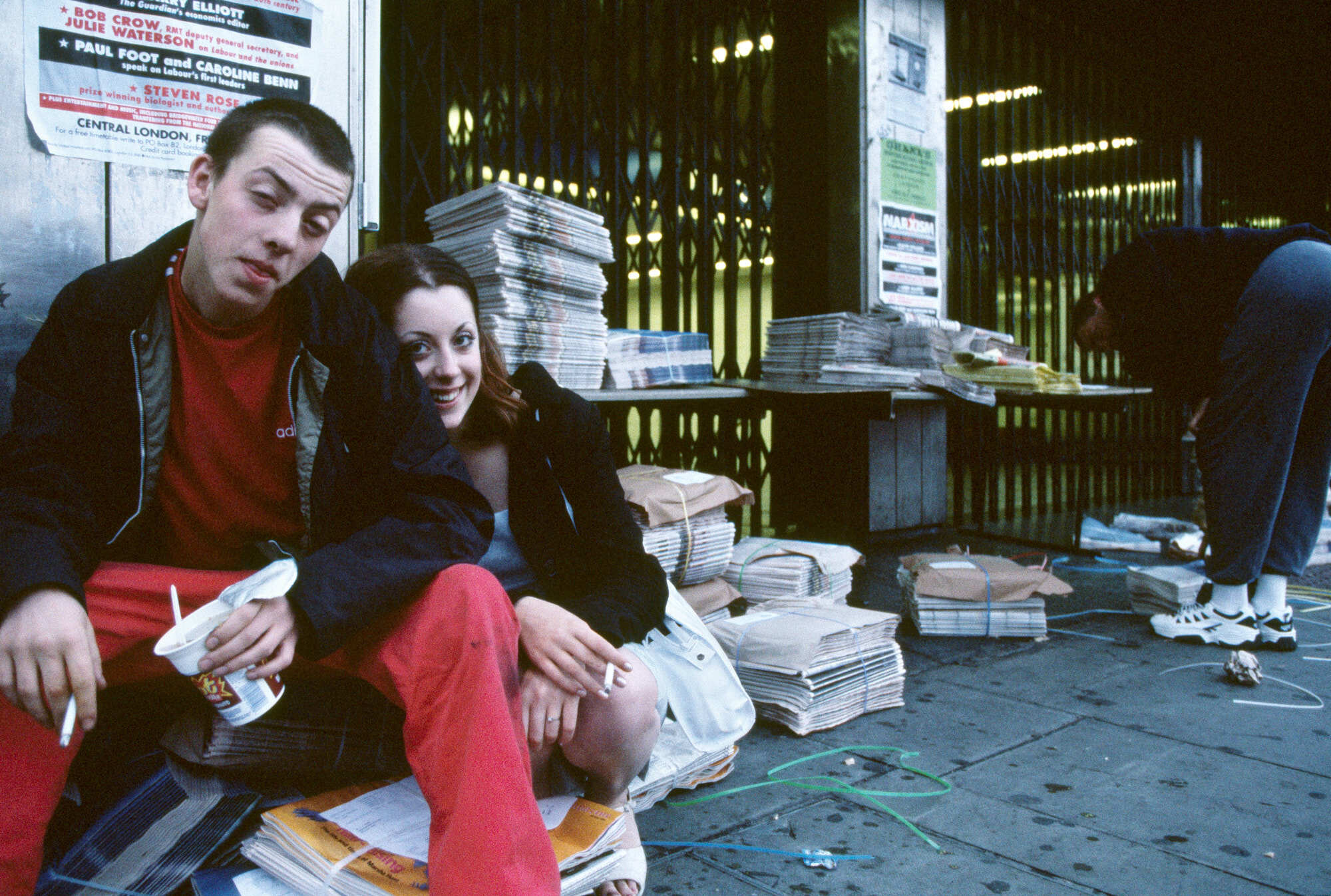
The then 27-year-old had been photographing club-goers for years prior, formerly working as a club photographer in Paris before moving to London in the mid-’90s. It was during his time shooting for women’s magazine Minx (what he calls a female version of Loaded) in the capital, when he noticed just how revered “afters” culture is to the British; this was a phenomenon, he observed, that was built into the city’s day-to-day functioning. “What is amazing is all the infrastructure here, and not just in London, but also in the other cities,” Haller says. “You can get out of a club at 5 am, and there will be some greasy spoon open that actually serves you breakfast!” Post-club feasting features heavily in Haller’s photos – in some, twenty-somethings are surrounded by polystyrene boxes or plates of chips – in others they’re lingering under McDonald’s doorframes or grinning in anticipation through kebab shop windows.
The British reverence for afters goes deeper, though: There’s a feeling of transgression to staying up into the early hours – a past-your-bedtime defiance that offsets the rigid social customs often ascribed to British culture. “I think there’s the desire for the night not to end because you’re having such a great time for five, six hours and you want to go on forever,” says Haller. “But also, when you let go in Britain then you really let go, because it’s a very reserved culture during the day or the week, but then on the weekend the gloves are off and anything is possible.”
It’s a feeling that clearly resonates with people today: Since the photobook was published by the British Culture Archive earlier this year, it has sold out its first and now second editions. “I thought it would take us a year to sell a thousand books. It took us three days. It’s crazy,” says Haller. “I think they struck a nerve because people are almost looking for something real and analogue, because we’re going down into this AI digital tech world and as a counter-product of that we’re looking more and more for something that we can actually feel and touch and be part of and that makes us feel human again.”