Published by .
6 min read
PETA entities worldwide are making waves for mice, rats, hamsters, and other small animals tormented in near-drowning experiments and driven to swim frantically for their lives in a widely discredited and wholeheartedly cruel practice known as the “forced swim test.”
Animals are dosed with substances, trapped in inescapable containers of water, and forced to swim to avoid drowning in the terrifying test. Experimenters assume that when the animals stop swimming and begin floating, they’ve given up, signaling “depression.” But research suggests the test is less reliable than a coin toss in measuring the effectiveness of antidepressants.
That’s why scientists from PETA entities are modernizing scientific policy and practice by pushing companies and institutions from all corners of the world to abandon this scientifically bogus experiment.
And it’s paying off in spades. More than 40 universities, 19 companies, and numerous medical research funders—and counting—have said they will not conduct, fund, or commission the forced swim test following PETA entities global scientific outreach, protests, shareholder resolutions, and e-mails and calls from PETA supporters.
Some international highlights:
Germany
State animal welfare commissioner, Dr. Madeleine Martin, announced in April 2026 that the forced swim test is no longer conducted in Hesse, Germany. Authorities in Brandenburg and Bremen also confirmed to PETA Germany that the forced swim test is not currently being used or planned there.
In June 2026, the German Mouse Clinic at the Helmholtz Center Munich, which breeds genetically modified mice for animal experimentation, told PETA Germany that it no longer uses the forced swim test and confirmed there is no reason to reintroduce it.
Ireland
After PETA UK shared scientific information with Ireland’s Health Products Regulatory Authority, the agency commissioned the country’s National Committee for the Protection of Animals Used for Scientific Purposes to investigate the test and issue advice. The committee found evidence to severely restrict the forced swim test in Ireland.
As of February 2026, the forced swim test is no longer permitted for use as a model of depression or to study “depression-like” behaviors or anxiety disorders because the committee found “questions over its validity for these purposes.” It’s also no longer permissible for experimenters to make animals to swim to the point of exhaustion in Ireland.
United Kingdom
In 2024, following a petition from PETA U.K. and 40,000 supporters, the U.K. Home Office stated its intention to eradicate the FST from the country. Lord Sharpe of Epsom, the Parliamentary Under Secretary of State for the Home Office at the time, accepted recommendations from the Animals in Science Committee, meaning that the FST can no longer be used as a model of human depression or for studies of anxiety and its treatment in the country.

In 2025, the Home Office published statistics on the use of the test in the U.K. in 2024, its first time designating the FST as a “technique of special interest,” and the Department for Science, Innovation & Technology (DSIT) explicitly prioritized the development, validation, and uptake of non-animal approaches to replace the FST in its 2025 roadmap for ending experiments on animals. DSIT wrote that the FST “has limited scientific validity, particularly its translational relevance to human mental health disorders” and “does not pass the harm-benefit test.”
Fifteen universities in the U.K—including Kings College London and The University of Manchester—have confirmed to PETA U.K. that they do not use the FST.
India
After receiving a scientific critique of the forced swim test from PETA India, the Pharmacy Council of India directed all agencies under its purview to review and take necessary action on the continued use of the widely debunked experiment in April 2025.
In February 2026, Chitkara University became the first university in India to formally ban the forced swim test after hearing from PETA India, confirming that it no longer permits the experiment at its institution. Dr. Thakur Gurjeet Singh, Professor and Dean of Chitkara College of Pharmacy, wrote: “In line with the [Pharmacy Council of India] notification, we have ensured that the Forced Swim Test will not be considered or approved for any future academic or research activities.”
Multiple other institutions swiftly followed.
- CT University stated it would “formally adopt a policy prohibiting the use of FST in all current and future research,” after hearing from PETA India. CT University Principal Dr. Vir Vikram also admitted “that immobility in FST is often a learned, adaptive behavior rather than a valid model for human depression,” adding: “Our School of Pharmaceutical Sciences will prioritize human-relevant models, including computational modeling, in vitro human cell studies, alternatives to animal studies, and genomics.”
- Himachal Institute of Pharmacy Principal Dr. Ramandeep Singh confirmed to PETA India: “[O]ur institute has already adopted the policy prohibiting the Forced Swim Test (FST) and supports cruelty-free research methods. This has been implemented in accordance with the circular issued by the Pharmacy Council of India (P.C.I) dated 30.01.2026 and as per the recommendations of the concerned academic and research committees of the institute, in line with the applicable regulatory guidelines and the recommendations of PETA India.”
- Al Azhar College of Pharmacy officially supported a full ban on the forced swim test. In an email to PETA India, Al Azhar’s Principal Professor Dr. Shyamkumar B said they “support the blanket ban on the Forced Swim Test, as alternative methods are available.”
Australia
The University of Melbourne prohibited the forced swim test after hearing from PETA entities, Animal-Free Science Advocacy, and more than 12,000 supporters in 2025.
New Zealand
In 2026, Victoria University of Wellington stopped subjecting animals to the cruel forced swim test following campaigns—including letters to university leaders and eye-catching protests—by PETA Australia, PETA U.S., New Zealand Anti-Vivisection Society, Save Animals From Exploitation, and Beyond Animal Research.
Latin America
After hearing from PETA U.S., numerous universities in Latin America confirmed they do not use or will stop using the forced swim test. Including:
- The Universidad Austral de Chile, where Rector Dr. Egon Montecinos confirmed that the university “has established an explicit prohibition” of the forced swim test “across the entire institution,” in accordance with the official Resolution No. 10/2026 issued by the Vice Rector’s Office for Research, Development and Artistic Creation.
- Brazil’s Universidade Federal de Uberlândia, citing “the fact that our current research lines no longer demand this specific model and, more importantly, because our institution is committed to remaining aligned with international recommendations and the principles of the 3Rs (Replacement, Reduction, and Refinement).”
- Puerto Rico’s Ponce Health Sciences University, stating “PHSU currently has no active or planned research protocols that utilize the forced swim test.”
- Perú’s Universidad Nacional de Trujillo and Universidad César Vallejo, Argentina’s Universidad Nacional de Mar del Plata, and Chile’s Pontificia Universidad Católica de Chile confirmed that the forced swim test is not used on their campuses.
Recent Highlights from the U.S.
In 2025, life sciences company Creative Biolabs and Pennsylvania-based contract research organization Melior Discovery both cast aside the test after hearing from PETA. Both companies previously offered the FST as a service, but now neither will offer or perform it. A Creative Biolabs representative noted that the test is “no longer relevant for drug development efforts.”
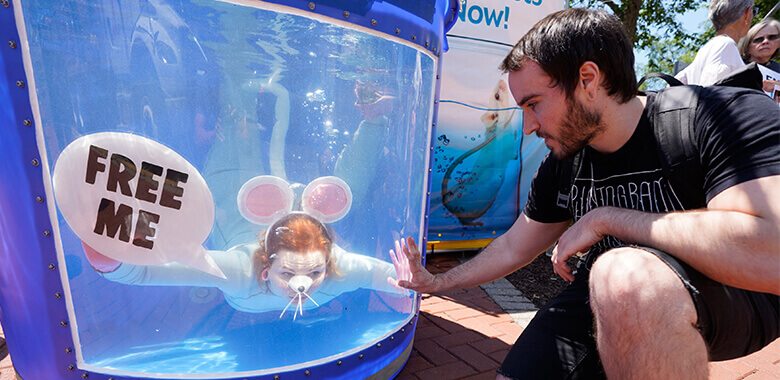
Since 2018, most major pharmaceutical companies—including AbbVie, Amgen, AstraZeneca, Bayer, Boehringer Ingelheim, Bristol Myers Squibb, GSK, Johnson & Johnson, Novo Nordisk A/S, Pfizer, Roche, and Sanofi—have banned the FST after hearing from PETA scientists, shareholders, and hundreds of thousands of e-mails from supporters.
What You Can Do
This monumental progress is saving countless animals around the world from suffering, but there is still more work to be done. Please take action and urge pharmaceutical companies and universities to ban the forced swim test: