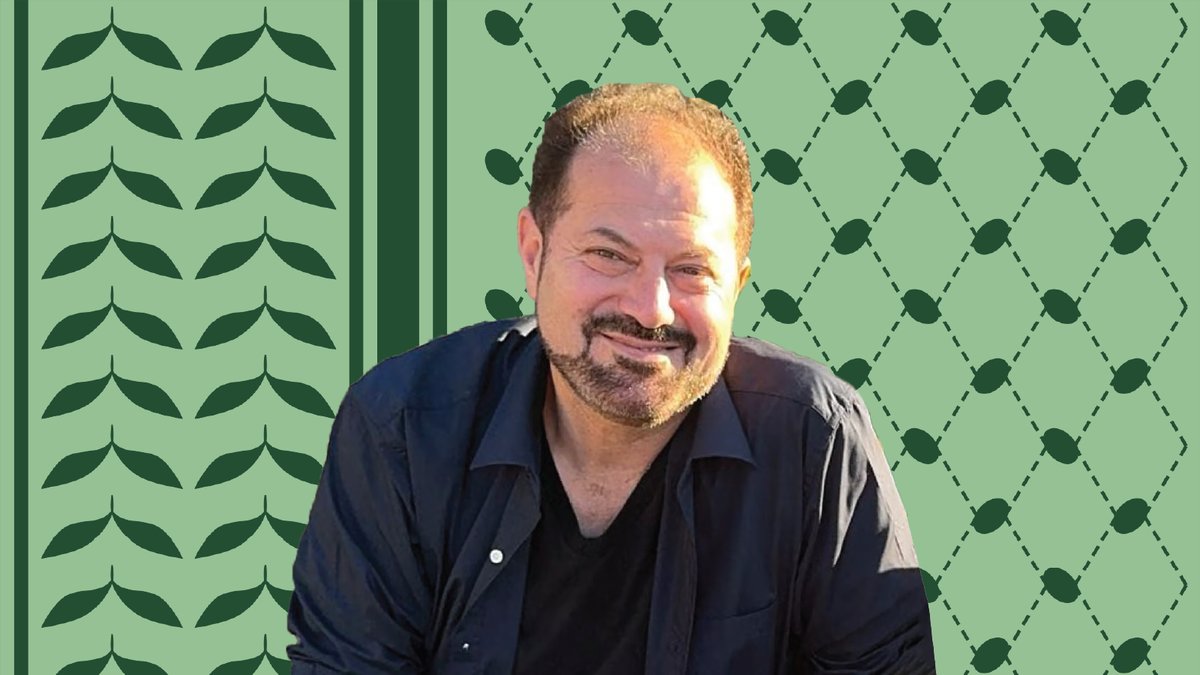

In his first public remarks after being released from U.S. Immigration and Customs Enforcement (ICE) custody, Palestinian American Salah Sarsour, a U.S. permanent resident who has lived in this country for more than three decades, made no mention of the thirty pounds he had lost during his eighty-day detention, and only a passing reference to how cold his cell at the Dale County, Indiana, facility was. What he remembered most was the mail.
“I brought back with me more than 400 letters,” he told community members and reporters at a June 19 press conference at the Islamic Society of Milwaukee, Wisconsin. These came from supporters in multiple states around the country and helped Sarsour, who was released by a Trump-appointed district judge on June 18, maintain hope during his time in custody.
A few days earlier more than 150 Jewish, Muslim, and Christian allies had gathered to protest outside the Indiana facility where Sarsour was being held.
“In the two months since Salah Sarsour was taken from his beloved community here, thousands of Jewish Americans have risen up to oppose the state terror done in our name against Salah and other Palestinians,” Jodi Melamed, one of the lead organizers of a group called Jews for Salah, told reporters about the June 14 protest and the Jewish community’s broader solidarity effort. “We know that Jewish safety depends on protecting a free multicultural, multiracial democracy and that when ICE comes for one, they come for us all.”
Despite his ordeal, Sarsour was optimistic about his case. He thanked Judge James Patrick Hanlon of the Southern District of Indiana for his “fairness,” adding that, “honestly, he gives me hope for the system.”
In his twenty-nine-page order to release Sarsour, Hanlon cited the Milwaukee resident’s “decades of living a law-abiding life in the United States.” The judge said the green card holder, who emigrated from the Occupied Palestinian Territories in 1993, has a “substantial” claim that the federal government violated his Constitutional rights. “Mr. Sarsour’s speech in support of Palestinian rights is protected by the First Amendment,” Hanlon wrote.
The Trump Administration contends that First Amendment rights do not extend to noncitizens, a claim the judge’s order rejects. Sarsour was represented by the New York law firm Beldock Levine & Hoffman and the ACLU of Illinois, the latter of which released a statement upon Sarsour’s release.
“In issuing this order, the federal judge made clear that the government cannot detain a lawful permanent resident for speaking out about Palestinian human rights,” the statement read. The case, it continued, holds “everyone’s free speech rights” in the balance.
The fifty-three-year-old Sarsour is not the first lawful U.S. resident of Palestinian origin to be detained by ICE for allegedly endangering U.S. foreign policy interests. But his case stands out because of his long presence in the country. The other prominent cases, those of Palestinians Mahmoud Khalil and Mohsen Mahdawi, involve younger men who entered the United States more recently to attend college.
Unlike Khalil, who was moved during his detention to a facility in Louisiana, Sarsour was not transfered from Indiana to a third state, where judges might have been more receptive to the Trump Administration’s campaign to strip legal permanent residents of their green cards for “national security reasons.”
The government had asked that Sarsour be released only on cash bail and that he be fitted with an ankle monitor—requests that Hanlon, who determined that Sarsour did not represent a flight risk, denied. “Sarsour has no history of non-compliance and is well established in the Milwaukee community,” wrote Hanlon.
As Sarsour continues to fight the immigration case brought against him by federal authorities, his attorneys are pursuing a case arguing that the government’s actions violated his Constitutional rights. Luna Droubi, one of the attorneys representing Sarsour, told attendees at the June 19 press conference that his detention in the United States was “punitive,” and “in retaliation for his advocacy on behalf of his people.”
“This is about Palestine, but it can affect any other area [of advocacy],” Droubi said.
In the immigration case against him, the Department of Homeland Security alleges that Sarsour lied on his green card application by neglecting to mention that he had been convicted by the Israeli military in 1989 for allegedly throwing stones and a Molotov cocktail at soldiers. Sarsour, who resided in the Israeli-occupied West Bank at the time, has always denied these charges.
Hanlon noted that the Israeli allegations against Sarsour were known to the U.S. government and that immigration officials had more than thirty years to act on them but did not. In the meantime, Hanlon added, Sarsour established a life in America and has never fallen afoul of the law in this country.
Israel’s ongoing occupation of Palestinian territories is illegal under international law. Using a procedure known as “administrative detention,” the Israeli military routinely holds Palestinians in the Occupied Territories without charge, or based on allegations that rely solely on soldiers’ testimony. Palestinians can be held for up to six months at a time, with sentences renewable indefinitely.
Israeli human rights organizations have documented widespread abuse, including torture and sexual violence, in detention facilities. Children, some as young as fourteen, have been detained and denied access to their parents during interrogations, according to B’Tselem, a leading Israeli watchdog organization.
Since the October 7, 2023, Hamas attacks on Israel, the number of Palestinian prisoners from the occupied territories has skyrocketed, with B’Tselem documenting a more than 100 percent increase. Israel’s war on Gaza since then has met the definition of a genocide, according to leading scholars and the Lemkin Institute, named after the Jewish legal scholar Raphael Lemkin, who first coined the term.
Combined, Israel’s earlier assaults on Gaza—including in 2008 to 2009, 2012, 2014, and 2021—killed thousands of Palestinians, destroyed large swaths of the territory, and displaced hundreds of thousands from their homes, including those living in refugee camps.
Israel’s attacks in Gaza have slowed since October 2025, when the United States announced what it called a ceasefire. The term is misleading at best, however, as more than a thousand Palestinians have been killed since the announcement, with a further 3,000 injured, according to the group Medical Aid for Palestinians, which cites figures from the Ministry of Health in Gaza.
Meanwhile, restrictions on Palestinian movement in the West Bank continue, with Israeli soldiers reoccupying parts of the territory and displacing tens of thousands of Palestinians from their homes. The campaign has included violent attacks by Jewish settlers, who are often protected by Israeli soldiers. A recent New York Times column reported on multiple instances of sexual violence, including rape, against Palestinian detainees—cases that have been documented by Israeli organizations such as the Public Committee Against Torture.
A majority of Democrats in the United States support ending military aid to Israel, while recent polls show that a majority of voters under fifty years old from both parties view Israel unfavorably. That shift is beginning to register at the polls, too, with Dr. Adam Hamawy, an Egyptian American surgeon, Army veteran, and outspoken supporter of Palestinian rights—he volunteered to treat the injured in Gaza—winning the June 2 Democratic primary for New Jersey’s Twelfth Congressional District seat. After this November’s election, Hamawy is all but guaranteed to serve in Congress for the reliably blue district.
Republican voters’ views on Israel may have contributed to the Trump Administration’s recent criticism of the Israeli government, especially over its ongoing attacks on Lebanon. But there remains little evidence to suggest that the White House seeks to ease its crackdown on Palestinian solidarity activists in the United States.
As he awaits a verdict in his pending cases, Sarsour has vowed to remain outspoken on Palestinian rights, even as he has recommitted to working for justice in his hometown of Milwaukee. “I am back to serve the community,” he told supporters at the June 19 press conference.
Sarsour also thanked his daughter, who gave birth to his ninth grandchild while he was in detention, for driving to the gathering from Memphis, Tennessee, where she lives. He noted that all his children, including his six sons, were born in the United States. “We belong here,” he said, “and we want to continue to build here.”
Rachel Ida Buff contributed reporting for this story.