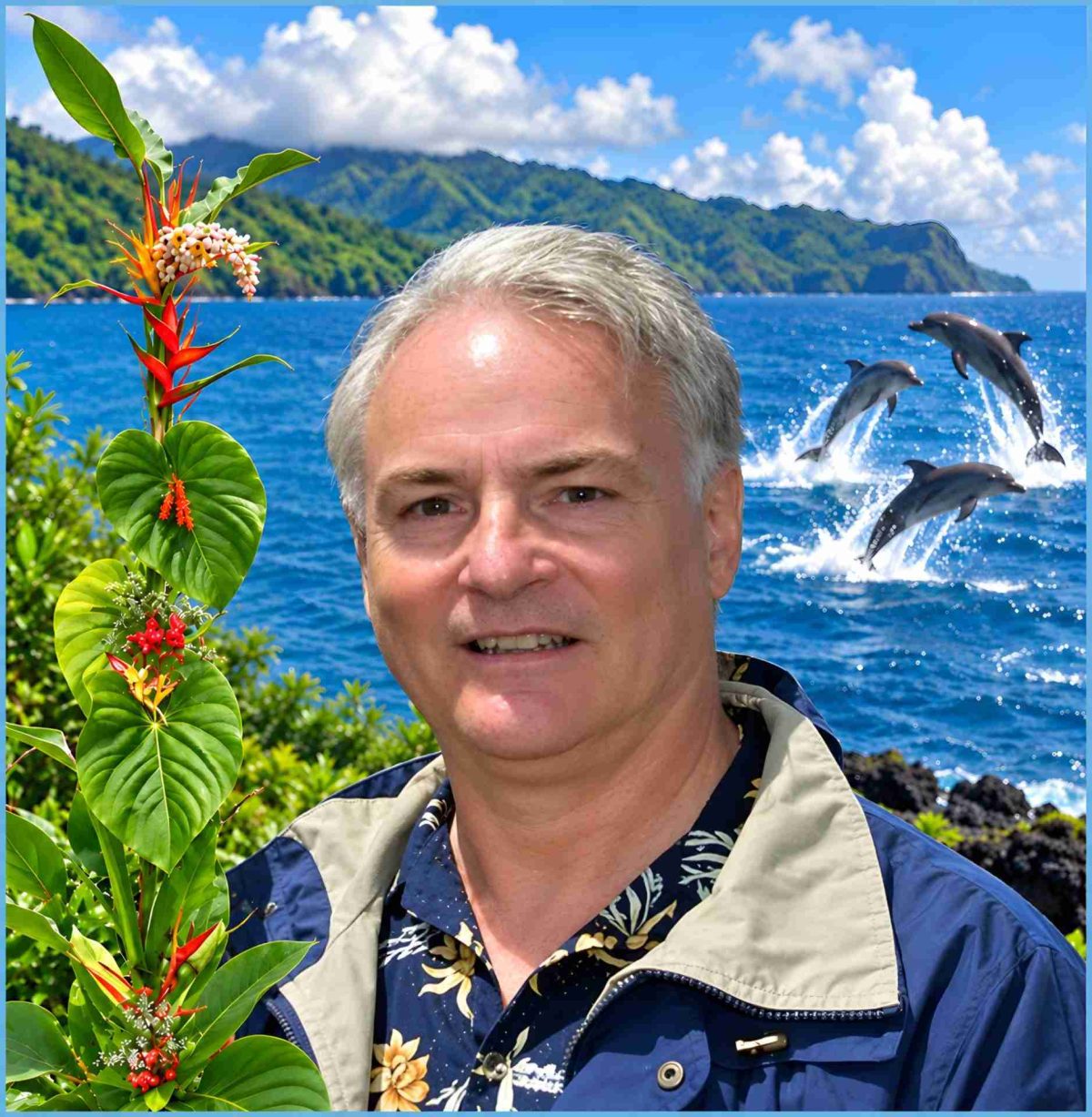

Guest column by Kenneth W. LeVasseur
Editors’ note:
Kenneth W. LeVasseur, of Kaneohe, Hawaii, a dolphin intelligence and communication researcher for more than fifty years, with colleague Steven C. Sipman on May 29, 1977 released into the ocean two dolphins, Puka and Kea, who had been held at the University of Hawaii marine mammal laboratory, where both had worked under Louis M. Herman (1930-2016).
LeVasseur and Sipman then called police, and awaited their arrests.
Both LeVasseur and Sipman eventually did community service sentences.

Inspired by Ric O’Barry
Both LeVasseur and Sipman have continued their work on behalf of whales and dolphins, inspired in part by the work of Dolphin Project founder Ric O’Barry, the former Miami Seaquarium trainer who turned proto-cetacean freedom advocate on Earth Day 1970 by attempting to release a dolphin named Charlie Brown from a marine mammal laboratory in Bimini.
LeVasseur responds below, in part, to What do “rescued” beluga deaths signify for marine mammal captivity?, posted by ANIMALS 24-7 on September 29, 2026.
The article discussed how four of thirty beluga whales evacuated from the defunct Marineland of Niagara in Niagara Falls, Ontario, Canada, during July and August 2026 have died at their new homes, three of them at the Shedd Aquarium in Chicago, along with a fifth beluga who was already at the Shedd Aquarium.

Another beluga has died
Since then, yet another beluga from Marineland of Niagara has died at the Shedd: Caspian, a 27-year-old female. That leaves six survivors of the emergency transfer still at the Shedd.
What do “rescued” beluga deaths signify for marine mammal captivity? extensively quoted from an essay headlined “Finding homes for whales and dolphins when parks like Marineland Canada close isn’t easy – a biologist explains why sea sanctuaries aren’t the answer,” by Jason Bruck, published on September 23, 2026 by the online magazine The Conversation.
Bruck is an associate professor of biology at Stephen F. Austin State University in Nacogdoches, Texas. Bruck also holds a variety of uncompensated positions with entities involved in the cetacean captivity industry.
–––––––––––––––––––––––––––––––––––––––––––––––––––––––––––

“Cetacean captivity is a failed technology”
Please pause for a minute and think about what cetacean managed care truly means for cetacean captives. Try to use some empathy.
“Any time while I was a slave, if one minute’s freedom had been offered to me, and I had been told that I must die at the end of that minute, I would have taken it just to stand one minute on God’s earth a free woman.”
― Elizabeth Freeman (1744-1829)
Cetacean captivity is a failed technology, and on so many levels, especially those technological developments and questions noted by cetacean captivity advocate Jason Bruck in recent opinions and articles.
Instead, Ric O’Barry is right!
What is wrong with cetacean captivity and cetacean association with humans – is the involvement of humans!

“Cetaceans have no homes as humans know them”
Instead of expanding the technology of “managed care,” researchers would be studying and implementing the science involved in captive cetacean release into their native habitat if they are looking out for the best interests of the captive cetaceans as Bruck implies.
Jason Bruck’s recent opinion piece in The Conversation, “Finding homes for whales and dolphins when parks like Marineland Canada close isn’t easy” misses the whole point in his effort to defend the managed care of captive cetaceans, better known as captivity.
The major problem is human management of events and circumstances that humans do not have enough information about to manage competently despite decades of effort.
Cetaceans have no homes as humans know them.
That is the first indication that Bruck’s opinion will not be scientific and will be based on inadequate information to evaluate competently.

“To cetaceans, their social network and their native habitat is their home”
The vast majority of cetacean species are social and in order to bring cetaceans into captivity, the individual cetaceans have to be violently separated from their social networks. This traumatizes the individual and damages the social network they leave behind in their native habitat.
To cetaceans, their social network and their native habitat is their home, if you need an analog. To not recognize that principle is to ignore the science in cetacean science.
Yet in the natural environment of cetaceans, the scientific study of various species have occasionally found them in new social configurations of two or sometimes more species.
The more we study cetaceans in their natural environments, the more we learn how little we know about them; yet it was determined decades ago that it would be acceptable to violently separate them from their social networks and remove them from their native habitat.

“Best practices do not involve longterm human presence”
And now when things fall apart in their managed care because it is not acceptable, there is no interest in returning the captives to their original social network’s native habitat where their extended family may still travel.
In Bruck’s case very little is said about the environment and location where the belugas and associated dolphins came from. At one point in another piece he does mention Russia broadly but avoids mentioning the dozen orcas and 90 belugas captured in 2018 and all released back into their native habitat a couple of years later, with one orca and three belugas killed in the effort, as reported by CBS and National Geographic.
Bruck’s positions in his opinion pieces are not scientific, they are technological.
All the points Bruck makes about managed care are about the technology of managed care, with nothing about the science of what is involved for the captives, which in all best cases is release into the cetaceans’ native habitat and the social network the captives were born into and lived in until their social network and their own lives were so negatively affected.
The best practices in all these cases do not involve long-term human presence.

“Managed care has no scientific part in cetacean release scenarios”
The next best options still do not involve long-term human presence, but involve as close a natural habitat to the cetaceans’ original habitat as much as possible, with scientific evaluation.
Managed care has no scientific part in cetacean release scenarios, and the natural habitats involved, because managed care is always human exploitation, no matter how much effort is made to make it sound noble.
All cetacean managed care requires a business model, and all cetacean managed care business models involve the exploitation of the captive cetaceans involved for human benefit.
Bruck demonstrates the lack of science in his suggested opinions by making no effort to disclose where the captives involved lived before their capture. Apparently, repatriation into natural habitat is not an option in his opinion.
This is likely because such a strategy would emphasize the failures of captivity for decades and how kidnapping cetaceans damages social networks.

“An unscientific bogeyman”
In the past, repatriation was discouraged because the concept was being used by cetacean captivity enthusiasts to create an unscientific bogeyman to resist the obvious best practice.
Now, after emerging from a global pandemic, there is so much more science about disease and contagion that has been generated that repatriation can be substantially more scientifically evaluated and not simply dismissed out of hand.
Yet the fact that so much science will shed so much more light on the failures of captivity has scared away the false advocates and veiled captivity enthusiasts from using the anti-repatriation argument that they are now doomed to lose.
This is the genre Bruck’s opinions fit into.

The sleeping science students in the back of the class have been awakened because the science professor has drifted off subject and is trying to cast captive cetacean management as science when it is simply technology.
You do not manage cetacean science, you manage cetacean technology, and more technology benefiting humans is the last thing that captive cetaceans need.
Please donate to help our work:
More related posts:
Discover more from Animals 24-7
Subscribe to get the latest posts sent to your email.