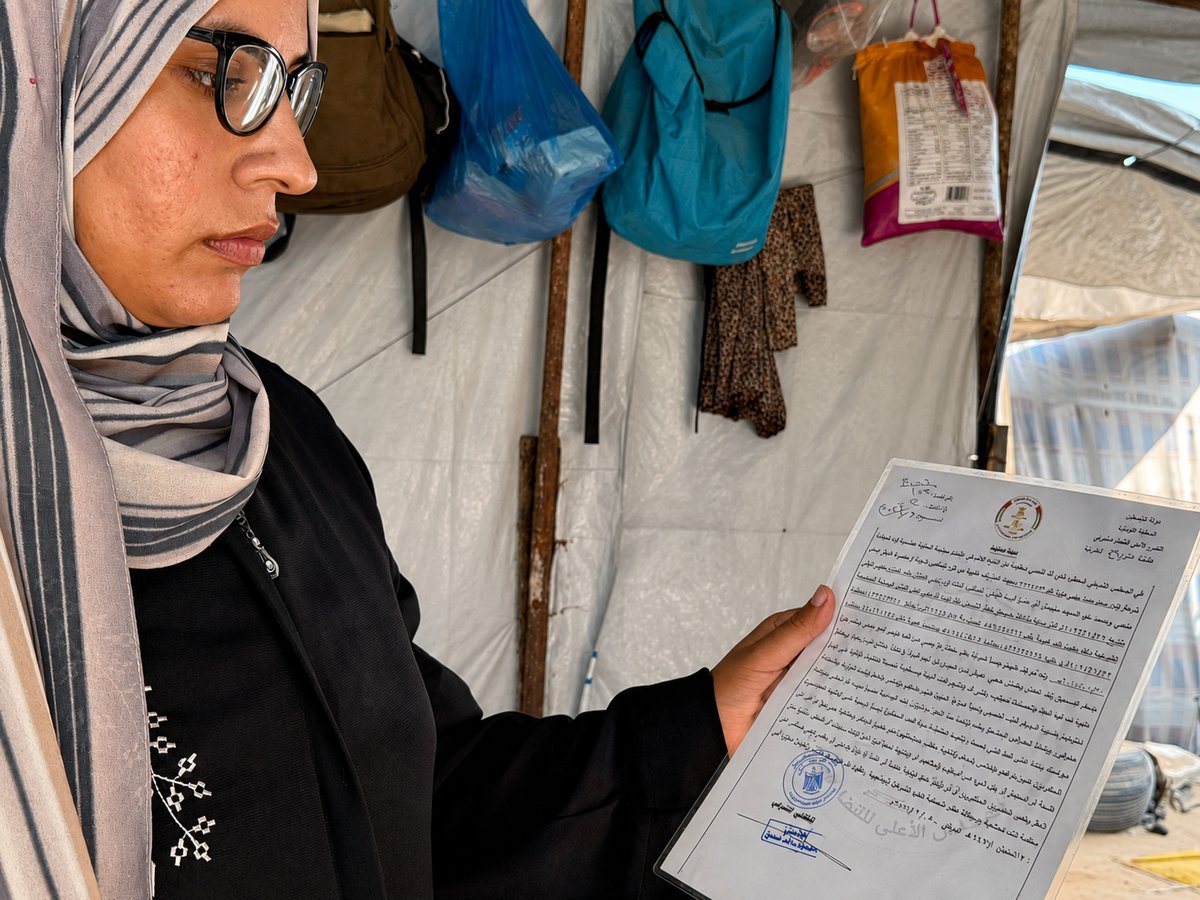

Mohammad Al-Jamal holds his nephew Omar’s hand whenever the boy needs to go to court or complete an official procedure. Omar, who is not yet ten years old, does not know much about the papers his uncle carries or why he needs them. All he knows is he has lost his family and his home, and that his uncle is the only person left by his side.
On October 15, 2023, the Al-Jamal family’s home in Gaza’s al-Nuseirat refugee camp was bombed by Israel. Omar’s mother, Suad Al-Jamal, was among those killed, while Omar was rescued from beneath the rubble in critical condition.
Five months later, another Israeli strike hit the Abu Zayed family, killing around thirty-five members of Omar’s family. Omar survived once again, but his siblings and father were killed, making him the sole survivor of his immediate family.
But Omar did not lose only his family and home. He also lost the documents that proved his identity and his family’s ownership of their home—documents he may one day need to establish legal rights and titles.
Mohammad says Omar’s mother had kept the family’s papers, including documents proving ownership of the home, as well as her children’s birth certificates and identity cards. They were buried with her under the rubble caused by the first strike, inaccessible to the survivors.
Mohammad became Omar’s legal guardian in September 2024, six months after Omar’s father was killed, and obtained a document from the Deir al-Balah court in central Gaza confirming his guardianship. But he later lost that document when Israel bombed the Nuseirat camp in November 2025.
Between the loss of documents and the killing of family members, Omar now faces a significant challenge: How can he prove his rights to the property his family left behind if the documents proving those rights were buried with them?
In Gaza, the war has destroyed homes and killed people—but it has also destroyed documents and records that establish identity, family relationships, property ownership, and legal rights. The loss of civil documents, including birth certificates and travel-related paperwork, can later complicate official procedures such as questions of inheritance and guardianship.
According to the United Nations Office for the Coordination of Humanitarian Affairs (OCHA), an estimated 30 to 40 percent of people in Gaza have lost their identity documents during displacement in the first three months of the war, according to Protection Cluster data—a number likely higher after three years of Israeli attacks and bombardment. In the context of medical evacuations, humanitarian organizations have reported that the loss of identity documents has become an obstacle for some people who need travel documents or accompanying relatives who hold passports.
In 2025, the United Nations found 83 percent of women in Khan Yunis and Rafah reported losing property documents, while 71 percent reported the same in the northern Strip’s Gaza Governorate. Between 48 and 80 percent of women surveyed reported discrimination or barriers to claiming housing, land, and property rights.
These figures point to a problem that extends beyond the loss of a single piece of paper. When a property deed, birth certificate, or identity card disappears, people may need alternative ways to prove information was previously documented. In a society where more than a million have lost homes and tens of thousands have lost family members, the evidence required to establish those details may have also been destroyed or lost.
According to Sheikh Hassan Al-Jojo, head of the Supreme Council of Sharia Judiciary in Gaza—part of a religious judicial system in Palestine that oversees cases related to personal status and Islamic law—Sharia courts have completed more than 358,000 cases since the beginning of the war through the end of May 2026, including custodial procedures involving orphans and minors. The courts have handled death-certification procedures for about 10,000 people who remained under the rubble or could not be buried because of wartime conditions, Al-Jojo says, along with related procedures concerning heirs and the rights of wives, children, and minors. All the while, he says 50 percent of Sharia court buildings were destroyed during the war, while paper archives of Sharia proceedings were burned by the Israeli military, including records dating in part to the Ottoman era.
For Fidaa Haji, thirty-three, the issue of guardianship began with another loss. In November 2023, her husband was killed in a massacre in Gaza City targeting his family, while Fidaa and their four children survived. She suddenly found herself alone, without property ownership documents and unable to support the children on her own amid war and displacement.
A year and a half later, she decided to remarry in the hopes of finding someone who could help her care for her family. But her new father-in-law, who remains in the hospital to treat kidney failure, asked Fidaa to transfer guardianship of the children to him. The move would grant him access to the children’s finances, which includes rights to their deceased father’s property, any aid they receive from the Palestinian government or humanitarian organizations, and any future compensation that is part of reconstruction efforts. Fidaa refused.
“He has kidney failure and needs to stay in the hospital, so how will he be able to support the children and take care of them?” Fidaa says. “I got married hoping to find someone to help me care for them, but instead, problems began over the guardianship of my children.”
After the loss of her husband and amid the uncertainty of war, Fidaa has found herself having to navigate legal procedures to keep guardianship of her children. She sees guardianship as more than simply an administrative procedure or a legal document. It shapes who has the right to care for and make decisions regarding her children, represent them in official procedures, and receive assistance on their behalf.
“All I want is to protect my children, raise them, and be able to provide for their needs,” Fidaa says.
For the Hassouna family in Deir al Balah, lost documents have made it hard to establish inheritance rights. In October 2023, several of eighty-eight-year-old Intisar Hassouna’s adult children were killed in an air strike. Based on Palestinian law, Intisar was entitled to a share of her middle-aged sons’ estates. But the family home, which represented a significant part of the sons’ assets, was also bombed and destroyed. The family could not access their other land due to Israeli military occupation in Gaza, while the documents related to both properties had been buried under the rubble, complicating the question of inheritance.
“At that time, the war was ongoing. The house had been bombed, and we could not even reach the land or determine its exact size,” says Fayez Hassouna, Intisar’s eldest son. “The courts were closed, the [property documents] had been damaged, and we felt that people’s lives were more important than following up on inheritance procedures.”
The legal procedures remained suspended until Intisar died nearly three years later. She left three surviving sons, who then began the process of dividing their mother’s estate. But the children of the sons who had been killed before Intisar died objected. According to Fayez, the case became more complicated because two estates were intertwined: the estates of the sons who died first, and then the estate of their mother, who had inherited from them while she was still alive.
“The problem is that we did not complete the inheritance process for my mother when it could have been done,” Fayez says. “She was alive when her sons were killed, so she was entitled to a share of their estates. But we put the matter aside because of the war. Three years later, she died too, and suddenly we had another inheritance to divide.”
According to Fayez’s account of what took place at the Deir al-Balah court, the judge explained that the grandchildren would not inherit from their grandmother in the way they had believed, because their fathers had died before Intisar. She therefore inherited from them, and what she received subsequently became part of her own estate after her death.
“During the war, we were not thinking about the house or the land. We were thinking about how to survive,” Fayez says. “But after my mother died, we discovered that everything we had postponed was still there, and the problem had become bigger because the number of deaths had increased, the heirs had changed, and the house itself no longer existed.”
As buildings are destroyed, records disappear, and land boundaries change due to Israeli occupation, determining ownership may become even more complicated during reconstruction. A joint assessment by the United Nations, European Union, and World Bank estimates that Gaza’s recovery and reconstruction needs will reach $71.4 billion over the next decade, with more than 371,800 housing units damaged or destroyed. But rebuilding structures alone will not resolve the question of who owns them or who owns the land on which they stood.
Rebuilding homes may take years, but establishing ownership and the rights of those who lived in them will likely take even longer; rebuilding legal rights may become part of the broader struggle to rebuild life itself. Palestinians will continue to have to grapple with challenges of proving these rights when the documents that once answered these questions have been buried beneath the rubble.