Paid search marketers spend a lot of time optimizing what happens before the click.
You build and refine targets, test creative, and analyze search terms.
However, one of the biggest sources of performance gains often happens after the click.
When a campaign underperforms, it’s easy to assume the problem is targeting, bidding, audience quality, or creative. Sometimes that’s true. But often times, the issue is that visitors arrive on the landing page and don’t know what to do next.
Marketers are also facing a second challenge. More customer journeys now involve AI experiences before a website visit ever occurs. LLMs and agents are increasingly becoming the consumer’s personal shopper, curating recommendations and influencing—or even deciding—their final purchases.
That’s why modern marketers need modern insights that help answer two questions:
- How are AI systems discovering and representing my brand?
- What happens after someone reaches my website, especially if AI referred them?
Microsoft Clarity helps answer both questions in a privacy compliant way.
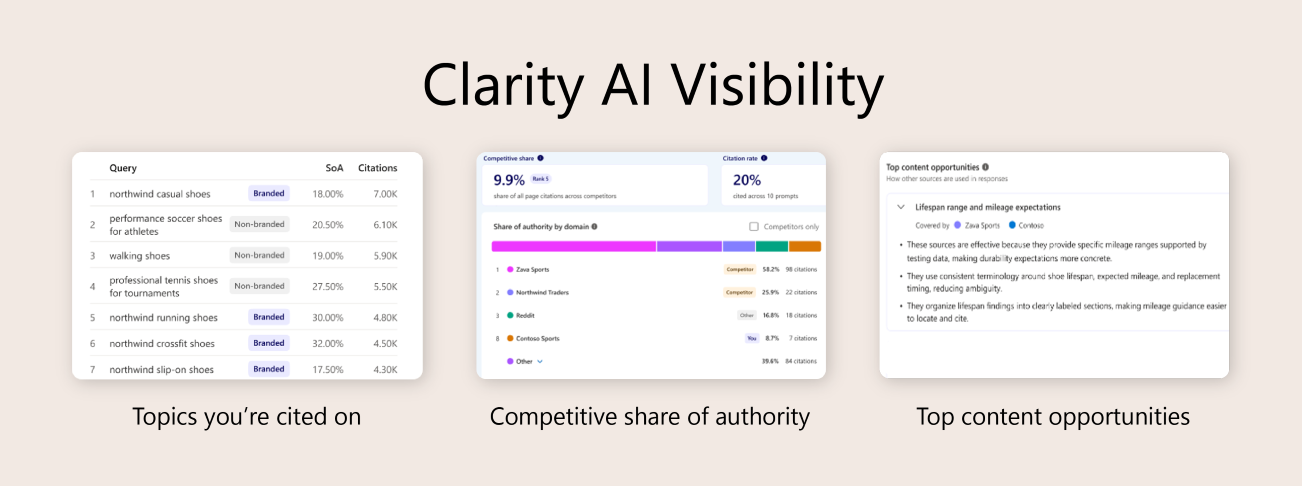
Clarity’s AI Visibility capabilities help marketers understand how AI systems discover, interpret, and cite their content. AI Visibility includes reporting on grounding queries, citations, share of authority, and competitive topic visibility, helping marketers understand how AI systems retrieve and reference information about their brand.
Its behavioral analytics capabilities then help marketers understand what visitors do after they arrive.
Together, these insights create a more complete view of the customer journey.
Pair search term transparency with new AI grounding query insights
Paid search marketers live and breathe search terms. You use them to understand customer intent, identify new opportunities, refine targeting, and improve campaign performance. Microsoft Advertising uniquely supports full search term transparency for any query resulting in a click, making search terms one of the most valuable optimization tools available to marketers.
However, AI-powered discovery works differently than traditional search.
When a person enters a search query, there’s typically a direct relationship between what they type and the results they receive. AI systems take a different approach. A single prompt often triggers a process called query fan-out, where AI breaks a complex question into multiple retrieval queries designed to gather information from different angles before generating a response.
For example, someone might ask an AI assistant: “What’s the best CRM for a mid-sized B2B company with a long sales cycle?”
Before generating an answer, AI may fan that prompt out into multiple retrieval paths focused on topics such as:
- B2B CRM platforms
- CRM solutions for mid-market businesses
- Long sales cycle customer management
- CRM implementation considerations
- CRM platform comparisons
Before generating an answer, an AI system translates a single human prompt into multiple retrieval and grounding queries — run in parallel, grounded against web content, then synthesized into one response.