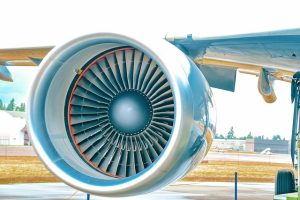

Compressor blades play an important role in jet engines. They are designed to compress air before moving it to the combustion chamber. Once in the combustion chamber, the highly pressurized air is mixed with fuel being ignited. Ignition, of course, creates hot gases as a byproduct, which are typically ejected out the back of turbojet engines. To learn more about compressor blades and how they work, keep reading.
What Are Compressor Blades?
Compressor blades are exactly what they sound like: long metal blades that compress a jet engine’s incoming air. As they spin, they suck in air while simultaneously squeezing the air molecules together. This process increases both the pressure and temperature of the air before it enters the jet engine’s combustion chamber.
Compressor blades are available in many different materials, some of which include the following:
- Titanium alloy
- Nickel-based super alloy
- Composites
The 2 Types of Compressor Blades
Most jet engines have two different types of compressor blades: rotors and stators. Rotors are the primary spinning blades connected to the shaft. Stators, on the other hand, are fixed blades found behind the rotors.
Rotors are designed to suck in air — similar to how a typical fan works. Stators don’t actually suck in air. Instead, they are designed to slow down the incoming air so that the pressure can build up. Most jet engines feature pairs of rotors and stators that work together to assist in the combustion process.
Why Jet Engines Use Compressor Blades
Jet engines use compressor blades to maximize their power and performance. Airplanes, of course, fly at high altitudes. Many commercial airliners have a cruising altitude of roughly 35,000 feet. The air at high altitudes such as this is very thin. If jet engines simply sucked in ambient air from the outside, airplanes would struggle to generate sufficient lift. They would experience a weak combustion process that manifests in the form of low propulsion.
Jet engines’ combustion chambers need more air molecules to overcome the thin air at high altitudes. Compressor blades offer a solution. The compress the incoming air so that more air molecules can squeeze into the engine’s combustion chamber.
Do All Jet Engines Use Compressor Blades?
Compressor blades are commonly found on jet engines that burn a mixture of fuel and air in a combustion chamber. Turbofans, turbojets and turboprops, for instance, all use compressor blades. With that said, not all jet engines use them.
Ramjets don’t use compressor blades. Ramjet-powered airplanes are very fast — so much that the air naturally compresses at it enters the engines. Scramjets also don’t use compressor blades. Like their ramjet counterparts, they fly at fast speeds, which allows the air to compress naturally from speed alone.