After analyzing more than 500 mammoth bones, researchers found that ancient humans disproportionately hunted female mammoths for reasons still unknown
/https://tf-cmsv2-smithsonianmag-media.s3.amazonaws.com/accounts/headshot/Sara_-_Headshot_thumbnail.png)
:focal(2016x1171:2017x1172)/https://tf-cmsv2-smithsonianmag-media.s3.amazonaws.com/filer_public/0c/47/0c47a6d0-7d89-4b9a-8466-7cbd9162cb43/2_img_4244_webb.jpg)
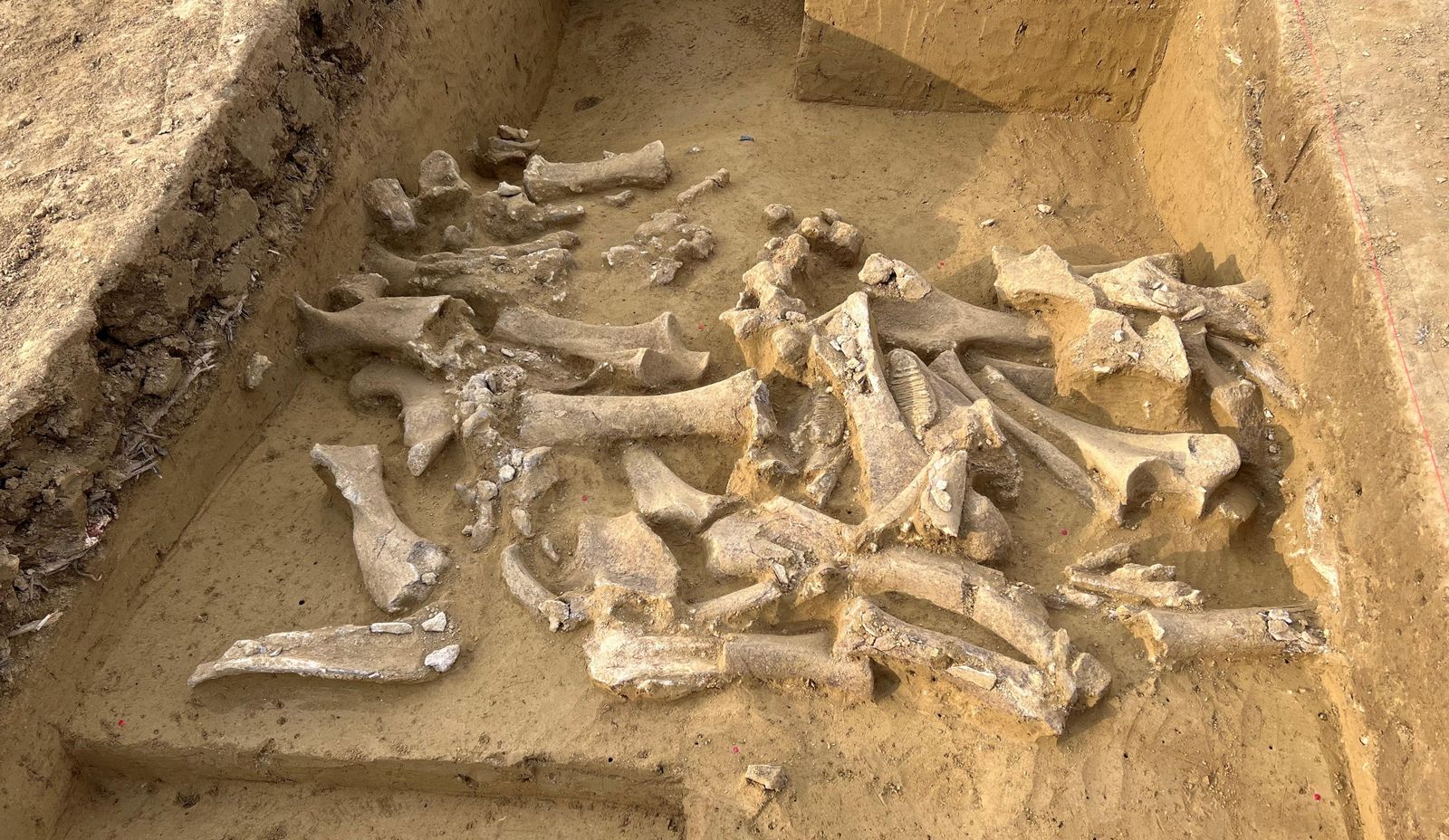
A collection of mammoth bones in a pit in Austria
Marc Händel / Austrian Academy of Sciences
Before their extinction, woolly mammoths (Mammuthus primigenius) were an important resource for Ice Age hunters. The animals provided meat and fat for food, thick hides for clothing and shelter covering, and ivory for art and ornaments. Now, a new study has found that our ancestors mostly targeted female mammoths.
Since the 1800s, archaeologists have uncovered massive accumulations of mammoth bones that have left them puzzled. Some argue that human hunters created the piles, while others believe the bones amassed after the animals died of natural causes.
To learn more about these sites, an international team of researchers analyzed ancient DNA from 521 woolly mammoths, including 100 individuals recovered from 11 human-associated bone accumulation sites from 20,000 to 30,000 years ago and 421 mammoths from natural deposition settings across Europe and North America. They found that males made up 66 percent of mammoths recovered from natural settings, whereas females accounted for 70 percent of individuals from human-associated bone accumulation sites.
The findings, published in the journal Current Biology yesterday, provide new information on the hunting habits of ancient humans. “By scaling up sample sizes, ancient DNA can go beyond evolutionary history to teach us about animal behavior and human culture tens of thousands of years ago,” says study co-author Love Dalén, an evolutionary geneticist at Stockholm University, in a statement.
The researchers still aren’t sure why this disparity exists between hunted males and females. “While it is tempting to assume that hunters would have targeted females because they were smaller than adult males, the reality may have been more complex,” says study co-author Hannah Moots, an archaeologist at the Centre for Palaeogenetics in Stockholm, Sweden, in the statement.
Did you know? DNA was preserved for 52,000 years in freeze-dried woolly mammoth remains
- In 2024, scientists used a piece of skin from a well-preserved female woolly mammoth found in Siberia to reconstruct the three-dimensional architecture of its DNA. This feat helped researchers understand how the mammoth’s genes behaved, while also providing insights into the conservation of other animals living today.
Woolly mammoths traveled in sex-segregated herds, so one possibility is that like modern elephants, female mammoths moved across the landscape more predictably than males. “One could also speculate that it would have been easier to pin down a herd with juveniles, where the females would have been reluctant to run away,” Dalén tells Will Dunham at Reuters, since females traveled with juveniles of both sexes.
Another possibility, according to the researchers, is that solitary males were more likely to die in natural traps, such as sinkholes or landslides, explaining why there are more of their bones in natural settings.
What’s more, the researchers also discovered a mammoth XX/X0 mosaicism, a genetic condition known as Turner syndrome in humans, where an individual has some cells with a single copy of the X chromosome, and two in others. It’s the first time the condition has been documented in an extinct species.
“I was amazed,” says Julia Gresky, an anthropologist at the German Archaeological Institute in Berlin who wasn’t involved in the study, to Christa Lesté-Lasserre at New Scientist. “But of course, we’re all mammals. So why wouldn’t they have genetic mutations like we do?”
Overall, the findings offer a new perspective on how ancient humans interacted with and exploited woolly mammoths, and provide strong genetic evidence that many mammoth bone accumulations were formed through human activity. But Audrey Rowe, a paleoecologist at the University of Alaska Fairbanks who wasn’t involved in the study, tells New Scientist that while the findings are interesting, they may also point to something darker.
“The elephant in the room, so to speak, is a new line of evidence that humans contributed to the extinction of mammoths,” she says to the outlet. “Sadly, they probably didn’t realize they were contributing to the thinning of their own resources over time.”