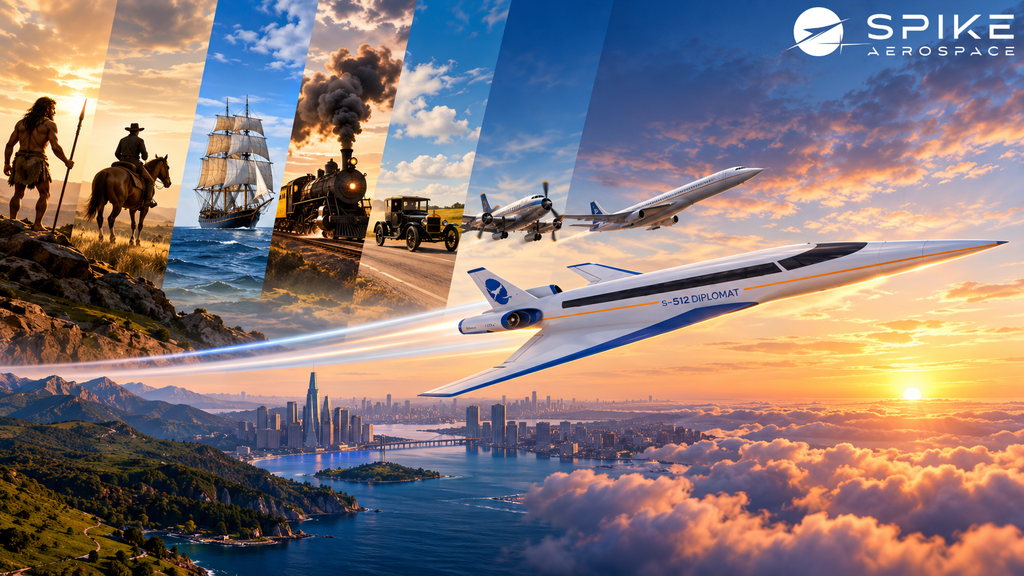
For most of human history, transportation has followed a remarkably consistent trajectory: we have tried to go faster, farther, more safely, and more reliably.
We walked, rode horses, built ships and railroads, invented automobiles, and eventually took to the air. Propeller aircraft gave way to jets. Each generation pushed against the limitations inherited from the one before it.
Then something strange happened.
We stopped getting much faster.
The first generation of commercial jetliners entered service nearly 70 years ago. Today’s aircraft are vastly safer, quieter, more efficient, more reliable, and capable of flying much farther. But in one important respect, the passenger experience has barely changed: we aren’t getting there much faster.
Why?
The Jet Age Changed the World — Then Speed Plateaued
When the Boeing 707 entered commercial service in 1958, it helped transform long-distance travel. Journeys that once consumed enormous portions of people’s lives could suddenly be measured in hours.
The decades that followed brought extraordinary progress. Aircraft became safer and more reliable. Engines became quieter and more efficient. Range increased dramatically. Materials, avionics, navigation, manufacturing, and airport infrastructure all improved.
Yet cruise speeds remained remarkably similar.
Concorde was the spectacular exception. It entered commercial service in 1976 and crossed the Atlantic at roughly twice the speed of sound. New York and London were suddenly separated by about three and a half hours.
Concorde proved that supersonic flight was possible, but its noise, fuel consumption, sonic boom, operating constraints, and economics limited the market it could serve. When Concorde retired in 2003, commercial aviation did something unusual for a transportation industry: it went backward in speed.
I think we took the wrong lesson from Concorde. The problem wasn’t that people didn’t value speed. The problem was that speed alone wasn’t enough.
The lesson from Concorde wasn’t that people don’t want to travel faster. It was that speed alone isn’t enough.
We Haven’t Stopped Valuing Time
If anything, I think time has become more valuable.
Businesses operate globally. Supply chains span continents. Families and colleagues live thousands of miles apart. Investors, engineers, scientists, executives, entrepreneurs, and government officials routinely work across multiple time zones.
At the same time, we have spent enormous resources eliminating delay everywhere else. Broadband replaced dial-up connections. Smartphones put information in our pockets. Video conferencing connects people across continents instantly. Logistics networks move packages around the world with extraordinary precision.
So why should transportation be the exception?
I have a phrase I use from time to time: “More is better.” When it comes to travel, I’m tempted to adapt it: “Faster is better.”
Of course, that’s not always true. Faster isn’t better if it makes an aircraft impractical, uneconomic, excessively noisy, or unsafe. But when speed can be achieved responsibly, it gives something back that none of us can manufacture more of: time.
Saving several hours isn’t simply about arriving earlier. It can mean avoiding another night away from home, conducting business on another continent and returning sooner, or reaching a customer, factory, negotiation, patient, family member, or crisis when time matters.
Sometimes the scarce resource isn’t fuel or money. It is time.
The Challenge Is Making Speed Practical
We already know how to fly faster than sound. I think the more interesting question is whether we can make supersonic transportation practical enough to become a meaningful part of aviation.
A new generation of high-speed aircraft has to address challenges Concorde could not fully solve:
- Reduce the sonic boom enough to make overland supersonic flight acceptable
- Reduce airport and community noise
- Achieve useful range with reasonable fuel consumption
- Operate within existing airport infrastructure
- Meet modern safety, environmental, and certification requirements
- Produce economics that work for owners, operators, and passengers
Those are difficult problems. But aerospace has a long history of solving difficult problems.
The tools available today are also very different from those used to design Concorde. Computational fluid dynamics, optimization, composite materials, improved propulsion, sonic-boom modeling, digital engineering, advanced manufacturing, and increasingly artificial intelligence give engineers capabilities earlier generations did not have.
None of this guarantees commercially viable supersonic travel. But I believe it gives us good reason to ask the question again.
Speed Changes Geography
This is where I think the case for high-speed aviation becomes much bigger than simply building a faster airplane.
Transportation doesn’t merely shorten trips. It changes our perception of distance. Railroads changed where people could live and work. Automobiles reshaped cities. Jet aircraft made routine international business possible. Each major advance made previously distant places more accessible.
Supersonic transportation could change geography again. A city that feels like an eight-hour journey away becomes very different when it can be reached in three or four hours.
The real product of high-speed transportation isn’t speed. It is access.
That changes which meetings are practical, which business relationships can be maintained, where companies can operate, and how frequently people can see customers, colleagues, friends, and family.
I also don’t think the first practical next-generation supersonic aircraft has to replace today’s airliners. New transportation technologies often begin with customers who value their advantages most. That could mean business aviation, premium commercial service, government transportation, medical missions, or applications we haven’t considered yet.
What Do We Have to Solve?
At Spike Aerospace, we have spent years thinking about what it would take to make practical supersonic travel possible. That means looking beyond speed to the combination of aerodynamics, propulsion, sonic boom, range, airport compatibility, certification, operations, and economics that determines whether an aircraft is genuinely useful.
We don’t have every answer, and I don’t think anyone else does either. No single company, university, government agency, engine manufacturer, supplier, or research organization holds every piece of this puzzle.
That is one reason I want to explore these questions more openly. There are extraordinary people throughout aviation, aerospace, universities, government, finance, manufacturing, and technology who have pieces of the solution. Some will agree with our assumptions. Others will challenge them, point out problems we have overlooked, or suggest approaches we haven’t considered. I want to hear from both.
For thousands of years, humans have worked to travel faster, farther, more safely, and more reliably. I don’t believe that ambition suddenly ended when commercial jets arrived in the late 1950s.
The question isn’t whether aviation was fast enough in 1958.
It’s what we have to solve so aviation can start getting faster again.