


When you think about unruly passengers, the first things that probably come to mind are drunken brawls, passengers trying to open aircraft doors, and flight attendants receiving physical and verbal abuse. Whether you’ve traveled with them or simply read about them, those types of passengers truly leave a lasting and dreadful impression.
However, there’s one type of unruly passenger behavior that doesn’t generate as much commotion, yet still causes disruption and safety risks to flights: in-flight smoking, which is categorized as an unruly passenger non-compliance incident.
According to an International Air Transport Association (IATA) safety report published in 2023, the smoking of cigarettes, e-cigarettes, vapes and puff devices in the cabin or lavatories is one of the most common unruly passenger incident types under non-compliance.
Unlike other forms of unruly passenger behavior, though, smoking on flights was once allowed, even encouraged. So why do people still try to smoke inside planes despite the act being prohibited on all commercial flights since 2000? And why do new aircraft still have ashtrays?
Let’s first take a look at the history of in-flight smoking to see how this act, once considered glamorous, became prohibited, and why, despite regulations, it remains irresistible to some.
Smoking in flights
From the 1920s all the way through to the 50s, smoking was mistakenly thought to have almost no negative consequences on health. When mass production of pre-rolled cigarettes arrived during the last quarter of the 19th Century, a number of anti-tobacco campaigns discovered that smoking caused stunted growth in children and was harmful to pregnant women.
At the same time, major tobacco companies actively engaged with physicians to use them in marketing and counter these negative discoveries being made about smoking.
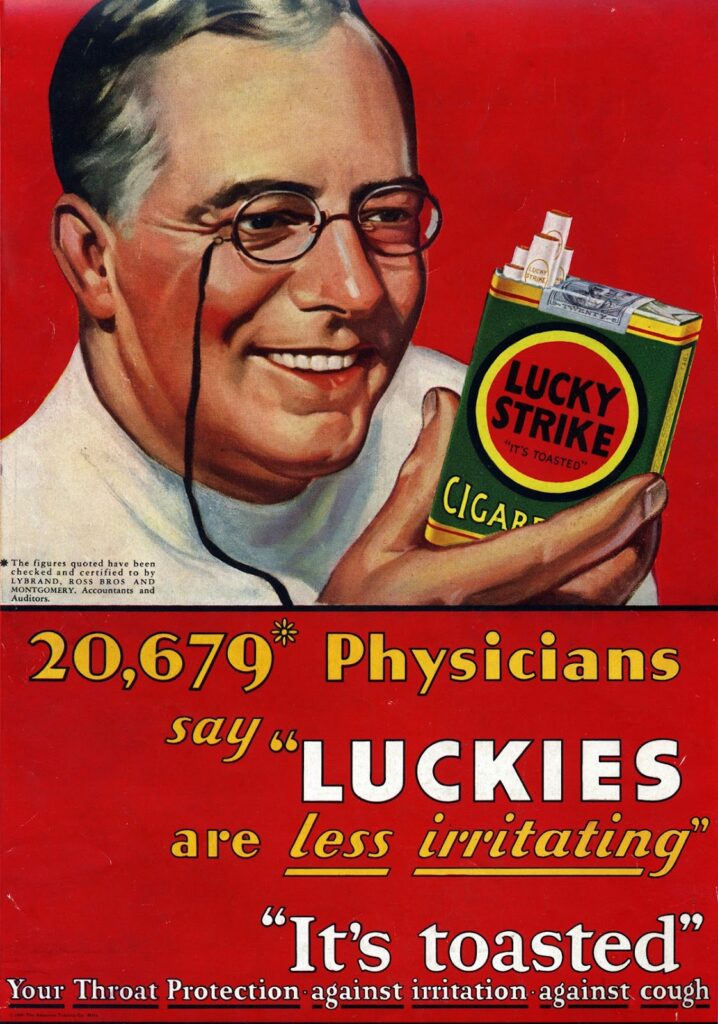
American brand Lucky Strike was one of the pioneering cigarette companies of the 1920s and one of the first to engage doctors to promote cigarettes, along with physician-backed claims that smoking protected the throat from irritation.
Traditionally, doctors held authority, and patients trusted their expertise. As cigarette health concerns arose, tobacco companies strategically used the powerful phrase “doctors recommend” from the 1930s to the 1950s, associating it with cigarettes. Despite cigarettes causing… pic.twitter.com/8ZhEo7YnFM
— History Photographed (@HistoryInPics) November 28, 2023
With the heavy and aggressive marketing of doctors promoting smoking, the technique became widely accepted for decades.
Upon the arrival of the Golden Age of Hollywood, along with the emergence of civil aviation as the latest frontier (1930s-50s), tobacco companies turned to these two industries for marketing. As a result, smoking and cigarettes became not just socially acceptable: they were now openly associated with glamour, sophistication and adventure.
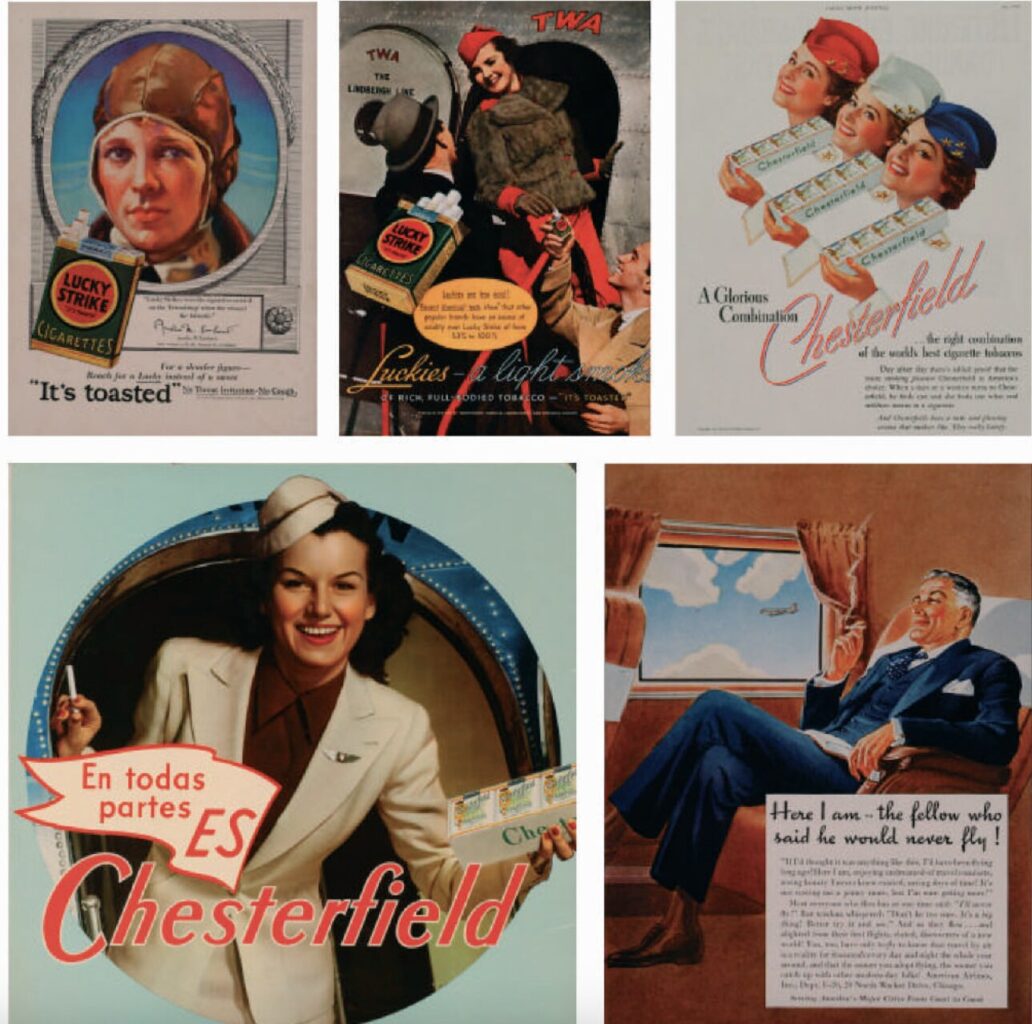
From the 1950s to 1970s, smoking was extremely commonplace on flights. Indeed, complimentary sample cigarette packs, complete with airline branding, were often given away by flight attendants.

Trans World Airlines (TWA) was the second US airline to fly the Boeing 707-300 jet. TWA, which ceased operations in 2001 when it merged with American Airlines, branded their B707 jets as ‘StarStream Jets’ and commemorated the launch of B707 operations in 1959 with a branded cigarette sampler, distributed on flights and in airport lounges.
Image: Famri.org

In 1963, the marketing division of the R.J Reynolds Tobacco Company proposed the idea of providing free samples of its cigarettes at 50 military bases and 15 airlines, with personalized branding.
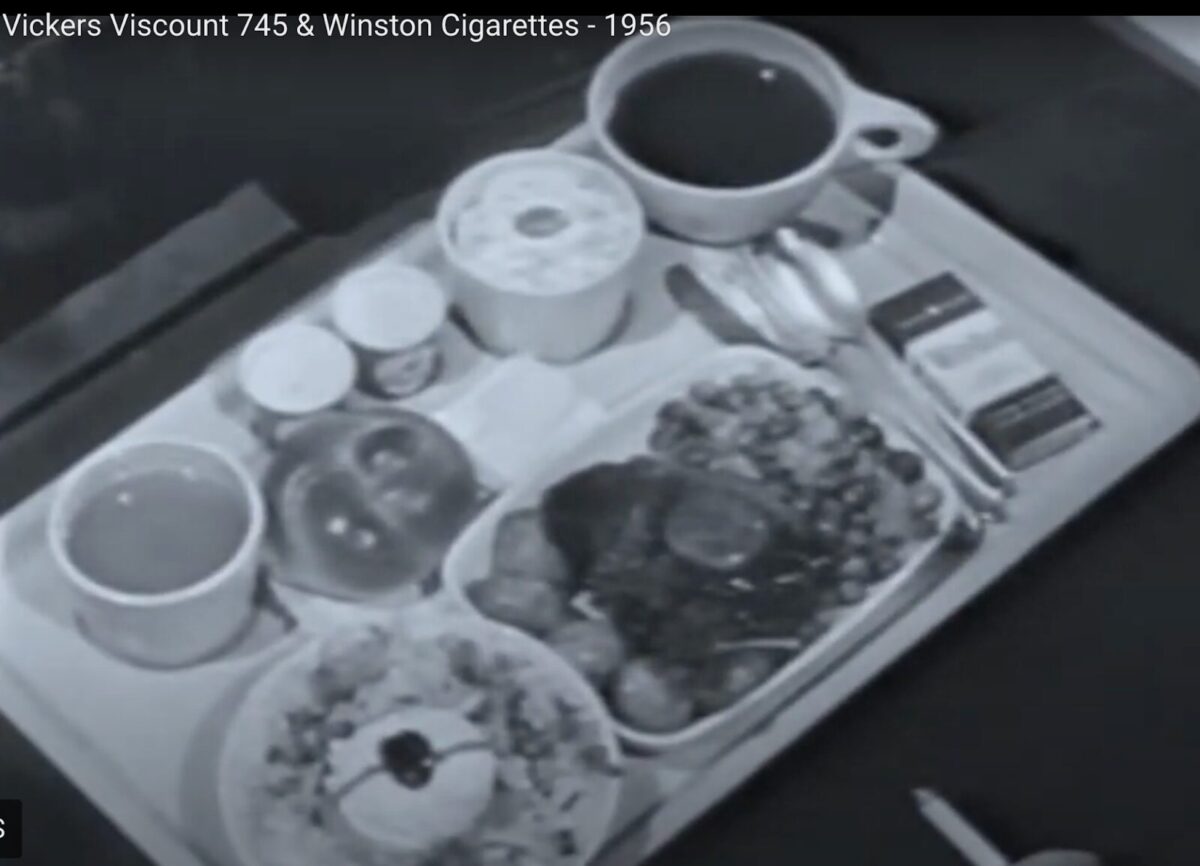
As seen in this 1956 ad for Vickers Viscount, a British medium-range turboprop airliner which operated from 1948-2009, cigarette packs could be part of an in-flight meal tray, along with coffee, bread rolls and dessert.
This 1965 ad for Newport Cigarettes shows not only passengers but also an aircraft pilot smoking during a flight, casually mentioning to his co-pilot that the new menthol cigarettes by Newport had a “fresh” taste.
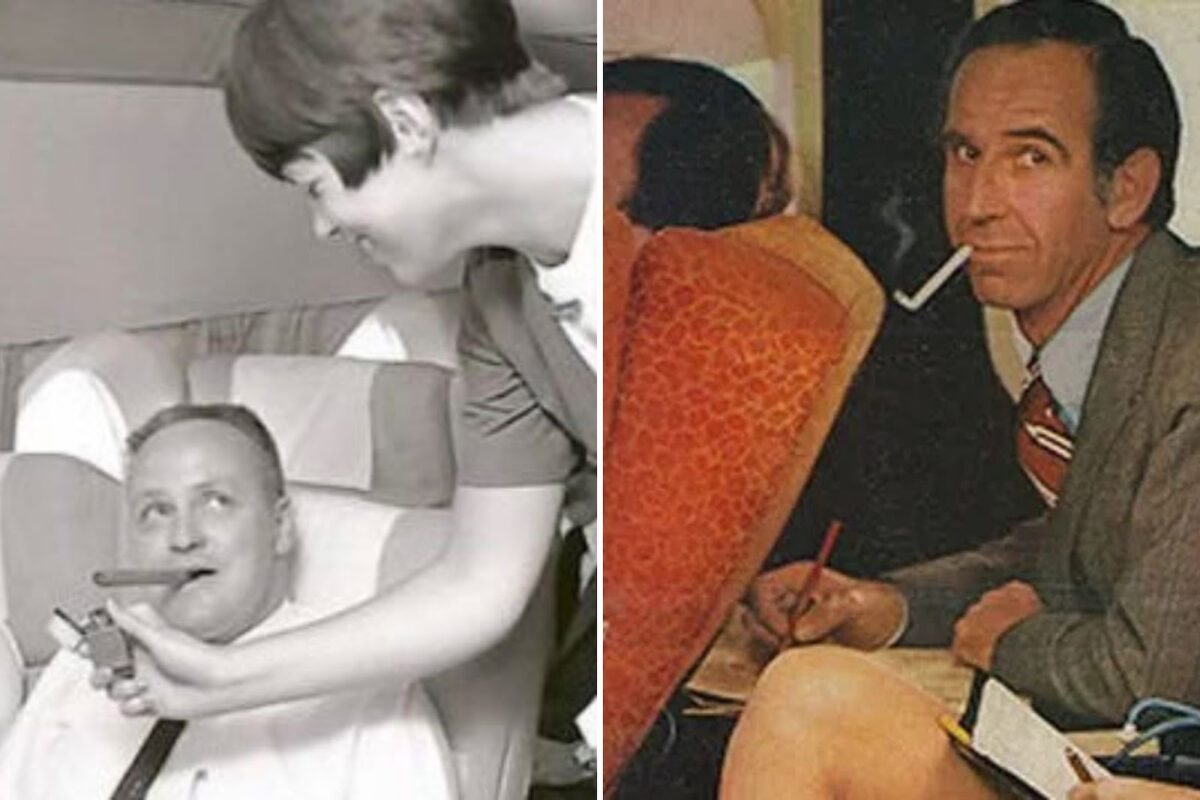
As much as smoking was encouraged during those years, airlines still had policies when it came to smoking cigarettes inside the aircraft.
The University of Alabama published an undated page sample of an airline’s smoking policy. This document can be found at the Louis A. Turpen Aviation Museum and Library in San Francisco.

Based on the document, smoking was only allowed during a flight’s cruising altitude, unless the flight was under “hazardous conditions” or the No Smoking sign was on.
Up in smoke: the end of the smoking era
How did smoking go from being encouraged to prohibited on flights?
The link between smoking and deteriorating health problems, particularly lung cancer, only became widespread in 1964 when US Surgeon General Luther Terry published a report on smoking and health.
According to the report, in June 1961 the American Cancer Society, the American Heart Association, the National Tuberculosis Association, and the American Public Health Association addressed a letter to President John F. Kennedy, in which they called for a national commission on smoking, dedicated to “seeking a solution to this health problem that would interfere least with the freedom of industry or the happiness of individuals”.
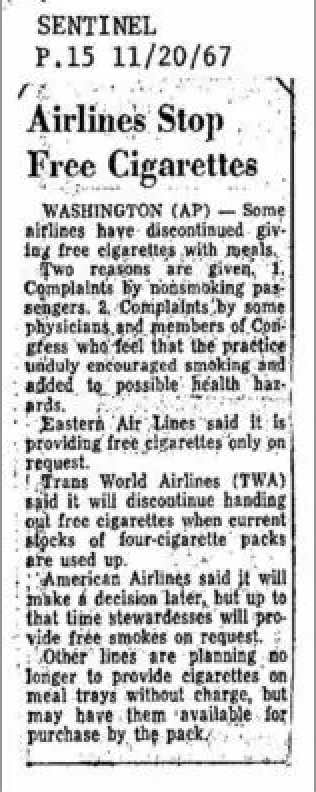
In 1967, a number of US airlines discontinued the distribution of free cigarettes along with meals, due to complaints from non-smokers, physicians and members of the US Congress.
Some airlines, such as American Airlines and Eastern Air Lines, decided to provide cigarettes only upon request, and TWA discontinued the handing out of free cigarettes.
During this time, passengers were still allowed to smoke on flights using their own cigarettes.
In August 1971, American Airlines became the first carrier to create non-smoking sections inside its aircraft. It first debuted the concept on its flights from New York John F. Kennedy Airport (JFK) to Phoenix Sky Harbor International Airport (PHX), providing three rows inside the aircraft where smoking was not permitted.

According to the organization Action on Smoking and Health (ASH), passengers loved the idea of a non-smoking section. American Airlines then extended the practice on more destinations, increasing the non-smoking area to more rows, then half the cabin, until the entire cabin became a smoke-free zone many years later.
Between the years of 1976-1988, the US government engaged in a decade-long push and pull battle with tobacco companies to eradicate smoking on flights. In 1976, the now-defunct US Civil Aeronautics Board (CAB) banned tobacco and cigar smoking on US flights, but ended up relaxing the ban in 1978 due to pressures from giant tobacco firms.
Congressional action in 1987 finally paved the way to ban smoking on flights. In 1988. US airlines banned smoking on domestic flights lasting less than two hours. In 1990, the ban was extended to all domestic flights under six hours.
In 2000, groups of flight attendants sought legal damages for diseases they believed had been caused by their long-term exposure to tobacco smoke in airline cabins.
As a result of the settlement of a class action lawsuit brought on behalf of non-smoking flight attendants in October 1991 against cigarette manufacturers, the Flight Attendant Medical Research Institute (FAMRI) was formed.
Currently, FAMRI sponsors scientific and medical research on the prevention, early detection and treatment of health problems caused by exposure to tobacco smoke. FAMRI also educates health care providers about diseases related to second-hand smoke.
In 2000, smoking was finally banned on all domestic and international flights in the US.
Other airlines and countries all over the world followed suit. Airlines in Japan banned smoking on international flights in March 1999; Turkish Airlines also prohibited smoking on all its flights in the same year. In 1997, the European Union (EU) prohibited smoking on all flights for its member countries. Australia banned smoking on all of its flights from 1996.
The last two countries to place a ban on in-flight smoking were Cuba (in 2014), and China, which only announced a ban on smoking on all flights in 2017 and still gave its airlines two years to comply.
Why are ashtrays still part of newly manufactured aircraft?
If smoking has been banned in domestic and international commercial flights in the majority of the world since the year 2000, then why do we still find ashtrays even on newly-manufactured aircraft?
A 2022 study shared by the National Institutes of Health (NIH) found that while some individuals follow norms and regulations, a number of individuals are still tempted to break organized rules, especially when the act is beneficial to them. In other words, people will still violate and break rules and regulations.
Airlines and governing organizations such as the Federal Aviation Administration (FAA) and IATA are aware of this, which is why ashtrays are still found on aircraft both as a safety measure and a reminder that smoking is in fact not allowed – despite the confusing message this might send.
Ultimately, it is better to have safe disposal of cigarettes in the event that the non-smoking rule is violated, rather than risk a disaster such as a fire starting in the cabin.
Currently, ashtrays are part of the International Civil Aviation Organization (ICAO)’s Minimum Equipment List (MEL) for an aircraft to operate.
An ICAO Minimum Equipment List (MEL) is a document that is developed by the aircraft operator and approved by their national airworthiness authority, that specifies which equipment can be inoperative under certain conditions while still allowing an aircraft to operate safely.
Can you smoke on private planes?
Ideally, smoking should not happen on any type of flight, but the answer to this question is yes.
Steve Varsano, founder and CEO of The Jet Business and part of Embry-Riddle Aeronautical University’s Board of Trustees, provided a very simple explanation.
@thejetbusiness #stevevarsano #thejetbusiness #privatejet ♬ original sound – The Jet Business
Varsano said that flying on a commercial plane is the same as being in an office building or a restaurant–you’re in a public space, that’s why passengers have to adhere to rules.
Flying on a private plane is like driving your own car instead of taking public transport, so you can indeed do anything you want – including smoke.


