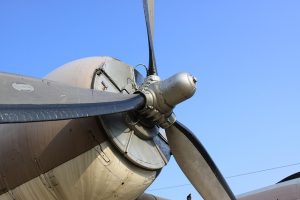

Not all airplanes are powered by turbofan engines. Statistics show that roughly four in five civilian airplanes use propeller engines. Propeller engines feature a gas turbine core that turns a propeller blade. As the propeller blade turns, it pulls air backward to propel the airplane forward. There are different types of propeller systems for airplanes, however, including full feathering.
Overview of Full-Feathering Propellers
A full-feathering propeller is a type of variable-pitch aircraft propeller that allows the blade to move into a feathered position. They essentially move edge-first into the wind direction to minimize drag when the engine is no longer running.
How Full-Feathering Propellers Work
When a propeller engine stops, the blade will typically continue to spin. Known as windmilling, this spinning action creates a lot of drag. Full-feathering propellers are designed to counter windmilling. The pilot can set the propeller for the failed engine to the feather detent position. This causes the blade to rotate until the flat sides are aligned with the wind. When the blade is properly aligned, it will stop spinning. The end result is less drag.
Common Types of Propellers
There are several common types of propellers, most of which can be classified as fixed pitch or variable pitch. Fixed-pitch propellers are characterized by a fixed blade angle. The angle at which they strike the air can’t change and, instead, remains the same at all times.
Variable-pitch propellers are characterized by an adjustable strike angle or pitch. The blade angle can change to match various conditions. Full-feathering propellers fall under the latter category. Rather than fixed-angle blade, they feature an adjustable-angle blade. The blade of full-feathering propellers can rotate until parallel with the wind. Once in the feathered position, the blade will stop windmilling.
Why Feathering Is Important
Propeller feathering is important for several reasons. When an engine fails or otherwise stops running, the propeller blade may continue to spin, which as previously mentioned, creates drag. Drag, of course, can make it difficult for pilots to maintain a safe altitude. By setting the propeller to the feathered position, pilots can eliminate windmilling-related drag.
Propeller feathering can also protect the engine from further damage. When left unchecked, windmilling can cause mechanical damage. The fast-spinning blade will strain internal components like the crankshaft or bearings. Feathering protects against such damage by aligning the blade with the wind.