
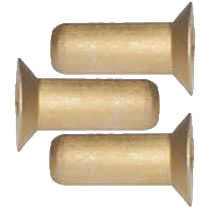

If you’re planning to install solid rivets, you may need to use a bucking bar. Solid rivets are permanent fasteners featuring a solid shank. They are used to secure two or more parts. A solid rivet is inserted through the parts, after which the tail is deformed. While there are different ways to deform the tail and “set” the rivet, one of the most common methods involves a bucking bar.
What Is a Bucking Bar?
A bucking bar is a handheld tool that’s designed to support the back of a solid rivet during installation. It’s typically made of heavy-duty metal, such as stainless steel or tungsten alloy. Aircraft mechanics commonly use it in conjunction with a rivet gun to install solid rivets.
There are different types of bucking bars. Some of them have flat faces, whereas others have angled faces. You can also find them in different shapes and sizes. Regardless, they are all used to install solid rivets. The term “bucking,” in fact, refers to the process of backing up the tail of a solid rivet while it’s being compressed.
Prevents the Rivet From Pushing Through the Hole
A bucking bar prevents solid rivets from pushing all the way through the hole during installation. When installing a solid rivet, you’ll need to insert it through the parts. A bucking bar is then placed behind the parts and against the rivet’s tail. Next, a rivet gun is used to repeatedly strike the rivet’s head.
As the rivet gun strikes the rivet’s head, the bucking bar creates resistance. It prevents the rivet from simply pushing through the hole. Instead, the rivet’s shank and tail will deform. This deformation helps to hold the rivet in place so that it’s highly resistant to loosening from mechanical forces like vibrations.
Assists With the Formation of the Shop Head
In addition to creating resistance, a bucking bar assists with the formation of the shop head. The shop head is the deformed head that occurs during installation. By pressing a bucking bar against the rivet’s tail, you can create a shop head using a rivet gun. The rivet gun will flatten and deform the rivet’s manufactured head, thereby creating a new shop head.
It’s important to note that solid rivets typically require access to both sides of the parts to install. You’ll need to access the front of the parts to use the rivet gun, and someone else will need to access the back of the parts to use the bucking bar.