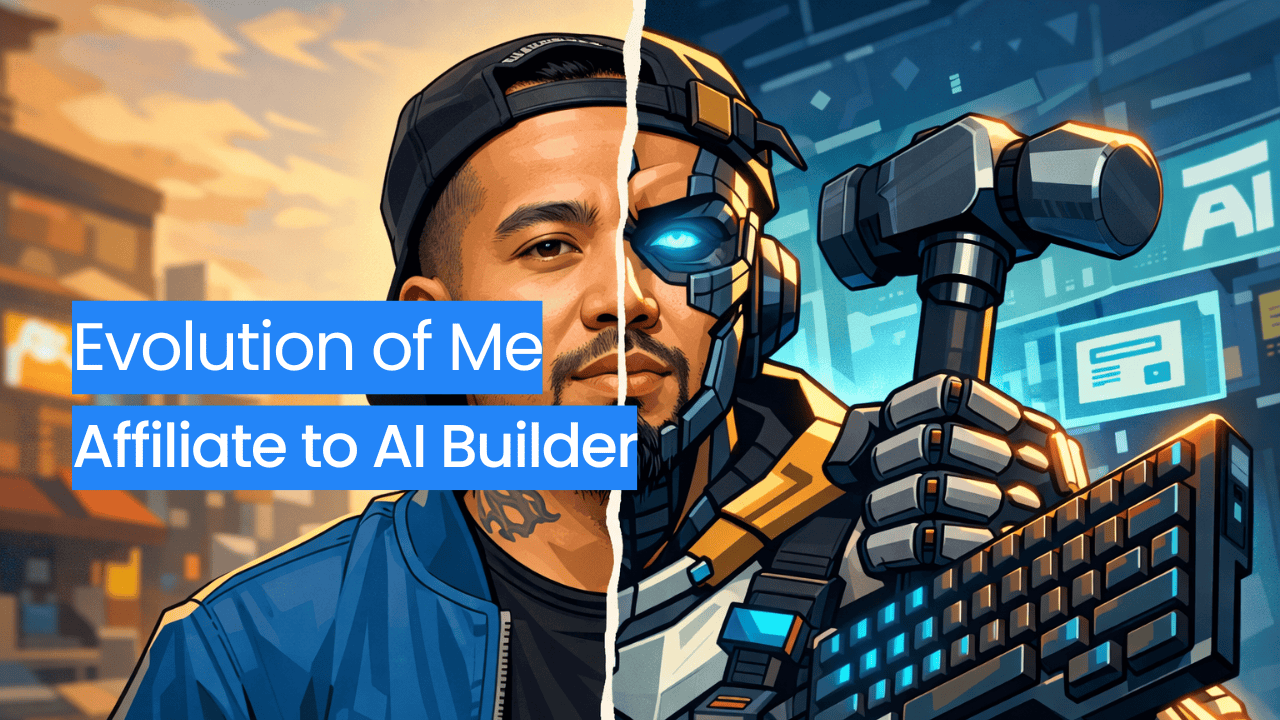
For most of my career, I labeled myself the same way most people in my world did — an affiliate marketer.
It was the simplest way to explain what I did. I bought traffic, built landing pages, ran funnels, tested offers, optimized performance. Anyone in digital marketing understood it instantly, and anyone outside of it didn’t need more detail than that.
But recently, I had a realization that reframed how I see myself — and honestly, how I see the last decade of my career.
I’m not just a marketer.
I’m a builder.
And affiliate marketing was never the destination. It was the training ground that shaped how my mind works.
Affiliate Marketing Was My Creative Playground
When people look at affiliate marketing from the outside, they see arbitrage. They see spreadsheets, payouts, traffic costs, and margins.
What they don’t see is how creative it actually is when you’re deep in it.
Some of my favorite moments in this industry had nothing to do with scaling budgets. They came from staring at a blank landing page and imagining what could exist there.
What headline would stop someone mid-scroll?
What story angle would make an offer feel personal instead of transactional?
What layout would guide attention without the user realizing it?
I was constantly blending numbers with imagination.
On one screen I had performance dashboards — CTR, CVR, EPC, CPA — all the metrics that dictated whether something lived or died.
On the other screen, I had design mockups, copy drafts, advertorial concepts, psychological hooks.
Affiliate marketing forced me to operate in two worlds at once. Analytical and creative. Structured and experimental.
And over time, I realized I enjoyed the creation part more than anything else.
Building the page. Structuring the funnel. Designing the flow. Testing variations.
Every campaign felt like building a miniature product from scratch.
I just didn’t call it that back then.
Systems Thinking Was Always There
Looking back, the signs that I was a builder showed up early.
I didn’t like relying fully on third-party platforms, so I gravitated toward building my own tracking setups and tools.
I didn’t want generic landing pages, so I designed custom flows tailored to each audience and traffic source.
I didn’t just want to run ads — I wanted to understand the infrastructure behind why campaigns worked or failed.
Funnels became systems. Traffic became inputs. Revenue became outputs.
That cause-and-effect loop fascinated me.
If I changed this headline, what happened to engagement?
If I adjusted page speed, what happened to conversion rate?
If I reordered the story flow, what happened to scroll depth?
I was engineering outcomes using creativity and data.
Affiliate marketing trained me to think in frameworks — not just tactics.
And that mindset naturally evolved into wanting to build bigger things.
The Turning Point: AI Made It Obvious
The real shift happened when AI became more accessible.
Not in the “write me an ad” sense — that part felt surface-level.
What clicked for me was what AI made possible from a systems perspective.
Instead of just optimizing campaigns, I could build platforms that optimized themselves.
Instead of testing copy manually, I could architect engines that tested writing frameworks automatically.
That’s when projects like OpenAssist, InboxEngine, and CrispyIQ stopped feeling like experiments and started feeling like extensions of how my brain already worked.
OpenAssist wasn’t about spinning up agents faster — it was about removing infrastructure friction that slowed builders down.
InboxEngine wasn’t about email automation — it was about building a testing engine for monetization logic.
CrispyIQ wasn’t just image generation — it was about analyzing performance signals and feeding them back into creative production.
Each product started the same way my early landing pages did:
An idea that didn’t exist yet.
A problem that felt inefficient.
A system that could be architected better.
The scale changed, but the mindset didn’t.
That’s when the realization hit me fully — I’ve always enjoyed building things from scratch and turning them into reality.
Affiliate marketing just happened to be the first canvas I painted on.
Identity Shift
There’s also an emotional layer to this realization.
For years, I wore the affiliate marketer label proudly. It gave me freedom, mobility, income, and opportunity.
But labels can also limit how you see yourself.
When you operate under one identity long enough, you don’t always notice how much you’ve evolved beyond it.
As I started building SaaS platforms, agent frameworks, dashboards, and automation systems, I felt a different type of fulfillment.
Campaign wins were exciting — but building infrastructure that enabled wins felt deeper.
It was less transactional and more architectural.
I wasn’t just asking, “How do I make this funnel convert?”
I was asking, “How do I build systems that make conversion easier everywhere?”
That shift changed how I approached my work entirely.
Creativity Never Left — It Leveled Up
One thing that stayed constant through all of this was creativity.
Affiliate marketing trained me to express creativity within constraints — ad sizes, page load times, compliance rules, audience targeting.
Now, software and AI expanded those constraints.
Instead of imagining a landing page, I’m imagining platforms.
Instead of testing ad angles, I’m testing product workflows.
Instead of designing funnels, I’m designing ecosystems.
But the core driver is the same — the joy of taking something abstract in my mind and making it tangible.
I still get the same satisfaction watching a tool go live as I used to watching a campaign scale.
Creation is the through-line.
Looking Ahead
What excites me most right now isn’t just growth — it’s alignment.
I finally feel like I’m operating in the lane that matches how my brain is wired.
I enjoy building from zero.
I enjoy architecting systems.
I enjoy solving inefficiencies with structure.
Affiliate marketing gave me the sandbox to develop those instincts.
AI and SaaS give me the construction site to apply them at scale.
And as I look toward the rest of 2026, I feel more energized than I have in years — not because of any single project, but because I understand the role I naturally play in everything I touch.
I’m a builder.
Not defined by campaigns or channels, but by the act of creating things that didn’t exist before.
Turning imagination into infrastructure.
Turning ideas into systems.
And turning systems into reality.