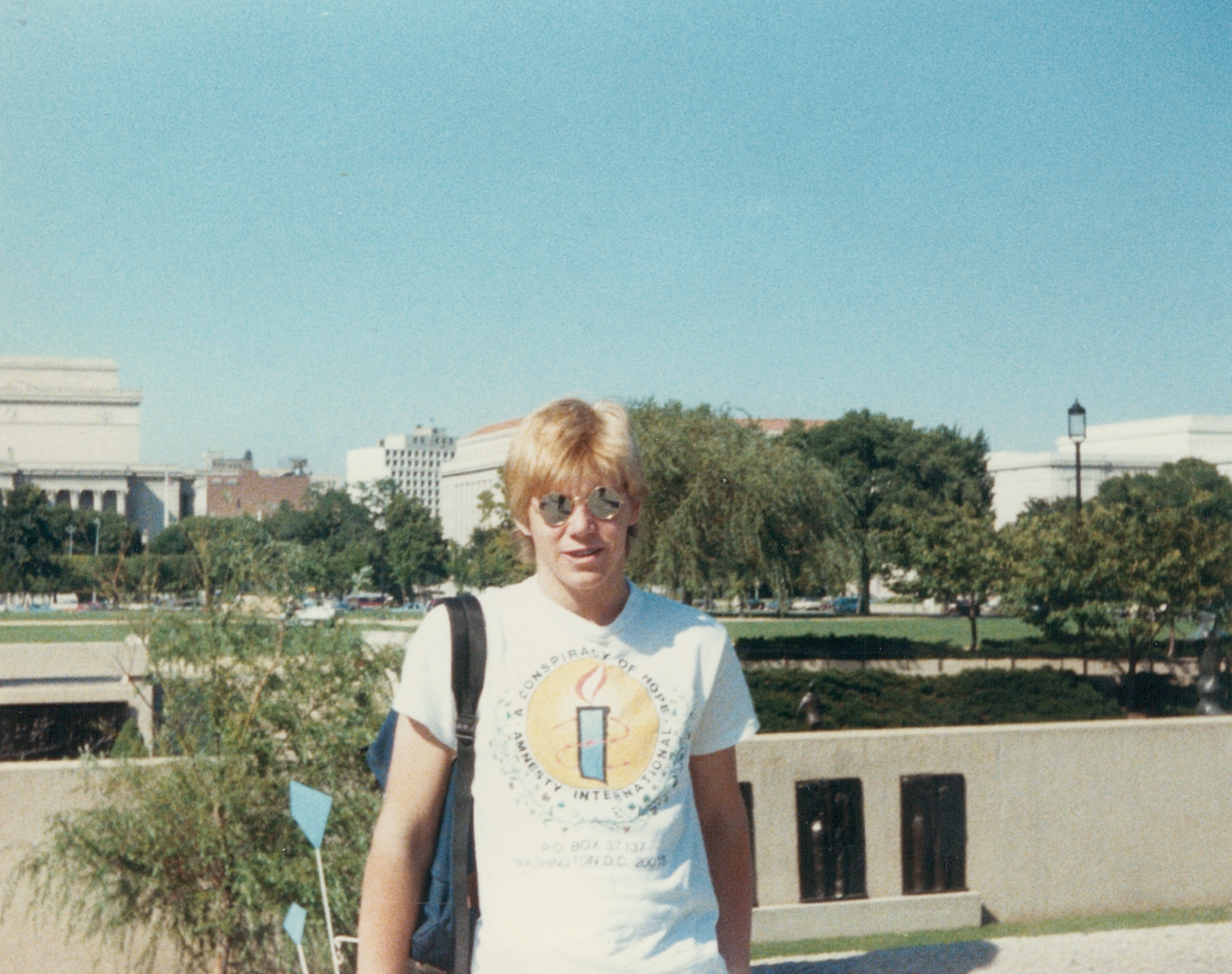
When I was a teenager, I would watch the Woodstock documentary whenever it was on PBS. Those days seemed so passionate and politically charged, and I wished I were around for it.

As Country Joe and the Fish came on stage to sing the “I-Feel-Like-I’m-Fixin’-to-Die Rag,” the lyrics would take me back to those protests against the Vietnam War.
“And it’s one, two, three, what are we fighting for?
Don’t ask me I don’t give a damn
Next stop is Vietnam.
And it’s five, six, seven, open up the pearly gates,
Well there ain’t no time to wonder why,
Whoopie! We’re all gonna die!”
I’d grown up hearing my dad play records with protest songs from the likes of Phil Ochs, Pete Seeger, and the Weavers, and it had a big impression on me.
I cared about the world and wanted to make a difference. So much of the music I was into was railing against Ronald Reagan and Margaret Thatcher.
I was deep into stopping apartheid in South Africa, calling attention to the Troubles in Northern Ireland, and fighting for human rights all over, protesting animal experimentation, and being outraged by U.S. military intervention in Central America.
I even spent a year not eating meat after getting radicalized by the Smiths’ “Meat is Murder” album.
When I discovered Billy Bragg on MTV’s 120 Minutes, I raced out to get his “Talking With the Taxman About Poetry” album, as well as his earlier work, and I loved songs like “Help Save the Youth of America,” “There Is Power in a Union,” and “Between the Wars.”
Activism to Apathy
When I got to the University of Maryland in fall 1988, I was sure it was going to be just like the grainy videos I’d seen of college campuses in the 60s and early 70s.
I’m sure there was activism going on, but I didn’t see it anywhere. I went to the various events for freshmen about campus organizations, and the only groups I saw that looked interesting were fraternities, and they cited philanthropy as a core part of their groups. That was cool.
So, I rushed and pledged Pi Kappa Alpha during my first semester, and while I kept listening to my music about various causes, I wasn’t really doing anything about it.
When the first Gulf War came along, I was sure that was going to be the moment when I could join protesters on campus. I’d heard how on May 1, 1970, there was a rally in front of McKeldin Library at the University of Maryland that turned into a nearly two-week violent protest after President Nixon announced expanding the war into Cambodia.
But 1990 was a long way from 1970 in College Park, MD. Some modest protests happened, but it wasn’t the scale I was anticipating.
By 1992, I did the most politically radical thing I’d done in my college years and voted for Bill Clinton and Al Gore. Before the general election, I went to a rally on campus where I shook Al Gore’s hand and got a Clinton/Gore sign to put in my frat house room window.
I wanted to make a bigger impact, but it never happened; that election did usher in an exciting new day when the decision-makers weren’t all older than my grandparents.