21 years after ‘Pop the Cap,’ North Carolina beer creates new opportunities for farmers – In the Field

Twenty-one years ago, a change to a North Carolina law would not only transform the state’s beer industry, it would also create new opportunities for some of the state’s farmers.
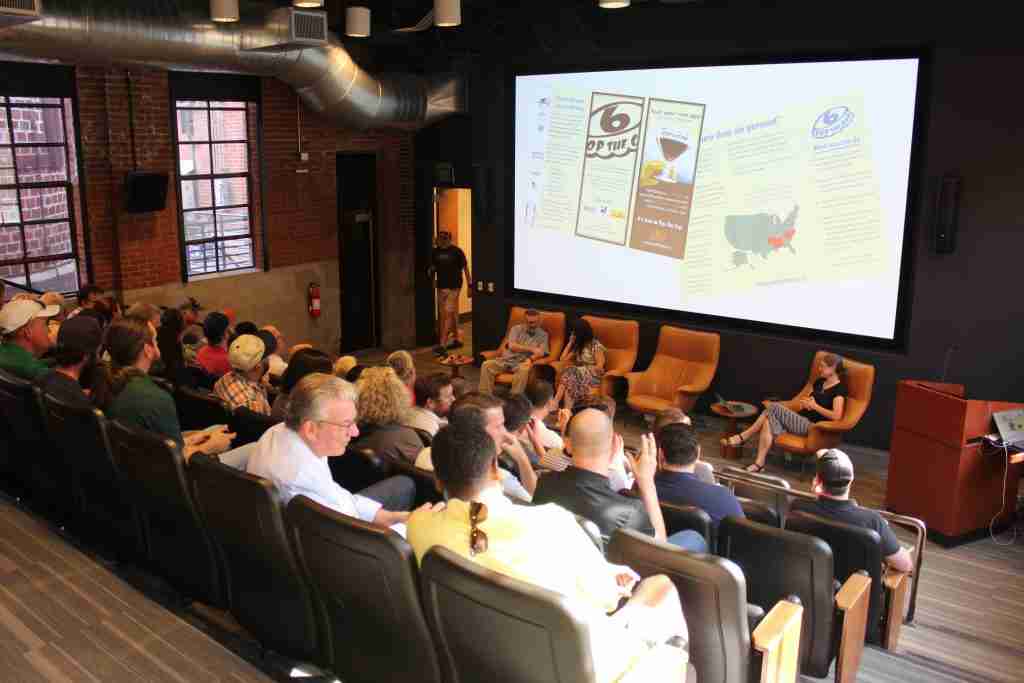
To celebrate the anniversary of that change, a crowd gathered in Durham on Aug. 13, exactly 21 years after Gov. Mike Easley signed House Bill 392 into law. That signing raised the state’s alcohol by volume (ABV) limit on beer from 6% to 15%.
Fullsteam Brewery hosted the gathering at its new still-under-renovation location at the American Tobacco Campus. Tryon Distributing and the N.C. Craft Brewers Guild co-hosted the event. A panel discussion focused on “Pop the Cap,” the grassroots effort that led to the change. During that discussion, Lisa Parker, executive director of the N.C. Craft Brewers Guild, noted just how much passage of HB 392 has meant for the state’s craft beer industry.


Several people involved in the “Pop the Cap” campaign were part of the crowd that gathered to mark 21 years since its success. The panel discussion felt like a reunion for some of the people who acknowledged familiar names and faces involved in the effort more than two decades ago.
“This singular change ushered in a new era of craft beer in North Carolina, allowing beer styles that many North Carolina craft beer enthusiasts had only heard of,” Parker said. “In 2005, at the time HB 392 was passed, North Carolina had approximately 20 breweries in operation. Today, our state has 385 permitted brewing facilities.”

The economic potential is considerably larger than the original Pop the Cap organizers imagined. Fullsteam founder Sean Lilly Wilson, who also helped lead the Pop the Cap effort, said the group estimated the law change would result in a net gain of about 300 jobs.
“I’ve never been happier to be so wrong in my life,” Wilson said.
Parker estimates the industry now supports around 16,000 jobs.
The change also helped create an industry that would have connections beyond the breweries themselves. Sebastian Wolfrum, founder of Epiphany Craft Malt, explained that as more breweries opened, brewers began looking for ways to incorporate ingredients grown and produced in the state. That created new opportunities for North Carolina farmers. While some farmers could grow blueberries, peaches or other seasonal “adjunct” ingredients for craft beer, a more substantial opportunity has been growing grains used in malt, an essential ingredient in beer.
Today, Epiphany in Durham is one of three malt houses in North Carolina. Riverbend Malt House in Asheville and Carolina Malt House in Statesville are the other two. They all source at least some of their grain from North Carolina farmers.
Wolfrum said the connection between breweries, malt houses and farmers grew naturally from the expansion of craft brewing.
“When that law changed all sorts of people started opening breweries across the state,” Wolfrum said. “And then what happened as the second line was this idea of making beers in the local communities and [they asked themselves] wouldn’t it be nice if we could also get local malt.”
That’s essentially what led Wolfrum to start Epiphany. He realized the success of the “Pop the Cap” campaign not only cleared a path for more craft breweries, but it created ripples of opportunity. Riverbend Malt House started in 2010 with founder Brent Manning saying he saw an opportunity to connect North Carolina’s farming community to the craft beer economy that started booming after passage of HB 392.
“[Riverbend] kind of spurred thinking about what it would mean to really have a quality and an abundant supply of local malt,” Wolfrum said. “So the epiphany came at an N.C. State Extension-sponsored meeting at Fullsteam in 2012 where essentially the various players came into the room. Brewers were there, some early distillers, some of the farmers and N.C. State people and maybe even someone from the [North Carolina] Department of Agriculture. The discussion centered on basically what can we do from the N.C. State Extension side to support more farmers to grow things that you brewers want to use, and it became clear there just wasn’t enough malting capacity in the state.”
Knowing that raw grain can’t work for making beer, Wolfrum saw his own opportunity. He founded Epiphany to turn wheat, barley, rye and other grains into malts — creating another connection between farmers and breweries.

Wolfrum said locally sourced ingredients can sometimes cost more to produce, but there is an important economic benefit because more of the money spent on those ingredients stays in North Carolina and supports local communities. That creates an opportunity for consumers to support not just a local brewery, but farmers and other businesses in the supply chain.
Wilson also said the change in the law opened the door for brewers to think more broadly about the ingredients they used and where those ingredients come from. Fullsteam was an early participant in that effort. Its first beer, brewed in 2010, used North Carolina wheat and locally grown basil. Wilson said the brewery has since invested nearly $1 million in local ingredients.
Wilson also sees potential for farmers to make use of North Carolina’s climate by growing barley as a winter crop.
“Farmers are finding opportunities to grow local barley as a winter crop, in that sort of middle season, rather than just letting the field lay fallow,” Wilson said. “They can grow barley, and, you know, for better or for worse, the climate supports it, and it’s a more economic opportunity.”
Wilson calls the broader connection between agriculture, breweries and consumers the “Southern Beer Economy” — an idea that beer is part of a larger, resilient local economy built around North Carolina-grown ingredients and agricultural entrepreneurship. He believes the state’s craft beer can be part of a new agricultural heritage in what he calls a “post-tobacco South.”
That wouldn’t be possible without the law that allowed for more beer varieties and the new breweries that became viable along with the change. Now, Pop the Cap’s success can be seen not only in those breweries and the jobs created across the state, but also in the connections being built between North Carolina farms, malt houses, breweries and the consumers who support them.

The gathering that celebrated the signing of HB 392 also offered a preview of Fullsteam’s new 9,000-square-foot home in the historic power plant building at American Tobacco Campus. It’s slated to open this fall, blending a taproom and restaurant with private event spaces including the Full Frame Theater. Piedmont Old Time Society provided live music.