

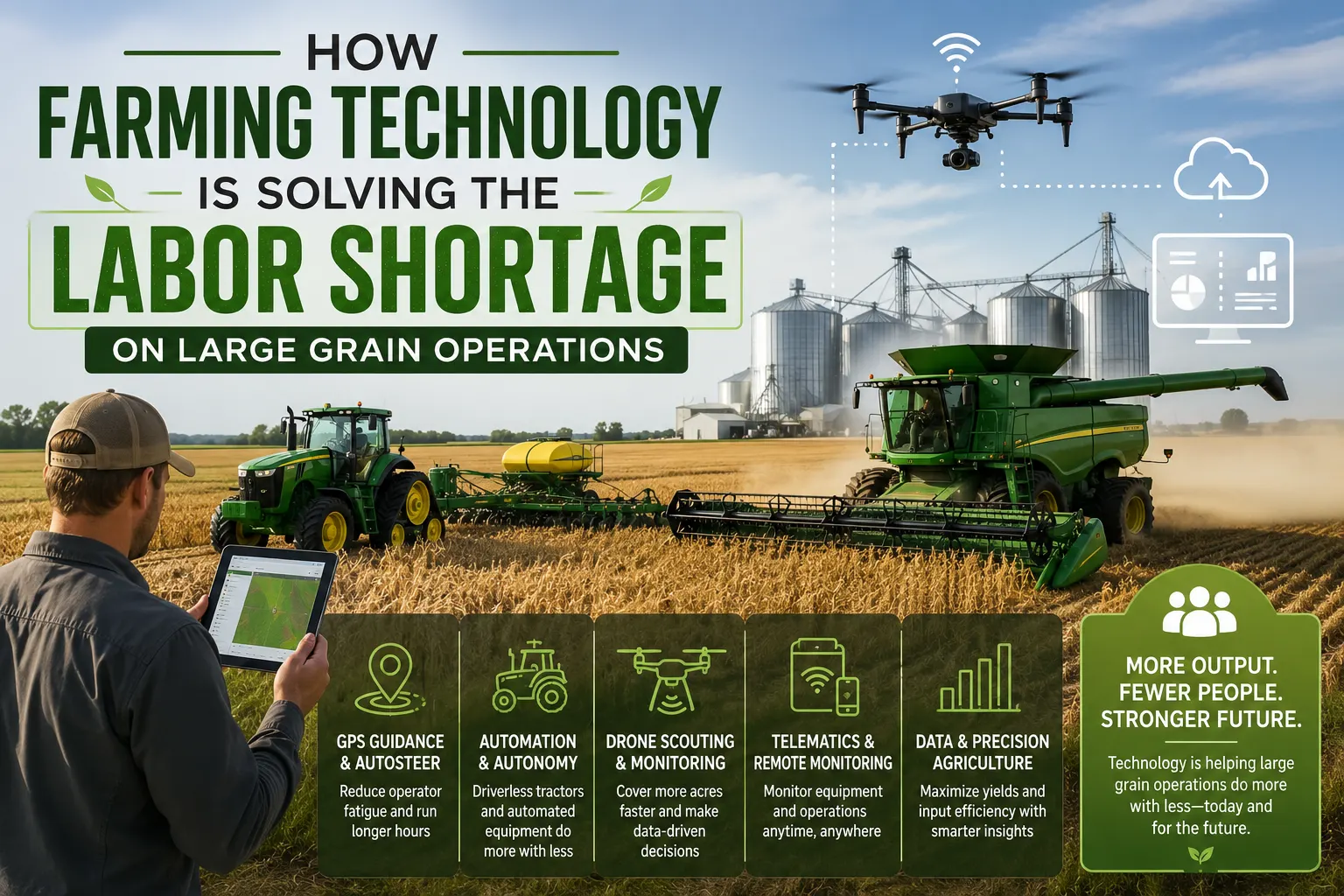
Large grain operations are running fewer hands across more acres every season, and the gap isn’t closing on its own. Modern equipment and automation have become the practical answer for farms that need to cover more ground, thresh more bushels, and keep the combine rolling without hiring the extra crew they can’t find. Here’s how automation, smarter equipment, and simplified operation are changing the labor math for grain farmers in 2026.
- An estimated 2.4 million agricultural jobs went unfilled in the U.S. in a single recent year, with more than half of farmers reporting ongoing labor shortages.
- Farm labor costs have climbed sharply in recent years, and overall agricultural employment has continued to decline even as acreage under management grows.
- Automation in combine harvesting is projected to cut harvesting labor costs by close to 40 percent as adoption spreads across large-scale operations.
- Automation and smarter equipment aren’t just replacing workers — they’re letting fewer, less-specialized operators run machinery that once required years of experience to set correctly.
- Equipment simplification, like all-crop threshing systems, reduces the skilled-labor burden during the highest-pressure weeks of the season.
Why Labor Shortages Are Hitting Grain Farms Harder Than Ever
The labor shortage isn’t a new story for agriculture, but it’s reached a point where it’s reshaping how large grain operations plan a harvest season. Recent industry reporting shows more than half of U.S. farmers experiencing ongoing labor shortages, with hundreds of thousands of agricultural positions going unfilled. At the same time, the workforce that remains is aging, and fewer younger workers are entering farm labor roles to replace them.
Grain operations feel this differently than specialty crop farms. Row crop labor costs represent a smaller share of overall production expenses than labor-intensive crops like fruits and vegetables, but grain farms are far less forgiving on timing. A narrow harvest window means a short-staffed crew doesn’t just slow things down — it risks leaving grain in the field, missing optimal moisture windows, and losing yield to weather. That’s exactly where automation and modern equipment have stepped in as more than a convenience. It’s become the difference between finishing harvest on schedule and finishing it short-handed.
The Equipment and Systems Doing the Heavy Lifting
Three categories of technology are carrying the labor load on large grain operations right now: automation, precision guidance, and equipment simplification.
Automation and Autonomous Features
GPS-guided steering, automated header adjustments, and self-tuning threshing settings mean fewer skilled operators can run more combines across more acres. Industry analysts have pointed to automation as a leading driver of adoption in large-capacity harvesters, with some projections putting labor cost reductions from automation near 40 percent as these systems mature.
Precision Sensors and Real-Time Monitoring
Yield mapping, moisture sensing, and cloud-connected performance data let one operator monitor conditions that used to require a second set of eyes in the cab or a supervisor checking multiple machines throughout the day. That data also shortens the learning curve for newer operators, who can rely on the system’s feedback instead of years of seat-time experience.
Equipment That Simplifies the Job Itself
This is the piece that gets overlooked. Solving the labor problem isn’t only about screens and software — it’s also about mechanical systems engineered to be easier to run correctly. Concave and threshing systems are a good example. Equipment that requires constant reconfiguring between crops, careful clearance adjustments, and an experienced hand to avoid grain loss puts a hard ceiling on how many operators a farm can put in the seat. Systems designed to handle all crops without swapping components remove that bottleneck entirely, which matters most when the available labor pool is thinner and less experienced than it used to be.
Traditional Labor-Dependent Tasks vs. Technology-Driven Solutions
| Harvest Task | Traditional Labor Requirement | Technology-Driven Solution | Labor Impact |
|---|---|---|---|
| Steering and header control | Experienced operator, full attention required | GPS auto-steer and automated header height | Reduces operator fatigue and skill requirement |
| Concave/threshing adjustment between crops | Skilled technician, manual reconfiguration | All-crop concave systems requiring no swaps | Eliminates downtime and specialized labor need |
| Grain loss monitoring | Manual field checks, walking behind the combine | Sensor-based loss monitoring in the cab | Removes need for a second field hand |
| Multi-combine oversight | On-site supervisor per machine or crew | Cloud-connected fleet data and remote diagnostics | One manager oversees multiple machines |
| New operator training | Multiple seasons of hands-on experience | Simplified, forgiving equipment settings | Shortens ramp-up time for seasonal hires |
Pros of Adopting Modern Equipment to Address Labor Shortages
- Fewer skilled operators are needed to cover the same number of acres
- Seasonal and less-experienced hires can be productive faster
- Reduced grain loss offsets some of the cost of hiring shortfalls
- Fleet-level data lets one manager oversee more equipment
- Faster ground speeds mean fewer total labor-hours per harvested acre
Cons and Challenges to Consider
Upfront Investment
Automation and equipment upgrades require capital, and not every operation can absorb that cost in a single season.
Technology Learning Curve
Even simplified systems still require some training, and not all operators adapt to new interfaces at the same pace.
Dependence on Connectivity
Cloud-connected monitoring and remote diagnostics rely on rural internet and cellular coverage, which isn’t consistent everywhere.
Maintenance Still Requires Skilled Labor
Technology reduces the need for operators in the seat, but qualified technicians are still needed to service and repair advanced equipment.
5 Common Mistakes Farms Make When Trying to Offset Labor Shortages With Technology
- Investing in software before fixing mechanical bottlenecks. A GPS system doesn’t help if the combine still needs a skilled hand babysitting the threshing settings all day.
- Assuming automation eliminates the need for training entirely. Operators still need a baseline understanding of the equipment, even with automated assistance.
- Underestimating the value of equipment that’s simply easier to run correctly. Not every labor solution is digital — some of the biggest gains come from mechanical systems built for less-experienced operators.
- Waiting until peak season to make equipment changes. Testing and training on new technology should happen before harvest pressure hits, not during it.
- Overlooking grain loss as a hidden labor cost. Every bushel lost to outdated equipment is production that additional labor can’t recover — it’s simply gone.
Key Takeaways
- Labor shortages are a structural, ongoing challenge for large grain operations, not a temporary blip
- Automation, precision data, and simplified equipment design all work together to close the gap
- Equipment that removes the need for skilled reconfiguration between crops has an outsized impact on labor efficiency
- Technology adoption comes with real tradeoffs, including upfront cost and a training curve
- The farms managing labor shortages best are combining digital tools with mechanically simpler equipment
Frequently Asked Questions
How is farming technology helping with the agricultural labor shortage?
Farming technology reduces the number of skilled operators needed per acre through automation, real-time monitoring, and equipment that’s simpler to run correctly, which helps large grain operations cover more ground with fewer experienced hands.
What type of farming technology has the biggest impact on labor costs during harvest?
Automated steering and header controls get the most attention, but equipment-level simplification — like threshing and concave systems that don’t require reconfiguring between crops — often has just as much impact on how many operators a farm actually needs.
Can farming technology fully replace the need for seasonal harvest labor?
No. Farming technology reduces how much specialized labor is required and shortens training time for new operators, but qualified people are still needed to run and maintain the equipment.
Is investing in farming technology worth it for smaller grain operations?
It depends on acreage and labor availability. Operations already struggling to find or retain skilled operators tend to see the fastest return, since the labor savings offset the equipment investment more quickly.
What’s the easiest first step for a grain farm looking to reduce labor dependence?
Start with equipment that’s already in use every harvest, like the combine’s threshing and separation system. Upgrading to components designed for consistent, forgiving performance across crops reduces the skill threshold before any software or automation investment is made.
Conclusion
The labor shortage on large grain operations isn’t going away, and farming technology has become the most practical way to close that gap without sacrificing harvest timing or yield. The farms adapting best aren’t just buying automation for the sake of it — they’re pairing smarter systems with equipment that’s genuinely easier to operate correctly, so fewer hands can still get the job done right. That combination is what turns a thin labor pool from a constant threat into a manageable part of doing business.
One of the most overlooked pieces of that equation sits inside the combine itself. The Estes XPR3 Concave System is built to run all crops without reconfiguring, covers, or bands, and it’s designed to be more forgiving for less experienced operators to set correctly — which means a thinner labor pool doesn’t have to mean a slower, less accurate harvest. Get a free XPR3 quote and see what it can do for your operation this season.


