This transcript was created using speech recognition software. While it has been reviewed by human transcribers, it may contain errors. Please review the episode audio before quoting from this transcript and email [email protected] with any questions.
[DOOR OPENS]
- jessica cheung
-
Hello.
- april hemmes
-
You must be Jessica.
- jessica cheung
-
Yes. You must be April.
- april hemmes
-
Yes. Nice to meet you.
- jessica cheung
-
Nice to meet you, too.
- april hemmes
-
So do you want a tour of the empire first?
- jessica cheung
-
Yes, I would love.
A few days ago, “Daily” producer Jessica Cheung traveled to Iowa to meet with a farmer.
- april hemmes
-
So this is from way up there where you see those poles to down there. There’s a creek down there. This is all —
- jessica cheung
-
This is all you?
- april hemmes
-
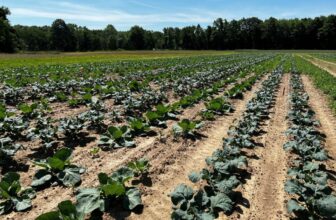
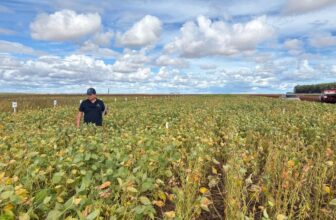
— one field. Yeah, one of my fields. It was a corn field last year. And then I will just go in and plant it in soybeans. And it’s amazing to look at this now and then come back in August, and weather permitting, they’ll be waist high.
- jessica cheung
-
And what will the crop look like?
- april hemmes
-
Green, leafy, waves.
- jessica cheung
-
Waves.
- april hemmes
-
Waves of green soybeans, yes. But for me here in Iowa, it’s usually April is go time. That’s planting season. So right now, I want to get these soybeans in the ground.
I want to plant and we want to plan. The thing about the tariffs, it’s hard to plan when they’re out there looming. What’s going to happen.
[PENSIVE MUSIC]
From “The New York Times,” I’m Michael Barbaro. This is “The Daily.”
In the increasingly bitter trade war between the United States and China, perhaps nobody has more at stake than America’s soybean farmers, whose crop has become the country’s single biggest export to China. Today, I speak with an Iowa farmer, who helped build the $13 billion market for US soybeans in China, about what the sky-high tariffs instigated by President Trump now means for her and tens of thousands of American farmers.
It’s Thursday, April 24.
Hi, April.
Hi. How are you? You’re sitting in a closet?
[LAUGHS]: I’m standing in a closet.
[LAUGHING]: Wow, that’s all you can afford up there at “The New York Times,” huh? Wow. Sorry. [LAUGHS]
I decided to do this from home.
Oh, OK. [LAUGHING]
Speaking of backgrounds, are you in your kitchen?
I am, yes.
What is that stuff on the wall behind you?
So it’s pictures of where I’ve been, and some of my personal travels and soybean travels.
And anything from China on those walls?
Yeah. Yeah, the Terracotta soldiers and the Forbidden City is over there. Lots of good stuff.
Wow. Well, are you feeling ready for this conversation?
Let’s rock and roll.
Can I just start, for the benefit of our listeners, by asking you to tell us your name, with your permission your age, and what you do on the farm?
So I’m April Hemmes. I am a 65-year-old farmer. I’m here on my family’s century farm. My great grandfather purchased it in 1901.
I raise soybeans and corn on my farm in Iowa, in the best soil in the world. And I’ve been on a lot of different boards through the years, United Soybean Board and the Iowa Soybean Board. So part of my travels to China were promoting soybeans.
And how much of your crop ends up being shipped to China right now?
About 53 percent. Over half of the soybeans exported in the US go to China.
Wow.
And that’s huge. The American farmers, we’re very good at what we do. We raised very high-quality crops. And so we’re so good, we don’t use it all here domestically. We have a great domestic market, but we need to export it.
So China imports our whole soybean. And they crush it there, because that’s the value is crushing that soybean, we call it. And then like 80 percent is the meal and around 20 percent is the oil. And the meal goes to feed all their livestock.
And I think they’re the largest pork producers in the planet. They raise the most pork. So a lot of our soybeans get fed to their pork, and ducks, and chickens, poultry. And then the oil, all the oil gets used for human use, for frying.
Got it. The reason we wanted to talk to you about all of this is because you, April, occupy a really interesting and kind of pivotal place in the story of how that relationship between Iowa farmers and China came to be. And we want you to tell that story. And I think that it would be helpful to begin with the past, basically what the world looked like before farmers, like you and those around you, sent so much of your crop to China. So can we start by having you paint a picture for us of what it was like in the before? I don’t know where you would start that, but I’m going to guess it’s a few decades ago.
So I came home in 1985. This is actually my 40th year at home on the farm, which is quite amazing to me. So I graduated in animal science from Iowa State University. And then I worked at the Iowa Swine Testing Station for a little while.
And then I got a phone call, we need somebody to talk Iowan in Washington, DC, greeting people to a brand new, elected congressman. And I learned pretty quickly, that’s not where I wanted to be. My goal all along was to come back to the farm.
I kind of made that decision, and called home, and I said, I want to come back to the farm. And my dad said, no, you’re not coming back to the farm. It’s terrible timing. And my grandfather was the one who said, if she wants to come back and farm, she’s coming back.
Well, what about the timing was terrible?
So it was the farm crisis. So everything just fell apart. We had huge interest rates. So it was like 16 percent interest. And then the land, the price of the land was going up. So some people bought land very high priced with a very high interest rates, and then our commodity prices were not good.
And then once farmers started failing, the banks started failing. So we had a lot of agriculture banks go out of business. And it was a time of white crosses in the courtyard when they had to go sell farms, and people selling off their possessions to make bank payments, things like that.
Am I right, April, in remembering from some civics book I read many, many years ago, that a factor in the farm crisis was that there was simply too much crop?
We did have overproduction. We just had too much. We weren’t trading around the world and exporting like we are now. And so that’s really late ‘80s, early ‘90s, is when that focus to export, especially to China, really ramped up.
Why was that market seen as a potential answer to the farm crisis?
Well, because they had such a growing population then. And we knew we had extra we had to export to. But you have to develop these things. And it takes a long time to develop relationships and trust. It actually started with President Nixon going there in the ‘70s, and you just start building that trust. And then they started importing in the ‘90s, from the US, soybeans.
You just hinted at how this is a relationship that needs to be worked on. It doesn’t happen on its own. So how do you, April, go from being a farmer who may be benefiting from this new Chinese market to somebody personally involved in working on and even expanding the relationship between farmers in places like Iowa and China. How does that happen?
Right. Well, it happens on getting involved in your local boards, or state boards, or in my case, national boards. So let’s zoom through the ‘90s into the 2000s, and through the Iowa Farm Bureau I got to visit China for the first time on a market study tour. And it was a bunch of Iowa farmers.
And what first struck us on our bus rides was the agriculture, of course, because we’re farmers. And it’s not just big, huge fields like we’re used to here. It was a very, very small parcels put together. So that’s how they got to lease the ground from the government. So it’s all hand done.
We saw the stover from the corn piled in the corner. The stover is the corn stalks, anything but the corn. And they would use that to heat their houses. They were drying their wheat on the road. They had spread the wheat out on the road to dry it.
You’re noticing some real limitations in how China farms.
Yes. And one of the biggest ones, they took us to one of their show farms. And the interpreters always wanted to be by me and talk to me. And so they say —
I can’t imagine why.
I know.
April, is this just like your farm? Now, it’s the same size as my farm, a thousand acre farm. There were like 400 landowners, let’s say. They didn’t own it.
Wow.
But right. And the Chinese are very good at showing you what they want you to see. There were like 24-row combines lined up, little, tiny tractors, a bunch of those. And the interpreter said, April, is just like your tractor? And I said, I don’t mean to be disrespectful, but that is like the tractor I mow my lawn with.
Wow.
And it’s like, I said, no. What you’re doing on this farm, I do by myself.
So what happens after that initial market tour trip?
So I was really glad I went on that. I assumed it was going to be the only time I ever got there. But then fast-forward to 2015, and I was appointed to the United Soybean Board by the secretary of AG. And so I was asked to go on a trip there to support soybeans.
And that’s where I met honorable Mr. President Bian. And if you ever go to China, I hope you guys have a chance to, and you meet public officials, it’s these huge rooms with the large murals in the background, and you’re just in awe. And it’s meant to be that way, I think. So I met with him, very cordial.
And just for those who may not understand, what is his role in the Chinese economy and government?
Yeah, he was the president of the Commerce Department for Food and Natural Agriculture Products. So it’s who we talk to when we went over there, because he was kind of the head of that commerce department.
Got it. So you’re kind of talking to the big cheese when it comes to soybeans.
He was the dude, yes. He was the man. So we meet and you go into this big room. I’m not a negotiator for the government or anything. I was there to tell my story, talk about the high-quality soybeans.
I just told him how I raised my crops. This is how I plant my soybeans, I keep my water quality high, how I harvested them, weed-free. And then afterwards, there’s usually a supper or a dinner. And literally, the big spinny table where you get to pick what you eat, the whole fish presented, or the whole duck, the Peking duck with the head on it and everything, and then they come out and serve you. It’s really quite grand when you have a state meal.
But then they bring the soju out. And it’s rocket fuel, basically. That’s alcohol. And then you do toast. And so you go around and the person that’s hosting goes around to every single person and does a toast to them. And you say “ganbei,” which means “bottoms up,” and then down it. And the higher the official, the better the booze, as we say.
So in this burgeoning personal set of relationships between you and the Chinese government and their economic community, do they end up sending their folks over to you?
Yeah. So the United Soybean Export Council used to bring soybean buyers from China and take a tour in the fall, and bring them to the farm so they can see what kind of a crop we’re going to have. Is it going to be a good crop? Are they going to have plenty of beans? And in the fall in Iowa, we host the World Food Prize here. And that’s when honorable Mr. President Bian came.
Oh, wait, that same official came to Iowa?
Yes. And he came to my farm. I knew they were going to stop by. I didn’t know it was going to be him.
And so I was combining corn. So I said, let’s go, hop in the combine. And I go, OK, and I showed him, because it’s autosteer. So you push a button and it steers itself. But he wanted to steer that thing. So he was driving over my 240 bush of corn, and I was getting a little upset with him, Michael.
Is he sort of destroying your corn?
Yeah, he was, yeah, driving over my corn. We got him back on the road and he was going. And I was explaining how the combine works. It takes the corn off the cob.
And then I said, turn around, and that’s where the corn goes. And he turned around and the corn is all going in the tank, in the combine. And he’s just, his eyes were huge. And he just kept saying, (MIMICKING) how satisfying. How satisfying.
[LAUGHING]:
I said, yeah, but not when you do it 9, 10 hours a day.
But just the amazement of being in there. And I also knew he would walk away with that. Driving this big, huge combine in the US and just being able to have that experience, I would think, is pretty important.
Tell me in your mind why this kind of interaction matters. You talking to this Chinese economic official, this Chinese economic official talking to you, fundamentally, what is the value of this?
I think the value is that personal connection, the personal relationship.
I mean, it does come down to price. But when we can tell our stories and they have a face to put with that farmer, they can go, oh, soybean farmer April, yeah, I know her. I’ve talked to her. I know how she raises her crop. I know. I’ve been to her farm.
Things like that, that personal connection goes a long way know. Am I saying it goes a lot farther than cheaper soybeans? No.
It’s a factor.
It really is. And it’s amazing to me how much of a factor it can be. And it does mean something now because they have other places they can go, and yet they still buy over half of our soybeans we export.
Overall, how many times do you end up going to China?
Eight or nine times. At least nine times, I think.
Wow. During this period, as you’re making all these trips and as these relationships are clearly growing, how much is the actual trade relationship growing between Iowa farmers, soybean farmers especially, and China? Like, if there’s a graph, a chart that shows what’s happening during this period.
That charts a beauty in 2016 or 2017, because it was growing, growing, growing. And then the first tariffs hit. And then boom, down.
[TENSE MUSIC]
We’ll be right back.
Let’s talk about today. After spending all these years cultivating the relationships that you have so successfully cultivated, and that has been beneficial to both sides — China getting the soybeans, farmers like you selling so much to China — I want to know what it’s been like to watch over the past few weeks as these historically high tariffs go into place. First by the US and reaching up to, I think, 145 percent. Then China retaliates, theirs go up to 125 percent, which directly impacts you. So what is the state of the relationship right now between the US —
You mean today?
Yes, right now. What is the state of the trade relationship?
Well, you call Donald Trump up. You call the president up and ask him.
I’m sorry. I wasn’t going to get political. [LAUGHS]
Well, since you raised it, did you vote for this?
I knew it was coming. Here it was. I never answer that question.
It’s private.
I have been asked that question every single time I’m interviewed. And my answer is, it doesn’t matter who I voted for. We have them for a president. And farmers tend not to look back. We like to look forward.
And I just wish the instability of everything right now is probably what bothers me more than anything. I worry about what’s the weather going to do, what are the markets going to do, what’s going be next for tariffs? But we need, especially in agriculture, quite honestly in any industry, in order to plan, we need some kind of stability.
Right. And this is not stability.
Absolutely not. And not just in agriculture but in the bond market, in the stock market, everywhere. So it’s hard for businesses, such as farming or any other business, to plan when we don’t know if we’re going to have a market to go to.
So I think — I hope, let me put it this way. I hope at the end of the day, they get together sooner rather than later — and whether it’s Xi and Trump or whoever, they get together and figure something out and say, let’s start working on this, because not doing anything isn’t helping anyone.
I’m curious if since this all began over the past month or so, if you’ve been in touch with any of your contacts over in China, that secretary for instance.
Yeah, no. He retired several years ago. So I don’t get to chat. I don’t get to see honorable Mr. President Bian anymore. And I have seen a couple buyers that live in Iowa.
You’ve seen some Chinese buyers in Iowa?
Yeah, because they live in Iowa or at different events and things like that.
And what do they say?
They’re the same way. They just want that market there. They want to not worry about the unknown. And I think we all expected tariffs to come back, but not to the extent that they have been. And just in the past, I know the Chinese will dig in their heels. And I wonder how long the American public will dig in theirs.
Well, let’s talk about the American soybean farmer, you. I mean, and whether you dig in and how you dig in. I mean, what would it mean for you for tariffs on the scale that are in place and the retaliatory tariffs that are in place, what would it mean for you for those to remain in place for any meaningful stretch of time?
Quite honestly, we don’t know. Other farmers I’ve talked to are a wait-and-see. Let’s wait and see. Some think they’re going to go broke tomorrow.
Here’s what I do on my farm. I plan for the worst and hope for the best. And that’s quite honestly what I did last year. I think more than anything, my inputs are going to rise, which they’re already very high.
And when you say inputs, you mean the things you need to do your farming.
The seed, the chemicals, the fertilizer, the things I need. So I spend then hundreds of thousands of dollars, over half a million right now, to put the seed that isn’t even in the ground yet, into production.
And do the tariffs affect the prices of those?
Oh, a hundred percent. Yeah. Yes, they do.
What would it mean if China stopped buying American soybeans?
Our price would go down. I mean, there’s no other answer to that. When they buy half of what we export, so it can do nothing but affect it.
I mean, the reason I asked that question about what it would mean if China stopped buying American soybeans, is that we don’t know, that it’s entirely theoretical. I mean, our own newspaper has reported that China is working on plans to replace US farmers in this moment. Now, maybe that’s just talk. Maybe that’s a scare tactic.
They’ve been saying that for years, by the way.
Maybe it’s impossible.
Since I’ve been going to China, they’ve been saying that.
They talk about Brazil. They talk about Argentina.
Yes. Yeah.
And is that a real risk?
Of course, it is. And I mean, I’m not going to downplay that. And that’s why we need these presidents talking, not just for agriculture’s sake, but for everyone’s sake, because whether we like it or China likes it, our economies need each other. I mean, period, end of story. I don’t know how we can do without each other.
When you think about the amount of work that you and fellow farmers put into developing the relationship between the United States and China, all the trips, all the pitches, all the meals and the translators, and the tractor rides, I mean, do you think that the president of the United States understands how much all that took and how quickly something like this trade war can kind of undermine it?
I don’t know how to answer that, because fortunately, I’m not in the president’s head. So I think it’s hard for anyone outside of agriculture to understand the amount of work we put into that or how important we know it is to our business. And so that is how I look at it.
I know how important it has been to many farmers I know and what we’ve worked for. And I also understand the inequity of this trade and how important that is to our president. So I can see that. And I hear a lot of other people talk about that. But I just I would hope that he would have considered that in his decision-making along the way.
I’m hearing you say that, on some level, perhaps the one that doesn’t acknowledge how you voted and I respect that, you understand his protectionist instincts when it comes to trade and you understand what he’s up to.
US first.
But you’re in a unique position. You may appreciate what he’s up to. You may even on some level support it. But you know, personally, the cost of it.
That it’s going to cause hurt. Yeah, yeah. Yeah. And evidently, he understands it, too, because he says it’s going to hurt for a while. Stick with me. There’s going to be pain. And so farmers know that. We’re like, yeah, we know that.
Yeah, we know about the pain.
We’ve been here before. So yeah.
Been there, done that. It’s like a school song we used to sing. “Same song, second verse, a little bit louder and a little bit worse.” And that’s kind of what this feels like. [LAUGHS]
What do you want the White House, the president, to understand right now, given where the trade war is and given the unique perspective you have about what it took to get to this place and how much this relationship between the US and China means to soybean farmers?
I guess what I want them to understand is rather than the snap of a finger and shock the world, honestly, to understand it takes a lot more than that. And then backtracking. I don’t think that did agriculture any good, to put it out there and then backtrack. So yeah, I wish he would understand that all the time and effort that’s gone into this.
Which for you has been —
Yeah. It’s a long time. It’s a long time. But I can’t say I haven’t enjoyed it.
I always get asked, why do you spend so much time on boards and doing this? I wouldn’t do it if I didn’t think I was doing any good. If I didn’t know these relationships mattered, then I certainly wouldn’t take time off my farm and be doing these things.
[PENSIVE MUSIC]
But yeah, no, to have the two biggest economies in the world not talking is not good for anyone. We need to have that relationship. And if a farmer can help it along, so be it.
It sounds like a farmer did help it along already.
[LAUGHS]: Well, we sure tried.
Well, April, I can’t thank you enough for your time. Thank you very much.
You’re welcome. I enjoyed this more than I thought I would.
[LAUGHS]:
We can do a podcast from my combine sometime.
Oh, that would be really, really fun.
Combine karaoke, let’s do it.
We’ll be right back.
Here’s what else you need to know today. In their latest clash, President Trump, on Wednesday, demanded that Ukraine’s leader, Volodymyr Zelensky, immediately accept a peace plan that heavily favors Russia, a demand that Zelensky flatly rejected. The Trump-backed plan would give Russia nearly 20 percent of Ukraine’s territory, prohibit Ukraine from joining the NATO defense alliance, and would recognize Crimea, which Russia illegally invaded in 2014, as part of Russia. US officials have warned Zelensky that the White House may abandon the peace talks in the coming days, unless a deal is quickly reached, and appear ready to blame Ukraine if the talks break down.
- archived recording (donald trump)
-
I think we have a deal with Russia. We have to get a deal with Zelensky. And I hope that Zelensky, I thought it might be easier to deal with Zelensky. So far, it’s been harder, but that’s OK.
[THEME MUSIC]
Today’s episode was produced by Jessica Cheung, Olivia Natt, Rob Szypko, and Alexandra Leigh Young. It was edited by Maria Byrne, contains research help from Susan Lee, original music by Marion Lozano, Elisheba Ittoop, and Dan Powell, and was engineered by Chris Wood. Our theme music is by Jim Brunberg and Ben Landsverk of Wonderly.
That’s it for “The Daily.” I’m Michael Barbaro. See you tomorrow.