By Bjorn Fehrm • Aerospace Analyst
September 25, 2026
Over the last few weeks, we have looked at the most common aeronautical composite with a thermoset matrix and its many production methods. The alternative to a thermoset matrix is the thermoplastic matrix.
The reinforcing fibers stay the same (carbon, aramid/Kevlar, or fiberglass), but the thermoplastic matrix changes production methods significantly. In short, it gets more complicated, but thermoplastic composites remain increasingly attractive for aeronautical production.
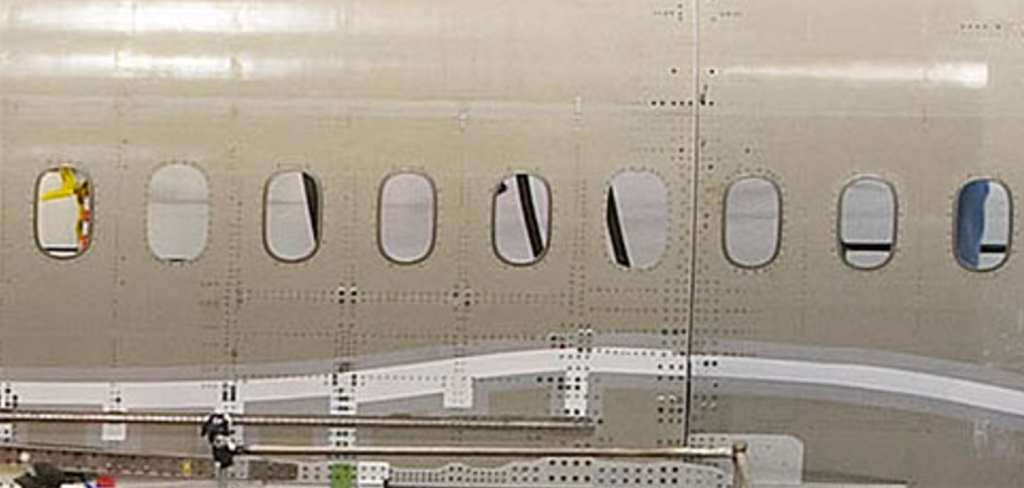
It’s because of one key capability: thermoplastic composite parts can be welded together rather than fastened (i.e., bolted). Figure 1 shows the amount of fasteners used in joining the thermoset fuselage skins, frames, longerons, and sections of the Boeing 787 fuselage (Airbus A350 is no different) .

Figure 1. Fasteners used in joining the thermoset 787 fuselage. Picture credit: Boeing.
Aeronautical thermoplastic composites
We focus on aeronautical thermoplastic composites as these use different variants of the PAEK family of polymer matrices. The dominant form is PEEK, which creates a very durable, high-strength composite. Other PAEK variants are being introduced to simplify thermoplastic composite production, as PEEK requires process temperatures of 380°C to 400°C.
So, what is PAEK, PEEK, etc., and why are these plastics many times more expensive than aeronautical epoxy? Every polymer in the PAEK family is made of three fundamental building blocks arranged in repeating chains:
- Aryl groups (A): Benzene rings that provide extreme rigidity, oxidation resistance, and thermal stability.
- Ether linkages (E): Oxygen bridges that act as flexible hinges, allowing the polymer to melt and become processable.
- Ketone groups (K): Carbonyl groups that create strong molecular interactions, enhancing crystallinity and chemical resistance.
The different acronyms within the PAEK family simply tell you the exact sequence and ratio of Ether (E) vs. Ketone (K) groups bound to the Aryl (A) rings. When utilized as a matrix for aeronautical composites, the exact ratio of ether-to-ketone groups impacts how parts are manufactured:
| Attribute | PEEK (Specific PAEK Variant) | Other PAEKs (e.g., PEKK) |
| Chemical Backbone | Fixed ratio: 66% Ether / 33% Ketone. | Variable ratios (e.g., PEKK flips it to 33% Ether / 66% Ketone). |
| Crystallinity Rate | Crystallizes rapidly. Requires strict, tight temperature control during cooling to prevent warping and internal stresses. | Tunable. Variants like PEKK can be modified to crystallize much slower, making them easier to form without warping. |
| Processing Temp | Extremely high (~380°C to 400°C). | Can be engineered to melt at lower temperatures, e.g., Low-Melt PAEK (LMPAEK) melts around 305°C, making composite processing easier. |
| Industry Adoption | The standard default for aerospace composites. | Rising as a major competitor in aerospace due to easier manufacturing. |
At the raw-material level, aerospace-grade PEEK matrix costs about five times as much as aerospace-grade epoxy resin. This cost difference stems from the extreme synthesis temperatures, high-purity chemical precursors, and rigorous qualifications required to produce PAEK thermoplastic matrices.
The thermoplastic manufacturing problem
Manufacturing thermoplastic composites requires overcoming the high melt viscosity of thermoplastic polymers (more like honey than liquid) to properly impregnate the reinforcing fibers. Unlike thermoset resins, which flow easily as liquids at room temperature, aeronautical thermoplastics must be processed through melt processing, i.e., heating the solid polymer into a viscous melt. This limits the composite manufacturing processes that can be used, as fiber infusion is off the table because of the melted polymer’s high viscosity.
Therefore, before shaping a final component, the polymer matrix and reinforcing fibers must be intimately mixed to minimize voids and ensure optimal load transfer. This can be done by:
- Fabric Film Stacking: Alternating layers of dry fiber fabric and thermoplastic film are placed into a press. The stack is subjected to high heat and pressure, forcing the molten polymer film through the fabric layers.
- Hybrid Yarns & Fabrics: Reinforcing fibers and thermoplastic polymer fibers are spun or woven together into a single hybrid textile. When heated during final molding, the polymer fibers melt to become the matrix and wet the fibers.
- Prepreg tape is produced by exposing the spread fiber tows to the molten polymer applied under high pressure through a die. The prepreg tape is then used in modified ATL/AFP tape laying systems.
When setting up a production line or designing a part for Carbon/PEEK, four factors dictate success:
- Thermal Management: You must heat the polymer to 380°C to 400°C to drop its viscosity enough for proper consolidation. Standard composites equipment cannot handle these temperatures.
- Cooling Rate & Crystallinity: PEEK is a semi-crystalline polymer. Its mechanical strength depends heavily on achieving roughly 30-35% crystallinity. If you cool the part too fast (quenching), it becomes amorphous and brittle; if you cool it too slowly, crystals grow too large, causing micro-cracking. A controlled cooling rate of 10°C to 20°C per minute is optimal.
- Tooling Materials: Standard aluminum tooling will distort or fail at PEEK processing temperatures. You must use Invar, steel, or specialized monolithic graphite tooling to match the thermal expansion and survive the heat.
- Warping sensitivity: Thermoplastic matrix polymers such as PEEK shrink significantly as they cool from a molten processing state back into a solid. Reinforcement fibers have a very low coefficient of thermal expansion and resist shrinking. As the matrix bonds to the fibers, the fibers restrain the matrix from shrinking, creating internal tension between the two materials. If the layup sequence is asymmetrical across the part’s thickness, one side will contract more than the other, forcing the part to warp when it is released from the mold.
The reason why its popularity is increasing
Despite the problems listed above, interest in thermoplastic composites in aircraft structures is increasing. It’s because a large part of the cost of a composite aircraft structure is the cost of joining the parts into assemblies and sections. This is especially true for the fuselage, which contains a myriad of part joins.
Parts can be joined with fasteners (titanium types for thermoset carbon composites), as in Figure 1, where join costs can be a significant part of the structure cost, or by less costly welding techniques when the matrix can melt, as car structures are spot-welded by robots on modern production lines. This is driving research into airliner fuselages made with thermoplastic composites.
As described, moving from the well-known, easy-to-work-with thermoset composite to thermoplastic parts is not easy, but if it succeeds, it promises to unlock high-rate, lower-cost production of complex aeronautical structures.
In next week’s Corner, we describe the present state of the art for thermoplastic composite structure production.
Related