
By Scott Hamilton
Aug. 26, 2026, © Leeham News: For nearly 20 years, beginning with the Potemkin-airplane 7-8-07 rollout of the 787, Boeing has stumbled from one miscue after another. The depths to which it bottomed out with the multi-year, multi-failures of the 737 Max program, were extended from March 2019 through mid-2024.
Consider:
- The 787 was 3 ½ years late. It racked up more than $50 billion in deferred production and tooling costs and billions in customer compensation. In addition to the deferred costs, a few billion dollars were written off for the first six test aircraft, none of which could be sold to customers. In October 2020, a production flaw in 787 assembly resulted in a 20-month suspension of deliveries. There was a big write-off for “abnormal production costs.”
- The 747-8 was 18 months late, and a few billion dollars were written off.
- The Max program’s problems are well known. And just when officials thought recovery was on its way, a door plug blew off a new 737-9 Max in January 2024. Boeing plunged into a new crisis that cost the chairman of the board, the corporate CEO, and the CEO of Boeing Commercial Airplanes their jobs.
- The KC-46A tanker program was a mess that still hasn’t fully been resolved. Deliveries were years late. The remote-vision refueling boom still doesn’t work properly. Nearly $8 billion has been written off.
- The 777X program is a financial mess. At Defense, the T-7, MQ, SLS heavy-lift space booster, Starliner capsule, and Air Force One programs are late, with cost overruns and technical problems.
It’s no wonder I’ve been a critic for all these years. Boeing had very little it could shout about from the rooftops. But it did a load of complaining from the bunkers.
Trending positively
Nevertheless, there is now a positive trend, evident in a series of events and improvements. Given the risk of unknown unknowns, sometimes brought on by Boeing itself, one must remain cautious about optimism.
Yet, I am the most optimistic about Boeing’s future as I have ever been. At the risk of sounding fawning, and I know his humility will reject this, the prime credit must go to Kelly Ortberg, who became CEO in August of 2024. The January door-plug blowout crisis wasn’t over, and Ortberg arrived at an awkward time: just 34 days before the contract with the IAM 751 expired. 751 is Boeing’s largest union, with 33,000 members, and it assembles the airplanes. After 10 years of being beaten down by prior CEOs, there was no way the members wouldn’t strike. They did, for 53 days. Boeing flirted with bankruptcy, saving itself with a $24 billion equity and debt raise.
Ortberg eschews taking credit for improvements that are converging today. Certainly, changes in final assembly, safety and quality control protocols were underway before he walked in the door. But his predecessor, David Calhoun, clearly fell short in follow-through on these programs.
Boeing’s executive committee advises Ortberg. So did former executives Ray Conner and Alan Mulally, both of whom had the respect of the workforce. Mulally continues to be revered by old-timers within Boeing (though he indeed had his flaws). But in the end, decisions are Ortberg’s to make. He’ll take the rap if they go wrong. He should get the credit if they go right.
Lots of work to do
When Ortberg joined Boeing, the Federal Aviation Administration (FAA) still had its thumb firmly planted on Boeing’s head. The company was severely limited in how it could achieve recovery; the FAA had to sign off on virtually everything when it came to designing, fixing, assembly, changing protocols and increasing production.
The production rate for the 737 was capped at 38 per month, a result of the door-plug blowout. Late last year, approval was given to boost the rate to 42 per month. This summer, the FAA granted authority to increase the production rate to 47 a month. Another increase, to 52 per month, is expected in the coming months. Fifty-two is the rate Boeing was at on March 10, 2019, when that second MAX accident happened. The global fleet was grounded three days later.
Ticketing authority revoked and finally restored
The FAA had revoked Boeing’s ability to certify its own airplanes as airworthy, the last step before delivery to customers. The FAA assumed that responsibility. This so-called “ticketing authority” was restored in July. (Boeing contributed $1 million to Sean Duffy’s American road trip video. Duffy is the Secretary of Transportation, whose department is the parent of the FAA. Pardon me for being cynical, but I can’t help but wonder if there was a connection to the restoration of ticketing authority. Maybe it’s just a coincidence, but the optics look horrible.)
After years of delay, certification of the 737-7 was granted last month. Boeing hopes certification of the 737-10 will come soon. The 737’s North Line, at the Everett, Washington, wide-body plant, was loaded with its first airplane for assembly on July 10. The North Line is required to return to that rate of 52 per month.
The 787 final assembly complex is being doubled in size so Boeing can produce up to 20 787s a month. For now, the target for increasing assembly is 14 per month, perhaps around 2030. The expansion is expected to be ready in 2028, enabling Boeing to reach a rate of 12.
Financial results
Despite the improvements, Boeing Commercial Airplanes still loses significant money, though the losses are shrinking. Losses are enough to put the entire company in a loss position; Defense made a small profit in the first half of the year, with a small loss in the second quarter.
An in-depth analysis by LNA, published on July 5 and July 6, concluded that Boeing is years away from full financial recovery and profitability across its divisions.
Resetting labor relations
There was little Ortberg could do to head off a strike by IAM 751. This die was already cast; the members were itching for a walkout.
Contracts with other, smaller unions were quickly agreed, except for one with IAM 837 at Boeing’s Defense plant in St. Louis, Missouri. This union only had 3,300 members. While tentative agreements were reached between the negotiating teams, the members rejected one contract after another. A frustrated Boeing official told me at the Farnborough Air Show, “We didn’t know who we were talking to.” This strike lasted more than 100 days.
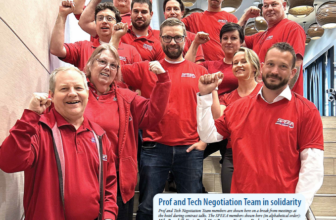
But the unions and contracts after 751 were all small. The next big test would come with the contracts with engineers and technicians represented by SPEEA. Both contracts expire on Oct. 6.
Talks began on July 1, earlier than usual. By July 30, a tentative contract had been reached. Both sides praised the collaboration at the bargaining table, in contrast to the tension and animosity that had permeated talks for the previous 29 years. The SPEEA talks could be the model for the 2028 contract talks with IAM 751. There is a real chance that Ortberg’s desire for a labor reset will come to pass.
Yet, membership voting on the two SPEEA contracts (one for engineers, one for technicians) reflected 10 years of pent-up anger. Despite unanimous recommendation for approval by SPEEA’s negotiating teams, both groups voted to reject the contracts by landslide proportions. They also voted to authorize a strike by even greater margins.
Talk will resume at an unspecified date—they must—but this is yet another legacy Ortberg inherited from Jim McNerney’s discredited 10-year tenure as CEO.
The next new airplane
Airbus is clear that it has no plans to move quickly to develop a replacement for its A320 family. CEO Guillaume Faury has repeatedly said that a program launch won’t come before 2030 (or maybe 2031), with entry into service around 2038. Boeing sees a 737 replacement more in the 2040 range.
But Boeing has also been studying whether to resurrect a version of the New Midmarket Airplane (NMA) that was set to launch in 2019, when the Max crisis began.
Ortberg has been clear that technology (principally engines), the airlines, and Boeing must be ready before a new airplane is launched. LNA figures that events could converge by the fall of 2028 or in 2029 for this to happen. The question is, what airplane will Boeing choose to make, a 737 replacement or the revised NMA?
Media relations and shareholder value
Before Jim McNerney became CEO of The Boeing Co. in 2005, the company had good relations with the media. Questions were answered with substance. But under McNerney, who didn’t really want to be bothered by the media and spurned most interview requests, relations began to “go south.” When, in 2007, the 787 program’s difficulties began to emerge, Boeing’s communications team retreated into the bunker and rarely came out. Executive access was denied. And the comms team actively engaged in efforts to undermine reporters and analysts who covered Boeing’s mounting travails.
Through the McNerney and David Calhoun eras, the comms team began a campaign to call reporters to complain about their stories, sometimes down to the use of a single word. Comms became notorious for replying to questions with ambiguity or answering questions that weren’t asked. Substance was all too often lacking. The comms team developed a horrendous reputation with the reporters.
Under Ortberg, some of these team members are gone. Access to executives is still sparse, and the comms team is still directed to respond “on background.” But at least for the most part, there is an effort to respond on background with real, substantive answers.
Calhoun and his CFO, Brian West, told analysts in November 2022 that they expected Boeing’s free cash flow to reach $10 billion per year by around the end of 2025. Left unsaid but, with a wink and a nod, was the message that stock buybacks and dividends might be restored then.
The January 2024 door-plug blowout also blew up shareholder value.
Ortberg hasn’t publicly said when shareholder value moves will be back. But he appears to understand that fixing the company correctly comes first and shareholder value will follow.
It’s a nice contrast to his predecessors.
Related