By Vincent E. Bianco III • Contributing Writer
October 12, 2026
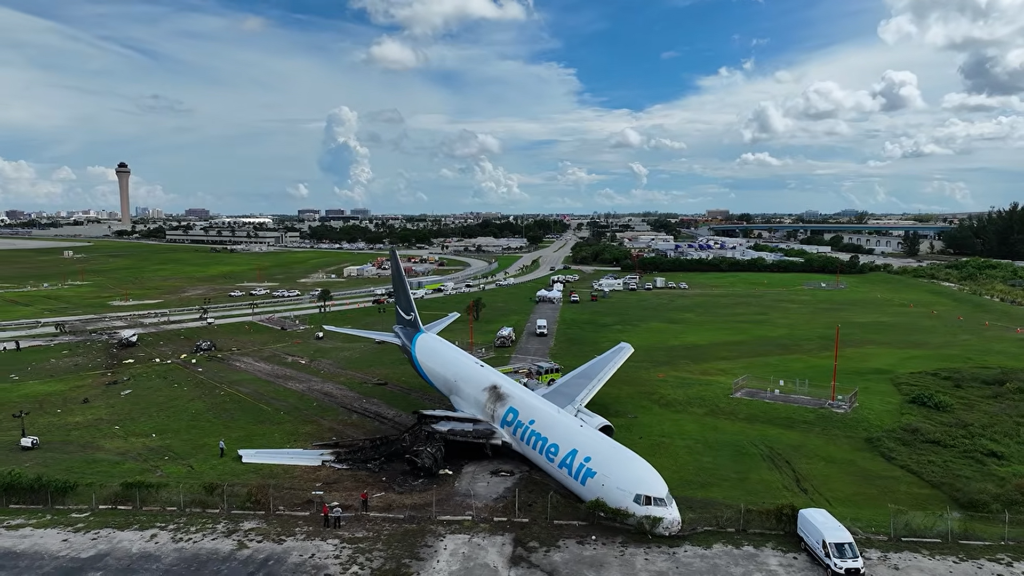
The basic facts have been established for weeks: On September 6, a Boeing 767 Freighter operated by 21 Air on behalf of Amazon landed long and fast after an approach to Runway 30 at Miami International Airport. It ran off the end at 113 knots and hit a van on the airport perimeter road. Five people in the van died.
The preliminary report from the National Transportation Safety Board (NTSB) outlines the crew’s role in the accident. It also shows that the tower cleared the airplane to land without giving the crew the wind reading, which FAA rules for controllers require whenever a tailwind is present.
The record starts with the crew.

The 21 Air-operated Boeing 767 involved in a fatal runway overrun in Miami in September 2026. Photo credit: Wikimedia Commons
The captain, who had earned his 767 type rating in May, was flying the inbound leg from Puerto Rico and had about 150 hours in the 767. He and the first officer had flown together for the first time that morning, on the leg to San Juan.
According to the airplane’s position broadcasts (ADS-B) and its flight data recorder, the 767 was about 105 feet above ground when it crossed the runway threshold at 177 knots, touching down about 3,750 feet down the runway at 160 knots. From flaps 20 on, the first officer repeatedly warned the captain that they were too fast. The cockpit voice recorder caught no consistent reply from the captain. Automated callouts warned “sink rate” twice and “too low terrain” five times. The captain called for flaps 30 at about 40 feet; investigators found the lever at 25.
On the runway, the speed brakes stayed down and the thrust reversers never deployed. With about 930 feet of runway left, the brakes came off and throttles went to go-around power—the setting for aborting a landing. Four seconds later the throttles came back to idle and the brakes went back on, with 415 feet left.
That is what happened in the cockpit. What follows is about the tower.
What the Tower Did
Miami splits its tower’s landing and takeoff duties between two controllers. That afternoon, the south controller worked Runways 9/27 and 12/30. The controller had 11 years of experience in air traffic control (ATC), had held the certification for that position since 2019, and had just started their shift. About 13:49 local time, with the 767 roughly 12 miles out, the controller cleared it to land on Runway 30. The clearance contained no tailwind warning.
The NTSB cites FAA Order JO 7110.65BB, the rulebook controllers call “The Bible.” Paragraph 3-5-3 is succinct: “When authorizing use of runways and a tailwind component exists, always state both wind direction and velocity.”
About four minutes earlier, the controller had given another flight the wind reading—190 degrees at 19 knots, gusting to 22 knots. The 767 was not on the frequency to hear it.
The rule exists for a good reason. Pilots expect to land into the wind, because that’s how controllers assign runways. A tailwind breaks that expectation, so such an order makes the controller say it out loud every time. What this crew would have done with that information is unknowable. What wind reading they had from the airport’s recorded weather broadcast, the Automatic Terminal Information Service (ATIS), the report doesn’t tell us.
The order requires a new broadcast whenever new official weather arrives, and the airport’s official record shows none between the 13:13 special weather report, which gave the wind as variable at 3 knots, and the 13:53 hourly report. When conditions change quickly, the tower is expected to give pilots the latest wind reading.
The Runway Question
The missed call is a symptom. The harder question is why Runway 30 was still the landing runway after the wind swung behind it.
The weather turned fast. At 13:13, the airport’s automated weather station showed the wind variable at 3 knots, with thunderstorms in the area. It logged a wind shift at 13:37. By 13:50 the wind was 190 degrees at 16 knots, gusting to 24 knots. The 13:53 observation read 190 degrees at 17 knots, gusting to 26 knots, and the peak gust of 26 knots out of 180 degrees came at 13:52.
Such wind shifts are common when summertime thunderstorms move across South Florida.
The order is clear on where the responsibilities lie: Paragraph 3-5-1 gives the tower supervisor (or controller in charge) the decision on which runway is in use. On how to weigh it, the order is blunter: Tailwind and crosswind considerations take precedence over delay/capacity considerations, and noise abatement operations/procedures/agreements.
The FAA wrote both into the order in 2022. It tells controllers to keep the supervisor aware of weather that affects their positions.
According to Leeham News and Analysis’ reading of the FAA’s published headings, Runway 30 points 299 degrees measured from true north, so a wind from 190 comes from behind and to the left. At the reported speeds, that is about 5-9 knots of tailwind and 15-25 knots of crosswind. Runways 26L, 26R and 27 point 267 degrees on the same scale. The same wind gives them 4-6 knots of headwind. The crosswind was about the same on all of them. Of the runways pointing west, only Runway 30 added a tailwind. Tower winds are given relative to magnetic north, about seven degrees off true north at Miami. Against Runway 30’s magnetic heading, the wind the controller read to another flight four minutes earlier, 190 degrees at 19 knots gusting to 22 knots, works out to roughly 8-10 knots behind a landing airplane.
What the Record Does Not Address
The preliminary report doesn’t tell us what comes next, nor can we expect it to. It doesn’t say whether Runway 30 was the airport’s planned runway setup or this crew’s request—the order expects a pilot who wants a different runway to ask—who was acting as supervisor, or whether anyone talked about changing runways after 13:37. Did the broadcast still carry the 13:13 wind reading?
If it did, the system was resting on a single directive from a single controller, on a busy frequency, in a thunderstorm. That would be what safety researcher James Reason called the “Swiss cheese model,” in which an accident happens when several small defenses fail at once. The NTSB’s public docket, when it opens, will fill in much of what we don’t know. It also doesn’t say what the position relief briefing covered, the handoff when one controller takes over from another.
Under the order, the controller leaving the position briefs the reported weather, both controllers share responsibility for a complete briefing, and a change that took effect July 9 spells out that both must work from the facility’s own relief checklist.
The order expects the relieving controller to be updated on weather conditions at the beginning of a shift, and to stay updated as conditions change. That relief came around 13:36, before the wind shifted. A briefing that was accurate at 13:35 could have been out of date within minutes.
This story does not offer a verdict. Nobody outside that tower cab knows what was in the controller’s head. But I do know from professional experience what a wind shift sets in motion at a busy airport: The tower calls the terminal radar approach control (TRACON) and the supervisor weighs a runway change against the arrivals already lined up on final approach.
Reroutes go out, runway assignments change, and coordination happens over landlines and face-to-face in the tower cab. The frequency recordings that the public hears do not capture those exchanges. FAA facilities must record operational communications to the maximum extent practicable, so investigators will have the landline calls the pilots never heard. What people said across the cab will be determined from interviews.
The NTSB will eventually find a probable cause. But it has already put one fact on the record: a required wind check never reached the 21 Air crew. Until the investigation determines what happened, air traffic control’s part in yet another fatal accident in the National Airspace System remains an open question. Following the fatal midair collision over the Potomac River in Washington, D.C. in January 2025 and the runway collision between a regional jet and a fire truck in March—both of which were fatal accidents—it is an unfortunate question to be asking again.
Vincent E. Bianco III is a contributing writer covering ATC for Leeham News and Analysis. He spent 23 years in FAA air traffic control and retired as an Air Traffic Manager.
Related