Subscription Required
By Scott Hamilton and Bjorn Fehrm
Aug. 13, 2026, © Leeham News: In 2017, Embraer faced what it thought was an existential crisis. Airbus agreed to buy 50.1% of the Bombardier C Series because of Boeing’s trade complaint against the Canadian company. If the purchase had been consummated (as it would be the next year), Embraer felt that its Commercial Airplanes division (ECA) could not compete with the C Series. Airbus had the marketing muscle, the ability to renegotiate C Series supplier costs, and the ability to wrap C Series deals with other Airbus airplane contracts.
Embraer officials thought the company would be overwhelmed with its standalone E-Jet program. So, Embraer and Boeing agreed to a new joint venture in which Embraer would sell 80% of ECA to Boeing to create Boeing Brasil.
Regulatory approval of the JV stalled, dragging into 2020, when another existential crisis hit: the global COVID-19 pandemic, which shut down industries across all sectors. Boeing, weakened by its Max crisis, walked away from the JV. Once again, Embraer was alone, and this time with costly carve-out work complete, in even worse shape than before the JV was announced.
The next few years were about survival. Today, Embraer is not only fully recovered—it is thriving.

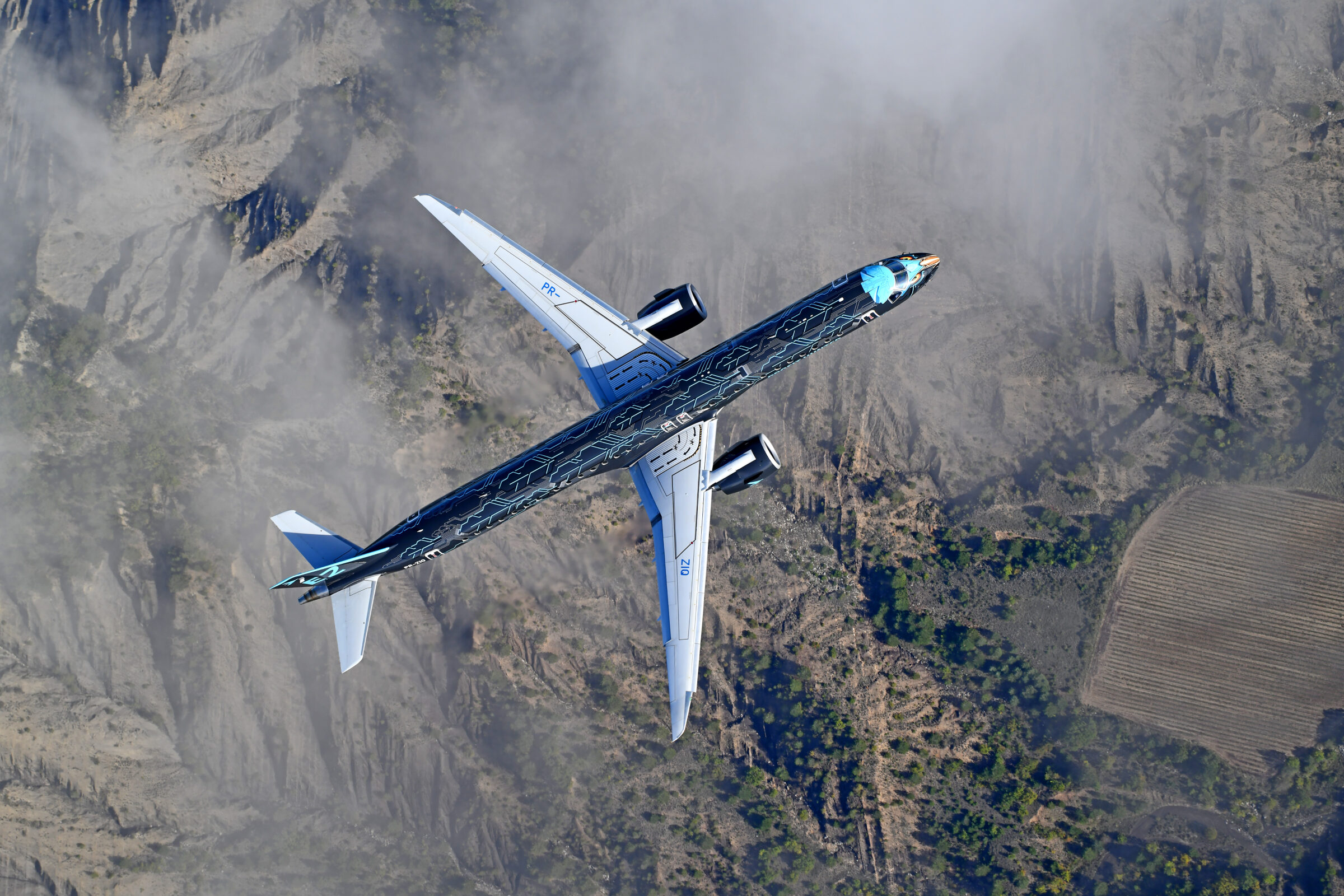
Embraer’s E195-E2 has proven a strong-selling aircraft in its segment, with adoption growing lately among Latin American carriers. Photo credit: Embraer
Today, Leeham News and Analysis (LNA) begins a four-part series about Embraer’s recovery—and how its financial and strategic fortunes rebounded from the lows of earlier this decade.
- Part 1: The regional market before 2018
- Part 2: The joint venture between Boeing and Embraer
- Part 3: Embraer, COVID through 2023
- Part 4: Turnaround, 2023-Present