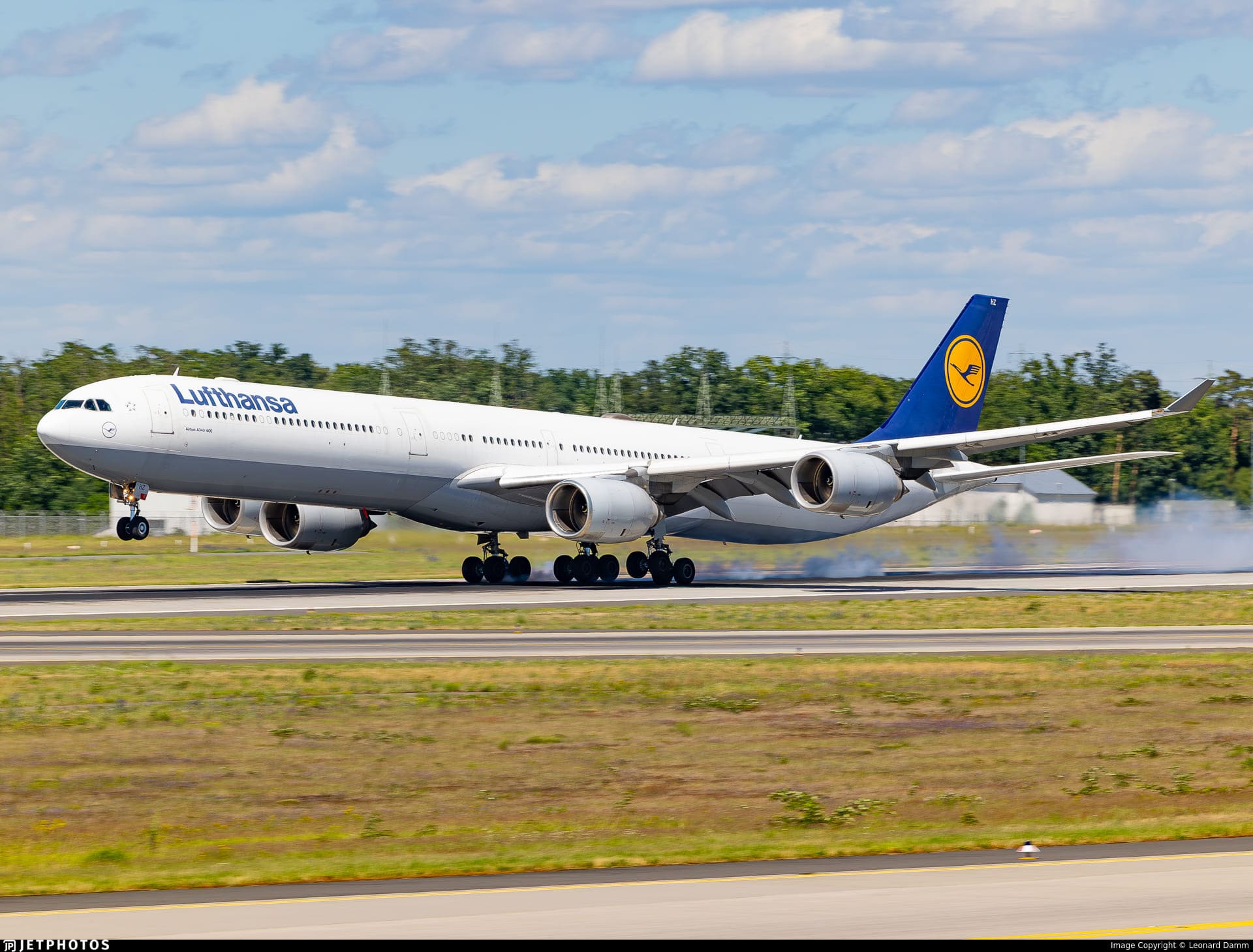
The end of an era is here: on October 18, Lufthansa (LH/DLH) will permanently retire one of its most iconic four-engine aircraft from service. Flight LH419 is set to mark the end of over 23 years of service for the Airbus A340-600—a tenure interrupted only by the COVID-19 pandemic.

In December 1997, Lufthansa placed its first order for Airbus A340-600 aircraft. The German carrier officially became the launch customer for this new Airbus project, which joined its previous models—the A340-200 and A340-300—aircraft that were already in service.
The deal was made official on December 5 that year, with a firm order placed for 10 Airbus A340-600s—a number that would eventually increase—along with another order for five Boeing 747-400s. At the time, the joint commitment represented a massive investment of approximately $2 billion.
Lufthansa’s selection of the Airbus A340-600 was far from routine. Both Airbus and Boeing offered the airline competing options to fill the capacity gap it was facing between the smaller A340-200/300 and the larger Boeing 747-400. Following a fierce battle between the manufacturing giants, Lufthansa ultimately chose the European aircraft.

Boeing had proposed the Boeing 777-300—its newly announced twin-engine aircraft—to Lufthansa. In 1997, the aircraft was not yet in service and would not make its maiden flight until a year later, a situation similar to that of the Airbus A340-600, which would not officially enter service until 2002. However, at that time, safety regulations for transoceanic flights by twin-engine aircraft—known as ETOPS (Extended-range Twin-engine Operational Performance Standards)—were not as lenient or flexible as they are nowadays.
For its part, Airbus offered the extended version of the Airbus A340, a family of aircraft Lufthansa had known very well since the early 1990s. Back then, the airline had eight Airbus A340-200s in its fleet and was about to take delivery of its first Airbus A340-300s. In addition, Airbus promised that the new aircraft would carry more passengers than its predecessors, maintain pilot training compatibility, and provide the flexibility to fly maritime or polar routes without restrictions thanks to its four-engine configuration.
The commitment for 10 firm orders for the -600 variant increased to 17 in June 2001, during the Paris Air Show at Le Bourget. Subsequently, the airline signed new purchase agreements and lease contracts for the addition of more Airbus A340-600s, eventually bringing Lufthansa’s total subfleet to 24 aircraft. As of this writing, four A340-600s remain in service, with operations scheduled to end on October 18, 2026.

On October 10, 2003, the Airbus A340-642 with serial number 517 made its maiden flight, still bearing the French test registration F-WWCR. In late November that year, carrying its German registration D-AIHB and having been christened “Bremerhaven,” the aircraft departed for Frankfurt on its delivery flight. Following a two-week period of crew-familiarization flights in early December, the aircraft officially entered commercial service on December 15, 2003.
Lufthansa chose its introduction into the Airbus A340-600 era to be on the Frankfurt–Buenos Aires route, one of the longest intercontinental services within its network. These aircraft replaced the Boeing 747-400s, which would eventually return to Argentina the following year on the Frankfurt–São Paulo–Buenos Aires route. In 2005, the flight became nonstop with Boeing 747s, as it remains today.
While Argentina marked its inaugural destination, North America—specifically the United States—proved to be the primary market for Lufthansa’s A340-600s, anchoring various routes throughout their operational lifespan. Major hubs like New York (serving both JFK and Newark), Washington, D.C., Chicago, Boston, and San Francisco saw regular service, alongside Canadian gateways like Toronto and Vancouver. Beyond the transatlantic market, the A340-600s also flew to Asia, the Middle East, Africa, and more countries in South America, including markets such as South Korea, Hong Kong, China, Japan, India, Israel, Saudi Arabia, South Africa, Brazil, Chile, and Colombia.

Lufthansa added the 24 Airbus A340-600s to its fleet between November 2003 and May 2009, keeping this number for nearly seven years before withdrawals began in 2016. Most of these retired aircraft have already been scrapped at various airports, although two of them continue to fly for Universal Sky Carrier (USC), a German cargo airline. This company purchased three additional A340-600s from Lufthansa, but they were used exclusively as a source of spare parts.
| Registration | Delivered | Retired | Age |
|---|---|---|---|
| D-AIHA | November 2003 | November 2018 | – |
| D-AIHB | November 2003 | February 2020 | – |
| D-AIHC | December 2003 | April 2020 | – |
| D-AIHD | December 2003 | March 2020 | – |
| D-AIHE | January 2004 | March 2020 | – |
| D-AIHF | February 2004 | March 2026 | – |
| D-AIHH | March 2004 | March 2020 | – |
| D-AIHI | April 2004 | November 2025 | – |
| D-AIHK | May 2004 | March 2020 | – |
| D-AIHL | May 2004 | March 2020 | – |
| D-AIHM | September 2006 | November 2016 | – |
| D-AIHN | September 2006 | September 2018 | – |
| D-AIHO | October 2006 | April 2016 | – |
| D-AIHP | November 2006 | June 2025 | – |
| D-AIHQ | January 2007 | March 2016 | – |
| D-AIHR | February 2007 | December 2016 | – |
| D-AIHS | March 2007 | February 2017 | – |
| D-AIHT | April 2008 | March 2025 | – |
| D-AIHU | May 2008 | May 2025 | – |
| D-AIHV | March 2008 | January 2025 | – |
| D-AIHW | December 2008 | – | 18 years |
| D-AIHX | February 2009 | – | 17 years |
| D-AIHY | March 2009 | – | 17 years |
| D-AIHZ | May 2009 | – | 17 years |
Flight LH419 is scheduled to depart Washington, D.C., on October 18 at 17:55 local time, touching down in Frankfurt the following morning at 07:55 local time. This final arrival will bring the curtain down on Lufthansa’s 23-year history with the A340-600, leaving the smaller A340-300 as the sole four-engine aircraft survivor of its generation in the fleet. The German carrier has already indicated that the remaining -300 variant is slated for retirement by 2027.

Lufthansa’s Airbus A340-600s will be replaced by state-of-the-art twin-engine aircraft, including the Airbus A350 and the Boeing 787 Dreamliner. Regarding the Airbus widebodies, the fleet will include both the A350-900 and A350-1000 models—the latter of which will enter service in December on the Munich–Tokyo route—as well as the Boeing 787-9 and 787-10.
Four-engine aircraft will continue to operate for Lufthansa, specifically four models: the A340-300, the double-decker A380-800, the veteran 747-400, and the modern 747-8 Intercontinental. The next quadjet to be retired will be the A340-300s; there are currently 11 in service, all based in Frankfurt.
| Aircraft | Total | Config | Average age |
|---|---|---|---|
| Airbus A319-100 | 21 | Y138 | 23 years |
| Airbus A320-200 | 38 | Y168 | 16 years |
| Airbus A320-200 | 6 | Y180 | 10 years |
| Airbus A321-100 | 14 | Y205 | 31 years |
| Airbus A321-200 | 37 | Y205 | 18 years |
| Airbus A321neo | 20 | Y215 | 5 years |
| Airbus A330-300 | 3 | C42W28Y185 | 16 years |
| Airbus A340-300 | 11 | C30W28Y221 | 27 years |
| Airbus A340-600 | 4 | F8C56W28Y189 | 18 years |
| Airbus A350-900 | 10 | F4C38W24Y201 | 2 years |
| Airbus A350-900 | 21 | C48W21Y224 | 8 years |
| Airbus A380-800 | 3 | F8C68W52Y371 | 16 years |
| Airbus A380-800 | 5 | F8C78W52Y371 | 14 years |
| Boeing 747-400 | 8 | C67W32Y272 | 27 years |
| Boeing 747-8 | 17 | F8C80W32Y244 | 13 years |
| Boeing 787-9 Dreamliner | 3 | C26W21Y247 | 7 years |
| Boeing 787-9 Dreamliner | 18 | C28W28Y231 | 3 years |

Cover photo: © Leonard Damm – JetPhotos (Frankfurt, Germany)