The book deals with the ramifications of traumatic accidents they’ve been through and navigates through love languages, communication styles, what it means to love someone for a lifetime and the ways in which we change and adapt to both life and love as we grow older.
Listen to the entire show on HealthLife.net here
Listen to the interview segment here
Hello and welcome to The Schapera Show where Vivien will explore this big adventure called life.
Our guest today is someone we have had on the show before and she has just written another bestseller which we want to hear all about.
Let’s welcome back Cara Bastone.

Hi Cara, thank you for returning to the show.
Hi Vivien, I’m so happy to be here.
I’ve been looking forward to this so much especially as I just read your new release No Matter What and I loved it.
I absolutely loved it and I’ve got lots to say about that but let’s go this way.
So your newest release is called No Matter What and even before it was released it was a big hit.
I love a success story so please, please will you tell us all about it? Will you share how long it took to become a bestseller and what happened with the librarians before the release? Oh gosh, this was such a wonderful honor, the biggest honor of my career to date.
What happened with the librarians is there’s something called the library read list and No Matter What was the March top pick and it’s very coveted in the publishing industry because it’s not a curated list, it’s simply popular demand and it’s voted by librarians who have read your book which means that No Matter What was popular voted as the top pick for March.
Only books a year are chosen for that and it was an honor beyond what I could have imagined.
It didn’t even occur to me it was possible and then suddenly I was told that it had happened.
It was an unbelievable honor and it’s made me so happy to go into every library I’ve been into since then.
I feel just thrilled.
As for being a bestseller which was probably heavily influenced by the library reads because it’s kind of a taste making list and it indicates to a lot of booksellers what books to buy and even put on their shelves, it became a bestseller in the first week.
In the first week? It did, yes.
Wow, Cara, that’s amazing.
It really, really is.
I still feel like I’m on a cloud when I think about it.
I can believe you.
It must be hard to come down from that because it’s such a grassroots vote, isn’t it? What the librarians thought should be the book of the month for March and there it was no matter what.
But let’s tell everyone what no matter what is and also that it is part of a series, isn’t it? Not in a strict sense but in some other sense.
Can you explain about no matter what, what it’s about and then in what way it’s part of a series? Yes, absolutely.
No matter what is a romance, we refer to it as romance expansive because it has a lot of story lines that have to do with not romance and just life in general.
The book is about a married couple who the opening scene is we’re seeing them having very hard times.
She finds Elise and that’s how she knows he’s planning on moving out.
The book deals with the ramifications of traumatic accidents they’ve been through and navigates through love languages, communication styles, what it means to love someone for a lifetime and the ways in which we change and adapt to both life and love as we grow older.
As for its place in this series, it’s very loosely referred to as a series because there’s really only one character that ties it will ultimately be four books.
There’s only one character that ties all four books together and he’s very lightly in this third book.
But in my mind and in the soul of these books, the first one Ready or Not was about unexpected pregnancy and dealt with birth.
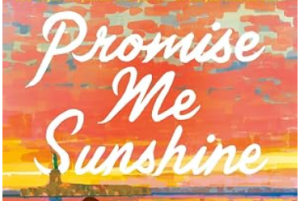
The second, Promise Me Sunshine, was about the death of a friend and what it means to fall in love while you’re grieving so that book is about grief and death.
This book, the third, is about PTSD and how we handle traumatic moments in our life and move forward.
The fourth is about body autonomy and self-perception and what it means to see and be seen as you fall in love.
So it’s these four greater themes that I think are unavoidable over the course of a lifetime and what it means to fall in love at these different stages of life, which is how I view the four being very connected to one another.
Wow.
All in the romance genre.
So that’s unusual, isn’t it? I mean, did you have trouble with your publishers convincing them that this was an okay thing to do?
Well, not my publisher so much because at this point they trust me to be able to pull the rabbit out of the hat.
I will say that people who haven’t read my books often struggle to understand how they can fit into the romance genre and think of them more as sometimes people call it women’s fiction or book club fiction.
But once they read them, I think they really do see that the romance is the spoonful of sugar.
It’s the base landscape to explore what can be really scary and/or unsettling themes.
But in my opinion, life is hard enough and I certainly don’t need a reminder of how life doesn’t always wrap up like a perfect pretty package.
And so for me, what I like to do in these books is create a safe playground where people can explore these topics, these real topics in a way that rings true and speaks to their personal experiences while being able to wrap it up safely so that they aren’t left feeling betrayed by what they’ve learned.
What they feel is that they were able to explore it and learn something and kind of end it appropriately so that they don’t have to carry it on into their life.
They can carry the glow of the book into their life.
They don’t have to carry the pain that they might encounter in the book.
The pain concludes the glow gets to go along with it.
Wow.
Well, I want to confirm a few things about that.
You’re not just speaking, ideally speaking, idealistically, because my experience of books is really important.
I have some personal experience that I do want to share.
But before that, I want to say how my book club responded.
So they read some pretty heavy books, which I have to admit, I can’t read.
They choose books set in a war landscape and some pretty difficult books and I just tend to avoid them.
I was very interested in how they responded to your book because no matter what, it’s a difficult topic.
It’s PTSD and imminent separation, perhaps divorce.
And it’s written about -something people, isn’t it? About how old are the characters in the book? I think he’s like young s and she’s late s.
Yes.
So in my book club, ladies were an old ladies group.
So their response was illuminating because they appreciated the book so much and they definitely were processing their life experiences through the palatability of your presentation.
And they raved about the book.
I mean, they absolutely raved about the book.
And they don’t usually do that.
We discuss the book and we hurry on to dessert and not in this instance, as you know, because you were there to talk to them, which was wonderful, absolutely wonderful.
So that was the one piece that I wanted to say.
And the angle that you come into with romance, what is that? How would you describe that? Can you?
Oh, I’ll try.
Well, I first have to say that speaking with your book club was one of my favorite events I’ve done for this book.
And it’s extremely validating because this book in particular, there’s not that many.
It’s an established trope.
Marriage in trouble is an established trope in romance.
But it’s pretty small, the number of books that fall into that category.
And the feedback I’ve gotten about what it means to write a love story for people who aren’t falling in love, but they’re recommitting to their love and going through, you know, phase two or three or four or five of a marriage as opposed to phase one, which is meeting and falling in love.
That has been extremely validating to me as a writer, but also as a married person.
I’ve gotten just to sort of see love through my reader’s eyes in whatever stage they’re in it.
And that was extremely validating.
As for the angle with which I approached this book, I thought that everything I write, I want it to feel true to life.
I’m not interested in big, unbelievable romantic scenes, you know, elaborate, lavish weddings or huge public declarations.
Oh, but it is.
Yes, exactly.
I’m really interested in the granular human-to-human moments of communication where love is actually watered.
I think everyone kind of knows by now, but, you know, a huge romantic gesture means nothing if you don’t connect to the person who’s giving you that romantic gesture on an almost cell-to-cell level where you’ve started from the ground up and you’ve communicated about who you are and what you need.
Okay, so how do we turn that into a book is the question I asked myself then, and so much of it is through my personal experiences.
This book is not autobiographical at all, but I was thinking, okay, I feel so much daily romance with my husband, and it’s not something you splash onto a movie screen, but I feel that it waters our marriage.
And so I was wondering, how do I put that into, how do I novelize that? And so I’m thinking of these issues.
They’re going through, oh, they’re having communication problems.
Maybe they’re falling into bad habits here, but then it hit me.
No, they’ve been through something.
They’ve been through something traumatic, and it changed the way they could see each other and communicate.
And that did come from my life.
And as I was writing, I was thinking, oh, man, I’m really nailing this PTSD storyline.
This is amazing.
I’m channeling it.
And then as I’m writing, I was thinking, oh, no, I think this is from my own experience.
And through writing this book, I was able to recognize that I probably needed to go to a therapist and talk about PTSD with them.
So Roz’s character arc through this book, her journey with PTSD, very closely mirrors my own.
Again, it’s not autobiographical, but it came from my empathetic imagination, and it comes truly from me into the book as well, which is always kind of the angle I try, not even try, it’s the angle that ends up showing up in my books is I’m in there somewhere.
You are in there, but the character, Roz, in No Matter What is so different from you and has such a different voice from you that I was actually almost shocked by the transition from reading No Matter What to the acknowledgments at the back where you come into your own voice and speak from your own voice.
And I go, what just happened here? And I was like, wow, and might be impressed that you were able to pull that off.
As you know, I’m a psychologist in my training background, and the authenticity, psychological authenticity, is a number one aspect for me when reading a book.
And you just pull that off.
And then I just want to be absolutely sure to say this as well, because, Kara, this is very meaningful for me personally.
My son who died, he was an artist, and the life drawing scenes in the book would normally have me just close the book because it’s too hard for me.
I mean, your book is about PTSD, and then you put in a life drawing scene as well, and I’m going, I don’t know if I can manage this, but it’s my book club book, and I’m the one who suggested it, and so now I have to read the book.
And I was in the middle of that debate, but reading, and the next thing, I’m laughing out loud.
I mean, really, the comedic scenes in No Matter What are unbelievable.
And of course, they do that in movies, don’t they? They paste, where you have a particularly intense scene, and then they give you a little break with some comedic value.
And you naturally, it seems like naturally, crafted that into No Matter What, and there I am, reading a book about PTSD, and there’s my trigger with the life drawing class, and instead of closing the book, I’m drawn along, and I’m laughing, and I’m metabolizing what I’ve been experiencing, and I’m now in a completely different place with all of that after reading No Matter What.
Wow.
Which is what I wanted to do on the show here.
Oh, sorry, go ahead.
That’s what I wanted to do on the show here, because mostly I’m not talking to fiction writers, I’m talking to people who’ve written non-fiction about these kind of topics, and yet your own book treats the topic of PTSD so successfully.
And I was wondering, how do you manage that balance?
You know, it came, again, from a very real place, because that’s actually what drawing has done for me.
And I think, in general, in terms of balancing the dramatic elements and the humor, so much of what romance does is deal with intimacy, and anyone who’s experienced genuine intimacy knows it often comes with a complete lack of dignity.
That’s a good point, you could be a writer.
There’s so much meat on the bone there.
You imagine going to a figure drawing class and having it be this romantic, well lit, candle lit experience where everything is, for lack of a better word, so sexy.
And then, if you’re me, you actually go to this class and there’s suddenly a naked man under fluorescent lights and you’re like, “
Oh, I guess I have to draw that.” And I just felt like, isn’t that light? You think it’s going to be one way, it turns out it’s another, and what can you do but metabolize what comes? And so that was very important to me, to capture what it actually is like to be in a figure drawing class.
And on a drawing level, a PTSD level, so much of what you’re doing when you’re drawing is capturing the essence of something on the page and making it live there.
And for me, in my drawing experience, there’s an essay at the back of the book where I discuss having lost a friend and turning to drawing where it was a way of codifying my memories of him was drawing.
And for that, art imitates life.
There’s an imitation of what it meant to go through the PTSD experience.
I thought if I’m writing this for the people in my life who have experienced something like this or something not like this, but they have PTSD, I need this book to not traumatize them.
I need this book to be safe.
And so I did try my very hardest to present it accurately and present it softly.
And I don’t mean out of focus.
Sharp focus, soft handling was really what I tried for.
Yeah, and you succeeded.
You definitely succeeded.
Cara, tell everyone how they can get hold of you, your website.
Of course, your book is available everywhere, including the libraries.
But just tell people how they can get hold of you.
Sure.
You can always find me at Carabastone.com, C-A-R-A-B-A-S-T-O-N-E dot com.
And the same, it’s @CaraBastone.
That’s my handle on Instagram.
Those are the best two places to find me.
Instagram? Yes.
And the web, yes.
Okay.
So what’s your favorite part? Just quickly, because we nearly have to take a break, but what was your favorite part of No Matter What?
Oh, man.
There is a scene, it’s the first scene I wrote for the book where she accidentally gets drunk with a classmate and realizes she’s on a date, but she’s still married and still very much in love with her husband.
She stumbles home quite drunk.
She can’t get her boots off, and she just explodes everything to him.
“
Oh, my gosh, I accidentally went on a date.” And instead of being mad or escalating the situation at all, he just finds the whole thing so hilarious, which to me, I mean, that’s marriage in a nutshell right there.
There’s just so much miscommunication, and you think you’re at your worst, and then your partner sees you through the clouds, and it turns out they’re adoring.
That truly was my favorite part of the book to write, and that scene was where the book was born from.
Wonderful.
Okay.
Cara, we’re going to come back after the break, and I’m actually going to ask you about yourself, because I think you’ve got such a lovely success story, and really that’s what this show is about, is helping people to become empowered and have success in their own lives, so I hope that’s okay with you, and everyone will be back after the break interviewing Cara Bastone about her success route.
Thank you.
Join us again.
Hello, and welcome back to The Schapera Show, where we are talking to bestselling author Cara Bastone.
We were talking about her newest release, No Matter What, but right now, we want to find out more about the person behind the success.
Are you up for it, Cara?
Oh, let’s do it.
Yeah, let’s do it.
Okay.
Thank you.
I have no advantage of knowing you for a while now, and I’ve been watching your progression with interest and open-mouthed wonder, because you basically achieved what is considered virtually impossible.
Many people are going to write a book, and it’s going to become a bestseller, and they don’t actually understand what that means.
Now, I want us to be talking in general.
You’re going to talk about book writing and succeeding at book writing, but the same elements of achieving success are there for every path that we may choose, and so those are the elements that I’m really hoping you will highlight, but you don’t have to do it self-consciously.
I think it’s going to come naturally if you just answer some questions.
Achieving the virtually impossible is of great interest to me, and you followed a step-by-step process that usually has a very low ceiling and that other people don’t even have either the capacity or the fortitude to sustain.
Can you tell us how you became an author? How I started my career was I was working as a receptionist at an NGO, and really, really not liking my job, especially how much time I was required to just sit and stare into nothing.
One day I Googled how to make money as a writer.
It took me immediately to a big website.
It’s the kind of website you can find someone to babysit your dog or find someone to come set up your Ikea furniture, but one of the other things it has is you can hire someone to write something for you.
I set up my profile, and I started applying to jobs of people who wanted novelists that they could then say that they had written the novel.
I got my first job within hours.
I wrote a -word novella over about five days and sold it for $which is obviously not very much money for how much work that was.
When I was over the moon, I was thrilled, and I started to get other jobs like that very slowly increasing my fee.
Someone I love was appalled at how cheaply I was willing to work, and he said, “Price yourself what you think you’re worth.” I did, and then no more work came my way, and I had outpriced myself.
I hadn’t built my foundation enough.
I was worth that price for what I knew I could potentially do, but you have to do a certain amount of work to be able to show your potential to other people.
I learned a hard lesson.
I changed my prices back down, and I decided to climb my way out of that fee structure to a more feasible fee structure where I could then eventually leave my job and then eventually leave ghostwriting altogether right under my own name.
I was talking actually with you about it, Vivian, where most people refer to that process as starting from the bottom, climbing up a ladder.
You referred to it as swimming through a river of a bad word that I won’t say on the radio.
That was so much more apt to me because climbing a ladder is the same all the way up.
Swimming through, let’s say a river with a very rough current at the beginning, the muscles I had to create to get to the other side of that first river were extremely dexterous, extremely strong, and I had to be willing to swim in very bad conditions.
Then the next river I went to, when the conditions were a little bit better, I was attacking it with that same ferocity that I had learned how to do in that very first very high current bad river.
Now I’m in a little bit of a different but maybe clearer river, and I can see the path in front of me, but I’m still using these very strong muscles that I’ve cultivated.
I think that really is, for me, that was the path to success.
It wasn’t just starting at the bottom.
It was starting in the hardest conditions possible and cultivating the type of skills I was going to need that were going to serve me.
If I had taken a short cut like I tried to at the beginning of pricing myself up so much higher to get to this price point that I needed to be at to make it my full-time job, I would have missed out on all of that muscle building that came between that low fee structure to the one that actually allowed me to leave my job, but I had to get there.
I had to do it.
I had to swim it.
I couldn’t short cut it.
That’s right.
There’s a river of doo-doo between us and what we want, and I don’t swim it by the way.
I’d say wade across.
It’s only ankle deep, but people don’t want to put their feet in it.
That’s where the issue is for so many people is that they don’t want to do what has to be done to get to where they want to be.
That thing about pricing yourself as to what you’re worth, I’ve heard and watched people getting that advice and causing them to falter and actually stop.
That’s exactly what you didn’t do.
I can only say that that is exactly why I’ve been watching you with an open mouth, because you got that figured out and you knew, “That’s what I want.
I’m going to get it.” That’s what it takes, isn’t it? That’s certainly what it took.
I’ve seen other people achieve success in a very similar pattern, so it seems to reinforce the older I get.
I’m sure you’re glad that it’s behind you, and yet they are very good.
As you said, it built these muscles.
It’s built you a foundation.
It was formative of not only your career, but also who you are as a human being.
Would you agree with me? I do agree with you.
In some ways, it doesn’t feel behind me because, for instance, a lot of the feedback I get from my industry is about my capacity to finish projects.
People are very amazed when I’m on deadline, when I meet things on deadline.
I’ve fine-toothed combed a project instead of taking one last glance at it and passing it along.
It’s these same skills that I was cultivating at the very beginning.
They serve me over and over and over, and they make me stand out within the industry.
Wonderful.
That’s wonderful.
Cara, can you just share with everybody how they can get hold of you and your books? Yes.
 You can find me on Instagram at carabastone.com, C-A-R-A-B-A-S-T-O-N-E.
You can find me online, carabastone.com.
The other one I forgot to mention is if you go to my website, you can sign up for my newsletter.
I will pop into your email.
I won’t sell you anything.
You’ll hear me talk about my life and writing.
Find out about the events that you participate in because there’s a lot of those, too, isn’t there? Yes, quite a bit.
Definitely, folks.
Go to carabastone.com because there is information there that will surprise you.
We’ve only said about half of what I was hoping to get through today, but thank you for joining us all here on the Schapera Show.
Thank you, Cara for coming and speaking to us again.
I know that your next book, I’ve got it.
We’re going to have to have you back for that one, too.
I’ve got you, isn’t it, the next book? It is, yes.
 There’s also all the audible books and material, isn’t there? There’s just too much to talk about, and we have to stop so sad about that.
Thank you.
Thank you, everyone.
Thank you for having me.
You’re so welcome.
After the break, Neil will be giving his report from the Spirit Realm.