One of my favorite things about Chinese medicine is that you don’t have to wait until something is wrong to use it.
In fact, that’s missing a large part of the point.
Traditional Chinese Medicine has always placed tremendous importance on maintaining health, cultivating vitality, and recognizing patterns of imbalance before they become bigger problems.
Modern healthcare tends to ask, “What disease do you have?”
Chinese medicine asks a slightly different question:
“How well is your body functioning?”
Those aren’t necessarily the same thing.
You can have normal lab results and still feel exhausted. You can be told everything looks fine while struggling with poor sleep, digestive problems, headaches, painful periods, brain fog, stress, or simply feeling like something is off.
Chinese medicine pays attention to those clues.
Chinese Medicine Is About Nourishing Life
There is a beautiful concept in Chinese medicine called Yang Sheng, which is often translated as nourishing life or cultivating life.
I think this concept captures the purpose of Chinese medicine perfectly.
Health isn’t simply the absence of a diagnosis. It’s having enough energy to move through your day, digesting your food well, sleeping deeply, thinking clearly, moving without pain, adapting to stress, and having the physical and emotional reserves to recover when life inevitably throws something at you.
Chinese medicine was developed around the idea that these functions should be supported throughout life—not only when we’re sick.
That’s a very different way of thinking about healthcare.
Your Body Usually Whispers Before It Yells
The body is remarkably good at giving us clues when something is becoming imbalanced.
Unfortunately, we’re also remarkably good at ignoring them.
Maybe you’re more tired than you used to be. Your digestion isn’t quite right. You’re waking at 3 a.m. every night. Your periods are changing. You’re getting headaches more frequently. You’re suddenly freezing all the time—or throwing the covers off in the middle of the night because apparently your internal thermostat has developed a personality of its own.
These symptoms don’t always mean something serious is wrong.
But they are information.
Chinese medicine pays attention to those early changes because they help us understand where the body may need support.
I’d much rather listen when the body whispers than wait until it starts yelling.
Chinese Medicine Looks for Patterns
Traditional Chinese Medicine doesn’t look at the body as a collection of unrelated parts.
Your digestion can affect your energy. Stress can affect your sleep. Your menstrual cycle can tell us something about Blood, Qi, Yin, and Yang. Chronic digestive problems can influence how well you’re nourishing the rest of the body.
This interconnected way of thinking is one of the reasons a Chinese medicine consultation can feel very different.
You may come into my office because of migraines and wonder why I’m asking about your digestion.
Or you may come in for fertility support and find me asking about your feet being cold.
There is a reason for the questions.
I’m looking for patterns.
What Are We Trying to Balance?
You’ll often hear Chinese medicine described as “balancing the body,” but that phrase can become a little vague.
What exactly are we balancing?
Chinese medicine looks at relationships between Qi, Blood, Yin, Yang, Jing, Body Fluids, and the organ systems.
These aren’t simply interchangeable words for Western anatomical structures. They describe functional relationships within the Chinese medicine system.
For example, a person may have signs of Qi deficiency, Blood deficiency, Liver Qi stagnation, Dampness, Yin deficiency, or Blood stasis.
Often, several patterns exist together.
The goal isn’t to force everyone into one diagnosis. It’s to understand your particular pattern and help the body move toward better function.
Your Pulse Tells Me More Than Your Heart Rate
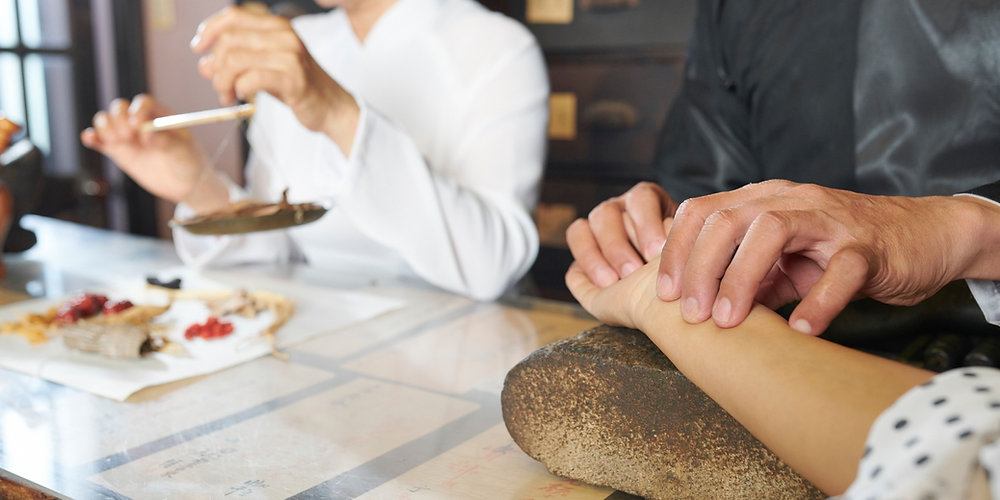
One of my favorite diagnostic tools in Chinese medicine is pulse diagnosis.
When I feel your pulse, I’m not simply counting how many times your heart beats per minute.
Chinese pulse diagnosis looks at the quality, strength, depth, rhythm, and position of the pulse to gather information about what’s happening throughout the body.
A pulse may feel wiry, slippery, weak, deep, rapid, thin, or have other qualities that help complete the picture I’m seeing from your symptoms, tongue, health history, and overall presentation.
This is one reason Chinese medicine is so individualized.
Ten people can walk into my office with the same Western diagnosis and have ten different pulse presentations—and potentially ten different treatment plans.
Acupuncture Is Only One Part of Chinese Medicine
When most people hear “Chinese medicine,” they immediately think of acupuncture.
Acupuncture is an important part of the system, but it’s only one piece.
Traditional Chinese Medicine also incorporates Chinese herbal medicine, food therapy, lifestyle practices, movement, and other therapeutic techniques.
I frequently combine these approaches because they can support the body in different ways.
Acupuncture may be used to influence the nervous system, address pain and muscle tension, support circulation, and regulate patterns within the body.
Chinese herbal medicine allows us to continue addressing those patterns between office visits.
Food therapy takes those same principles into your kitchen.
That’s when Chinese medicine stops being something you “get done” at an appointment and starts becoming a way of understanding how to support your health every day.
Food Is Part of the Medicine
Chinese medicine has understood the relationship between food and health for thousands of years.
Food isn’t simply broken down into calories, protein, carbohydrates, and fat. Chinese food therapy also considers qualities such as temperature, flavor, season, and how individual foods affect different patterns within the body.
A food that’s wonderful for one person may not be the best choice for another.
Someone with significant Spleen Qi deficiency and Dampness may need more warm, cooked, easily digestible foods. Someone experiencing Yin deficiency with dryness and night sweats may require a completely different nutritional strategy.
Neither person necessarily needs a “healthier diet.”
They need a diet that makes sense for their body.
That’s one of the reasons I love incorporating Chinese food therapy into my practice.
Chinese Herbal Medicine Is Personalized Medicine
Chinese herbal medicine works according to the same philosophy.
There isn’t simply one herb for headaches, one formula for menopause, or one bottle everyone with digestive problems should take.
Herbs are combined into formulas according to the person’s Chinese medicine diagnosis and overall presentation.
As the person changes, the formula may change too.
Early treatment might focus on moving stagnation or clearing an excess pattern. Later, the strategy may shift toward strengthening Qi, nourishing Blood, supporting Yin, or rebuilding deeper deficiencies.
The treatment evolves because you evolve.
Why Continue Chinese Medicine When You Feel Better?
This is a question I love because it brings us right back to the purpose of Chinese medicine.
Many people initially come to acupuncture or herbal medicine because something hurts or isn’t functioning properly.
Once that problem improves, they sometimes continue treatment because they’ve realized they simply feel better when they’re taking care of themselves.
Their digestion is more consistent.
Their stress feels more manageable.
Or they notice when their body starts drifting away from its normal baseline much earlier than they used to.
At that point, Chinese medicine becomes less about treating a problem and more about maintaining health.
Dr. Stephanie’s Tip: Don’t wait for your body to become unbearably loud before you start listening to it. Pay attention to the little changes.
If your sleep suddenly changes, your digestion isn’t normal, your energy is dropping, your cycle is different, or stress is affecting you more than it used to, those symptoms are worth noticing.
Your body doesn’t wake up one morning and randomly decide to become difficult.
Usually, it has been leaving breadcrumbs for a while.
Chinese medicine teaches us to notice the breadcrumbs.
Preferably before they turn into an entire loaf of bread.
Chinese Medicine and Modern Functional Medicine
One of the reasons I combine Chinese medicine with functional medicine in my practice is that I don’t believe we have to choose between ancient wisdom and modern testing.
They give us different types of information.
Chinese medicine allows me to evaluate patterns through symptoms, pulse diagnosis, tongue diagnosis, and the relationships between different systems of the body.
Functional medicine allows us to investigate physiology through laboratory testing and look more closely at areas such as nutritional status, metabolic health, hormones, digestion, and other biomarkers when appropriate.
I find the combination incredibly useful.
One gives us a system of medicine refined over thousands of years.
The other gives us access to information those ancient physicians could never have measured.
Why wouldn’t we learn from both?
Chinese Medicine for Women’s Health and Healthy Aging
I think the philosophy of nourishing life becomes particularly important as we move through different stages of adulthood.
Our bodies aren’t supposed to remain exactly the same at 25, 45, and 65.
For women, pregnancy, postpartum recovery, perimenopause, and menopause can create significant shifts in Qi, Blood, Yin, Yang, and Jing from a Chinese medicine perspective.
Instead of fighting every sign of change, Chinese medicine gives us tools to support the body through those transitions.
This is also how I think about healthy aging.
The goal isn’t to stay 25 forever.
It’s to have enough vitality, strength, nourishment, mental clarity, mobility, and resilience to feel well in the body you have now.
Chinese Medicine in Central Florida
At New Direction Natural Medicine in Altamonte Springs, I combine acupuncture, Chinese herbal medicine, Chinese pulse diagnosis, food therapy, and functional medicine to create individualized treatment plans.
Patients come to us from Orlando, Winter Park, Maitland, Longwood, Lake Mary, Sanford, Casselberry, Apopka, and throughout Central Florida for support with women’s health, perimenopause and menopause, fertility, digestive health, stress and anxiety, chronic pain, and overall wellness.
But you don’t necessarily need to have a long list of symptoms to benefit from Chinese medicine.
Sometimes the goal is simply to stay well.
The Real Purpose of Chinese Medicine
The purpose of Chinese medicine isn’t simply to treat disease.
It’s learning to recognize your body’s patterns, support areas that have become depleted or stagnant, adapt as your body changes, and maintain health throughout the different seasons of life.
Acupuncture, herbal medicine, food therapy, and lifestyle aren’t separate pieces of that philosophy.
They’re different tools with the same goal:
Helping the body function as well as it can for as long as it can.
That’s the part of Chinese medicine I wish more people understood.
You don’t have to wait until you’re sick to take care of your health.
In fact, that’s kind of the point.