Turgut Erçetin does not lack for ideas, either conceptual or musical. In the five pieces across this overview of his work, in-between, we hear various chamber ensembles, a early-music group paired with a full orchestra, and a brass duet. That’s just the start. This music is stupefyingly complex.
Many composers claim to be interested in acoustics. Erçetin walks the walk: He has worked as a researcher at Stanford’s Center for Computer Research in Music and Acoustics, where he helped build a simulation of the acoustics of the Hagia Sophia in Istanbul. He specifies where musicians should sit in relation to one another (dependent, in part, on the performance space), and occasionally asks them to move around while playing. The trumpet-trombone duet, Das Phonem zwischen zwei Wörtern (a), tells each performer the angle at which they should hold their horns for each note. It changes often.
A lot of this stuff doesn’t come across on a recording. Still, you can hear both the complexity and Erçetin’s preoccupation with sound itself. Especially in the larger configurations, instruments often enter to play just one note, or a short phrase repeating a single pitch. Nearly every phrase is given some dynamic movement. In the brass duet, the trombonist is asked to play three sixty-fourth notes, at forte, pianissimo, and mezzo forte consecutively. Is that possible for a human to execute? Could anyone hear it if he did? I don’t know, but to some degree, the dynamic yo-yos are audible throughout this collection.
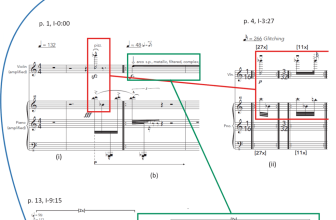
Where Erçetin really shines is his writing for woodwinds, especially clarinet. Carl Rosman, of the Ensemble Musikfabrik, fully meets the challenge of the final piece in this set, Resonances (b), for clarinet and string trio. It makes truly staggering demands on the soloist. The part is written on two staves, one of which indicates how much of the reed to use. Like the dynamic markings, these shift constantly. The rhythmic notation is no cakewalk either: Rosman compares it to that of the notoriously difficult Brian Ferneyhough, with the written music often implying contradictions between the literal meaning of the notation and how groups of notes should be phrased.
Somehow, Rosman–as well as oboeist Peter Veale and bassoonist James Aylward on Das Phonem zwischen zwei Wörtern (c)–manages to transcend all that. You can focus on the intricacy and sit in awe, or you can simply listen for novel sounds, of which there are plenty.
Somehow, this description has yet to capture everything Erçetin is up to. He helped model the Hagia Sophia, as I’ve said. But in Das Phonem zwischen zwei Wörtern (b), the piece for full orchestra and baroque quartet, he’s working with the acoustic properties of spaces that no longer exist, including the ruined Basilica of St. John in Ephesus. The same piece is also an example of his “simultaneous” technique, in which the orchestra piece and the quartet piece can be performed separately or together. Again, these concepts probably don’t influence how the music sounds on record. But it would be fascinating to hear the “simultaneous” pieces in all their permutations.
This is just the second major recording of Turgut Erçetin’s work. With his imagination and ambition, there’s little doubt he will come up with material for plenty more.