Your book explores the formation of early twentieth century “Anglo-Protestant” identity in Chicago, especially as it opposed the ethnic enclaves that animated the city’s political machines. Tell us more about this term, “Anglo-Protestant.” Where does it come from, and why don’t we see it more in our scholarship? How does this term help us understand Chicago’s community formation better than the term “white” or “whiteness”?
Thank you for picking up on that, as a lot of thought went into my choice to use that term. So much of the scholarship on the origins of fundamentalism and the evangelical movement it helped consolidate has focused on shared theological commitments or certain social impulses. As scholars like Judith Weisenfeld, Terene Keel, and Katharine Gerbner have shown, however, every religious movement is in some way racialized. Weisenfeld in particular coined the term “religio-racial” to describe how these cultural categories inform and shape each other. I actually considered describing Frank Wood’s faith as a religio-racial movement for a time, and I think that term can be applied to segments of the evangelical movement today. But I paused because Wood’s sense of himself as white in this formative period was inextricably wrapped up in his belief that he was an inheritor of those English traditions that he believed had founded the United States of America in the seventeenth and eighteenth centuries. Though a country boy from central Illinois, Wood claimed his true roots went back to the colonial shores of Massachusetts Bay, and that he continued the work of these founding fathers in the city.
And so, Anglo-Protestant became the term of choice. The term also had two added benefits. For one, it approximated the way Wood and his classmates described themselves, which was often as “Anglo-Saxon.” But the term also serves as a more subtle historiographical critique of the argument that evangelicalism emerged from the theological ferment that spanned of what is often called the Atlantic, or Anglo-Atlantic World. Where other scholars have traced the transatlantic movement of a certain revivalist sensibility, I think the term Anglo-Protestant more forcefully centers the importance of race to this supposedly shared history.
You observe that around 1914, the inter-denominational Sunday School curriculum of the International Sunday School Association became the subject of intense debate between those who leaned in the direction of the social gospel and those who promoted publications like The Fundamentals pamphlet series. What was at stake for Frank Wood in these debates and why should historians outside the field of religion care about them?
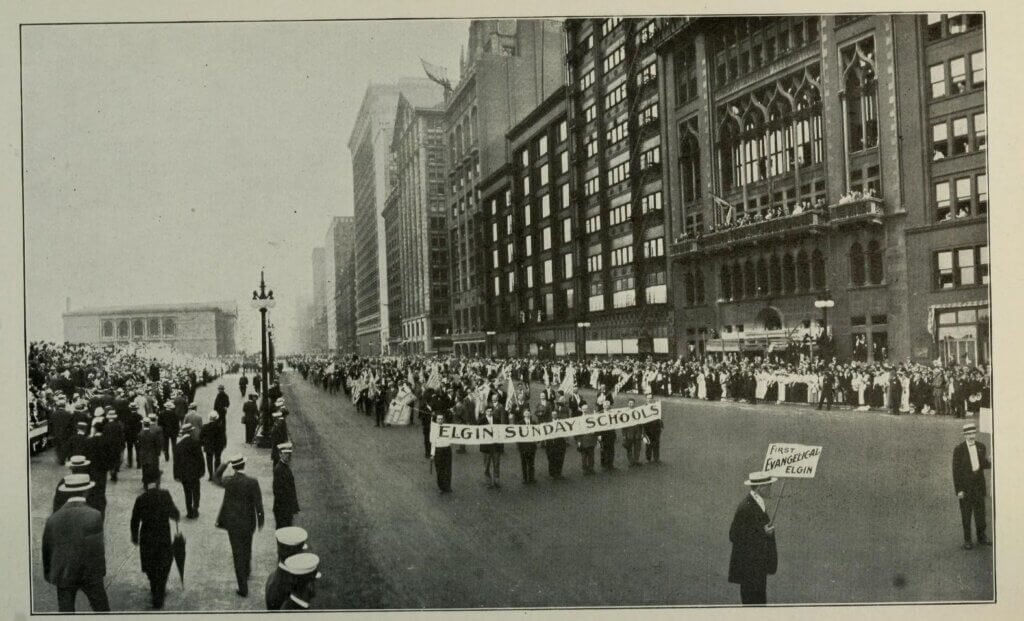
This, to me, was one of the more fun sections of the book to write, as it reveals how ordinary folks can profoundly transform the movements that recruit them. The International Sunday School Association was an ecumenical body that had published a widely popular Sunday school lesson series since the 1870s. In some corners of American Christianity, it’s still in use today. But when folks like Frank Wood began forming tens of thousands of adult Bible classes across the country, the curriculum suddenly became controversial. More liberal Protestants believed that classes full of grownups could handle the weighty insights of modern scholarship and worked to have the Association publish a series of “advanced” lessons that introduced Bible class students to the higher criticism and the social gospel. The effort provoked a response from conservatives, whose more prophetic or more evangelistic reading of scripture argued for keeping the Bible as the Sunday school’s only “textbook.” In an effort to counter their liberal colleagues, the ISSA’s conservatives, many of whom were also architects of the emerging fundamentalist movement, recruited Bible class teachers like Frank Wood to the organization. They hoped that the interest of Bible class teachers in remembering their rural roots might help the conservatives defend the ISSA’s lessons series as it was originally conceived.
The plan ended up backfiring, with both sides losing spectacularly. While Bible class teachers like Frank Wood may have been no fan of liberal theology, they had no problem with a local church that engaged in social action around a variety of local issues. For the conservatives, this meant that Bible class teachers actually supported the creation of an advanced lesson plan that promoted a robust social service program in their churches. For the liberals, however, this meant that most Bible classes were more interested in curbing the influence of non-Protestant immigrants in the city through election reform or local option campaigns more than supporting the labor movement. The fight ended up fracturing the International Sunday School Association. More importantly, however, the debate revealed how the racial and religious anxieties of ordinary Bible class teachers influenced, and thereby helped shape, the fundamentalist movement that sought their support.
Wood supported many “Progressive” causes throughout his life but ultimately could not bring himself to support Anton Cermak or any of Chicago’s New Deal Democrats. Why? What does Wood’s opposition to the New Deal teach us about both the Republican Party and the making of twentieth century evangelicalism?
In many ways, Wood’s initial support for policies like municipal ownership or the mandatory arbitration of industrial conflicts is a testament to just how awful it was to live in Chicago at the dawn of the twentieth century. Violence, inequality, and monopoly power affected everyone. But Wood’s interest in these efforts, as well as his eventual abandonment of them once they became a part of modern liberalism does have a certain logic to it. For Wood, urban governance—and governance more generally—was filtered through his understanding of community. It was a notion profoundly influenced by the memories he held of life in America’s hinterland before cities became the lodestones of American life. Those who were contributing members of a community were entitled to that community’s aid. For Wood, the municipal ownership of Chicago’s utilities was akin to a modern barn raising or corn husking. Something the community did to help itself. But that extension of aid was ultimately conditional. It required that citizens adhere to community norms in order to receive acceptance, which for Wood meant a certain deference to the nation’s Anglo-Protestant heritage. The emerging New Deal Coalition’s celebration of the nation’s ethnic diversity proved too much for Wood and others like him, for it did not require these American newcomers to defer to the traditions that preceded them. For Wood, his rejection of both the social gospel and the New Deal was as much about race as it was about theology, for the two were inextricably entwined.
In his older age, Frank Wood worked to preserve the history of Anglo-Protestants in Chicago by helping to found the city’s first neighborhood historical society in 1930. Why was this historical curation so important to Wood? What does it teach us about the making, and remaking, of American evangelicalism?
Wood’s interest in history served both political and theological purposes; and it was often tough to distinguish between the two. Politically, Wood’s turn to public history occurred at a moment when white, native-born Protestants of Anglo-European descent were no longer the neighborhood’s powerbrokers. Curating exhibits and developing an archive was a way for Wood and those like him to preserve their history and advocate for its centrality to both Chicago’s and America’s history.
Theologically, history helped Wood articulate what it meant to be a fundamentalist—and, later, an evangelical Christian. This is, in many ways, the book’s central argument. Without the benefit of an ecclesial authority or founding creed, history became the primary means by which fundamentalists and evangelicals like Wood articulated their social reality. They reached back into the diversity that is the history of Christianity and compiled a genealogy of spiritual forefathers who gave shape to an otherwise nebulous movement. And like the attendees of most Bible classes at this moment, this family tree was almost entirely made up of white Protestants of Anglo-European descent. This, in turn, wedded the evangelical movement that took shape after Wood’s death to the whiteness that continues to define it today.
I was able to make this latter point through the remarkable good fortune of connecting with Wood’s living relatives. The family remains a part of the faith, but they are deeply divided over its purpose. Some point to Wood’s support for progressive policies as proof of evangelicalism’s commitment to justice, while others emphasize his affiliation with organizations like the Moody Bible Institute as proof of his doctrinal orthodoxy. This debate over the history of evangelicalism is, in my estimation, what evangelicalism is; a religious movement that is constituted by a history that situates white Protestants at the center of America’s past, present, and future.
It’s also just a hell of a story, which was ultimately what drew me to center the book on Wood’s remarkable, and remarkably well documented life. There’s another version of this book that is possible which is situated in the mass migration of ordinary people. The ability to anchor this argument in the story of one person and the stories they both heard and told proved incredibly fulfilling for me. I hope it is to the reader too.