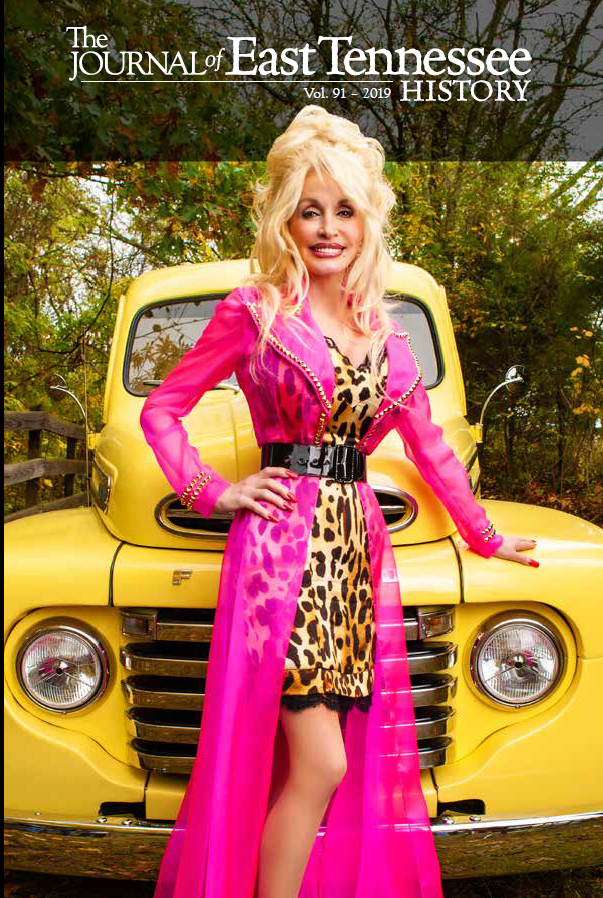
I am so pleased to learn that the late great Dolly Parton was not only a brilliantly talented singer/ songwriter and humanitarian, but, as David J. Gerleman’s 2019 article reveals, also a descendant of Southern Unionists from the Civil War Era.
—Vikki Bynum
By David J. Gerleman
published in the Journal of East Tennessee History, Vol 91, 2019


Dolly Parton has long been hailed as Sevier County Tennessee’s most celebrated resident and as a national cultural and entertainment icon, but there is little information about her ancestors. In recounting her upbringing near Sevierville in the Great Smoky Mountains in the audio version of Dolly: My Life and Other Unfinished Business
(1994), Parton detailed how long-standing Appalachian customs, traditions, and wisdom had been passed down through her family over the years. Biographer Stephen Miller’s revised book Smart Blonde (2015) supported this enduring oral tradition and declared that few detailed written records of Dolly’s ancestors existed. For the Parton
family, he stated, “much of what is known today has been passed down anecdotally from one generation to the next.” But is such a pronouncement correct?
It is certainly true that the 1860s represent a conspicuous gap in the Parton family history. East Tennessee has been the location for much of her family’s history, but none of the existing sources on the Parton family include discussion of the Civil War. How the struggle affected the lives of Parton’s predecessors and whether her East Tennessee ancestors participated in the bloody conflict remain perplexing questions. Yet if irregularities in spelling the name Parton (such as Partin, Partain, Pardon, Parden, or Parten) are taken into account, a study of her nineteenth century ancestors is indeed possible due to the wealth of military service and pension records on file at the National Archives and Records Administration in Washington, D.C.
Those files verify that Dolly Parton had not just one Civil War ancestor but several–four brothers Elisha, John, Moses, and Benjamin. For historians seeking to better understand the complex story of wartorn East Tennessee, the Parton family pension files, military records, and census data can demonstrate how previously unknown lives can be unearthed and used to illustrate the war’s larger legacies. All four Parton brothers served in the same unit and reflected in microcosm a wide spectrum of East Tennessee wartime experiences: those who left early-on to join Union forces; those who remained at home awaiting federal occupation; those who “temporarily” deserted to attend to
nearby families; those who suffered severe health problems; and those who died because of their service. These records tell stories of wartime patriotism, apprehension, and hardship as well as of postwar struggles, selective memory, and the difficulties encountered by aging veterans and their families seeking to claim federal pensions.
Studying Dolly Parton’s Civil War ancestors is of beneficial interest to historians, country music fans, and East Tennesseans alike. The 150-year-old omission has great significance today. In January 2018, Parton’s long-running Civil War-themed dinner show in Gatlinburg and Branson, Missouri, altered its name from “Dolly Parton’s Dixie Stampede” to just “Dolly Parton’s Stampede.” The branding change came in the wake of criticisms from reviewer Aisha Harris who described the performance as “a play-acted version of the Civil War” tinged with a slavery-free romanticized Lost Cause narrative. Published barely a week after deadly violence flared over removal of Confederate statues in Charlottesville, Virginia, the review added to the growing national debate over Confederate iconography and public memorialization.
This essay presents the lives and Civil War military service of four Parton ancestors. Siblings Elisha, John, Moses, and Benjamin who each served in the Union Army and chalked-up uneven military careers. Benjamin lived into the twentieth century and was Dolly Parton’s great-great-grandfather. Like other East Tennesseans during the Civil War, they lived in a strongly pro-Unionist section of a Confederate state. Throughout the conflict the brothers had to face accusations of being spies, struggled to care for their families during active service, tried to avoid Confederate bushwhackers and home guards, and suffered from poor health because of their participation in the war. The Parton family’s forgotten saga, as detailed in original documentary evidence, contributes to our understanding of the
complexities of the Smoky Mountains in wartime and runs counter to the Lost Cause narrative of universal southern loyalty throughout seceded states such as Tennessee. Instead, Dolly Parton’s ancestors, just like the majority of the poor non-slaveholding East Tennesseans, declared continued allegiance to “the old flag” and took up arms against those who supported the Confederacy.