Everyday Democracy: How Johnson County Has Lived — and Tested — America’s Founding Ideals

The Museum’s new special exhibit, Everyday Democracy: Life, Liberty, and the Pursuit of Happiness in Johnson County, explores a powerful idea: democracy isn’t only debated in Congress or written about in founding documents. It is lived – imperfectly and persistently – in everyday decisions, actions, and encounters within our own communities.

The lofty ideals set forth in 1776 in the Declaration of Independence have never been static. In Johnson County, they have been embraced, expanded, contested, and at times denied. Residents have worked together – and sometimes against one another – to define what Life, Liberty, and the Pursuit of Happiness truly mean here.
Importantly, a 2025 study from the Pell Center’s Nationhood Lab reveals that 97% of Americans agree it is our duty to protect each other’s rights to these founding principles. Even more striking, 63% said it is not shared history or culture that unites us but shared civic ideals.
Everyday Democracy brings that idea home. The exhibit shares stories that are both inspiring and sobering – moments when Johnson Countians upheld democratic ideals, and moments when we fell short. Here are five episodes featured in the exhibit.
Liberty and Equality, Denied
Despite Kansas’s reputation as the “Free State,” freedom and equality were not guaranteed in practice. Between March and June of 1867, four lynchings of Black residents occurred in Johnson and Wyandotte counties.

In 1871, when Black children faced intimidation and segregation at a local school, a Black Shawnee resident known only as Armstrong sought help from law enforcement. In retaliation, white residents attacked him and his home, killing him. The only known account survives in a newspaper article from the Atchison Daily Patriot.
Armstrong’s story reminds us that the promise of liberty — declared in 1776 but unevenly protected in practice — was not extended to all.
The New Deal Puts People to Work
The 1930s brought the Great Depression, a period of widespread unemployment, poverty, and economic uncertainty. For many Americans – especially Johnson County’s already impoverished rural farmers – the era was one of intense privation summarized best by the era’s famous motto, “Use it up, wear it out, make it do, or do without.”

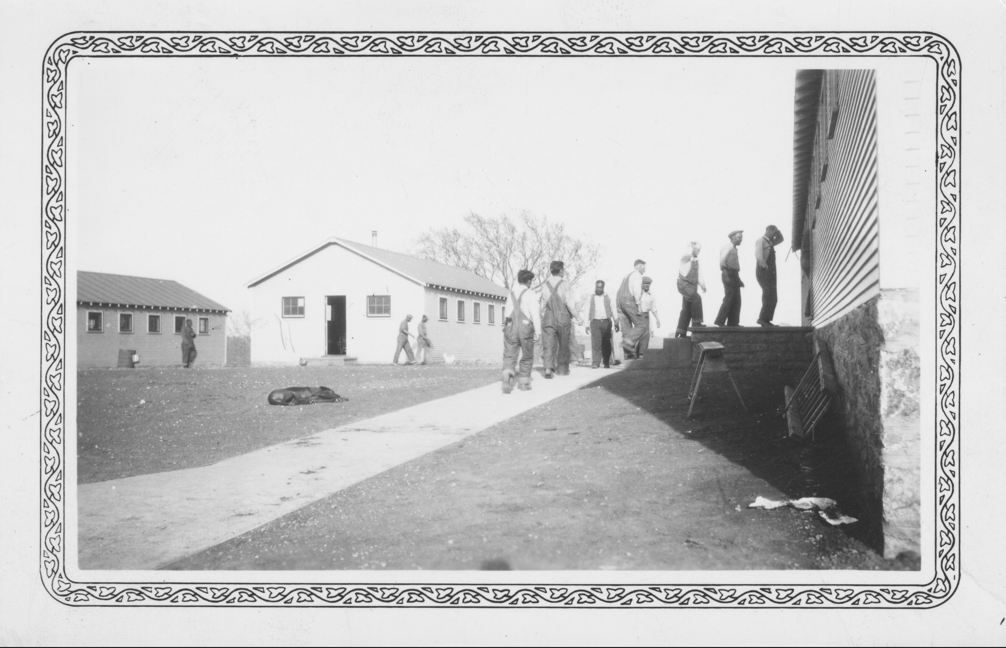
To help struggling Americans, President Franklin Roosevelt’s administration launched the New Deal, a slate of federal programs meant to put people back to work and help economic recovery. The Works Progress Administration (WPA), for example, provided jobs and improved local infrastructure. Projects such as Gardner Lake employed over 250 laborers, who lived in Transient Camp #9 (pictured above) and received housing, clothing, food, and medical care while earning between $1 and $3 per day.
In a time of crisis, these efforts gave residents – who sought basic survival not lofty ideals at the time – work, purpose, and hope during a time of national hardship.
Restricted Suburbs
As Johnson County transformed from farmland to suburb in the early 20th century, developers such as J.C. Nichols and William Strang promised a better life through homeownership.
Yet that promise was not extended to everyone.

Racially restrictive covenants – written into property deeds – barred African Americans and other potential homebuyers of color from purchasing homes in many neighborhoods. By 1950, such restrictions applied to 96% of Johnson County’s suburban neighborhoods.
For white families, homeownership was advertised as a pathway to freedom and opportunity. For others, it was legally denied.
To learn more about racial restrictions in Johnson County and the history of federal redlining programs, explore the digital version of the Museum’s award-winning REDLINED: Cities, Suburbs, and Segregation exhibit at JCPRD.com/Redlined.
Supporting the Right to Fair Trial
Rev. Dr. Robert “Bob” Meneilly, longtime pastor at Village Presbyterian Church in Prairie Village, never shied away from what he considered moral action, even when it was unpopular at the time. In 1971, Meneilly supported his church council’s request to provide $10,000 from its Defense Fund for Angela Davis’ legal defense in California.

Davis, a Black Marxist and feminist activist with a doctorate in philosophy, faced charges related to purchasing firearms later used in a courtroom hostage situation (Davis was not involved in the event). She, her family, and her legal team insisted that racism and politics motivated the criminal charges against her. Davis was ultimately acquitted on all counts.
For his stance, Meneilly received letters from both supporters and detractors. One self-identified Black woman wrote to congratulate Meneilly, saying “your thinking should be the way everybody should look at human beings… I applaud you for your courageous stand.” Another individual wrote to wish Davis great harm, suggesting to Meneilly “your ‘church’ too should be severely disciplined.”
Despite such differing opinions, in June 1971, Meneilly preached, “I have to ask myself: can she have a fair trial? Most of the folks around here who have expressed disgust for the church involving itself have already judged Dr. Davis as absolutely guilty… is that a fair trial? We cannot limit justice for those with whom we agree, or there is no justice for any of us.” Meneilly’s sermon touched on the idea that all of us are responsible for upholding fundamental rights for one another.
Women Seeking Equal Rights

The ratification of the 19th Amendment in 1920 granted women the right to vote. But equality under the law remained incomplete.
First introduced in 1923 and passed by both houses of Congress in 1972, the Equal Rights Amendment (ERA) was a proposed constitutional amendment that sought to guarantee equal rights regardless of sex. Despite support, it did not receive enough state ratifications by the deadline to become law.
A robust archival collection assembled by the League of Women Voters of Johnson County contains pamphlets and publications both supporting and opposing the amendment, circulated in the county in the 1970s. These documents reflect a community wrestling with questions about gender equality and social change. Women – locally and nationally – continued to advocate for equal pay and legal protections, though frustrations – including the ERA’s failure – persist to this day.
Your Everyday Democracy
These stories – spanning more than 100 years – show that democracy is not self-executing. It requires participation, vigilance, courage, and sometimes uncomfortable reflection.
Everyday Democracy invites you to explore what Life, Liberty, and the Pursuit of Happiness have meant in this place, and to consider what they mean now, and in the future.
The exhibit is included in regular Museum admission and is open Monday through Saturday, 9am to 4:30pm. The Museum offers quarterly community Free Days, including March 19, June 6, September 12, and November 25.
To plan your visit, go to JCPRD.com/Museum. You can also view the exhibit’s content online at JCPRD.com/everydaydemocracy.