Is the United States a “Christian Nation”? How the Revolutionary Wartime Baptists Fought for Religious Freedom for All

What would Baptists at the time of the American Revolution have thought about the notion that the United States was founded as a Christian nation, an idea which is being heavily promoted in many conservative and “evangelical” circles today? The answer might surprise you.
This question was among the topics raised during a fascinating discussion on religious freedom and the American Revolution which was held on July 17 at an historic Anglican/Episcopal church near Culpeper, Virginia. The panel discussion on “Before Religious Freedom: Faith Traditions in Revolutionary Virginia,” was part of the Annual Historic Germanna conference, which this year had a focus on the nation’s 250th anniversary.
The all-day panel discussion featured representatives of the Anglican/Episcopalian, Lutheran, and Baptist traditions.[i]
The Rev. Dr. Ian Markham, President of Virginia Theological Seminary, opened the discussion with a review of the Anglican Church (the Church of England), in the Virginia Colony. To be a Virginian in those days, Dr. Markham stressed, meant being an Anglican, a member of the legal, tax-supported Established Church of Virginia. Within the Anglican Church there were rigid class distinctions. The church parish was run by the vestry – a self-perpetuating group of twelve leading “gentlemen,” who were the same “gentlemen” that ran the county court and the militia.

At the other end of the religious spectrum were the Baptists – who, Dr. Markham said, posed an enormous challenge to the Established Church by their radical and unorthodox ideas, and their unlicensed preachers who refused to ask for permission to preach. To the gentry, the Baptists represented not just heresy, but “a revolt against the whole culture of rank and deference.”
Characterizing the gulf between the Establishment Anglicans and the dissenting Baptists, Dr. Markham said that “the Virginia ‘great man’ in the Anglican tradition prized display, hierarchy, horse-racing, and hard drinking.” The Baptists, on the other hand, “built tight, disciplined, plain communities” — men and women, black and white, who at times worshipped together, and who called each other “brother” and “sister.” They “deferred to no gentleman, at all.”
Preaching from the Jailhouse
Following Rev. Markham’s remarks, Pastor Dan Carlton of the Culpeper Baptist Church took up the history of the brutal persecution of the Baptists by the Anglican Establishment, and the Baptists’ essential role in asserting the importance of religious liberty.

Baptists preached to both enslaved and free blacks in camp meetings which were often broken up by men on horseback (Anglican Vestrymen and others) riding through the crowds.
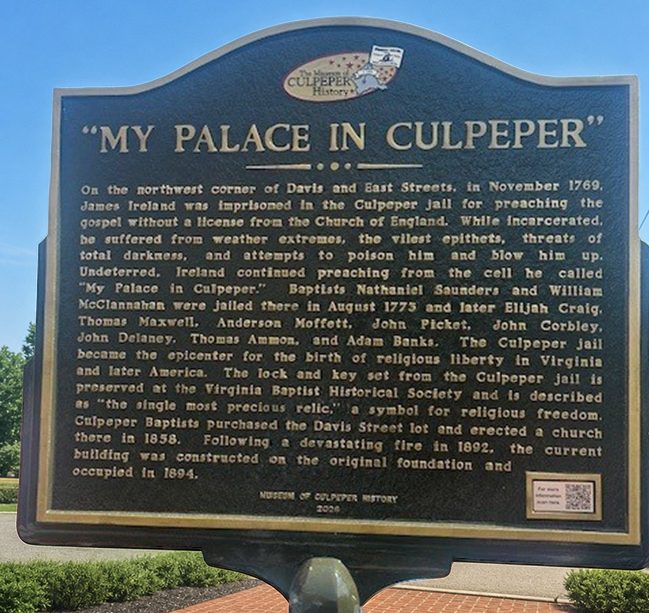
Eleven Baptist preachers were jailed in Culpeper alone in the 1768-1770 years, and nearly half of all the Baptist preachers in Virginia were imprisoned at one time or another. The best-known was James Ireland,[ii] jailed in 1769-1770, who called the county jail his “palace in Culpeper.”

At one point, his enemies tried to blow up his basement jail cell; they tried to poison him, and at another time, they urinated in his face as he was preaching through the barred window of his cell. (Decades later, with a wonderful sense of irony, the Culpeper Baptists built their church on the site of the old jail.)
After reviewing this history of persecution, Pastor Carlton then went on say that he thought it was important to discuss what he called “this seemingly endless conversation about how America was founded as a Christian country.”
“I’m not so sure our Baptists would agree with that,” Carlton pointed out. “They were persecuted greatly.”
What the Early Baptists Thought
Pastor Carlton then turned to the example of John Leland,[iii] whom, he said, was probably the most prominent Baptist in the young nation. Leland was radical on religious liberty, and was greatly influenced by Roger Williams,[iv] the most prominent early advocate in the North American colonies for religious freedom and the separation of church and state. Leland was the pastor of Mount Pony Baptist Church (now Culpeper Baptist Church)from 1776 to 1778, at which time he moved to Orange County, Virginia, where he stayed until 1791, when he returned to New England.
Religion is a matter between God and individuals, and civil rulers have nothing to do with religion in their official capacity, according to Leland. Consequently, Leland believed that a man has a civil right to believe that which is erroneous, Carlton said, and a civil right to do that which is morally wrong, and the government has no right to punish a man for this.
As to the idea that the government should favor one religion over another, Leland wrote:
“The notion of a Christian Commonwealth should be exploded forever… Government should protect every man in thinking and speaking freely, and see that one does not abuse another. The liberty I contend for is more than toleration. The very idea of toleration is despicable; it supposes that some have a pre-eminence above the rest to grant indulgence, whereas all should be equally free: Jews, Turks, Pagans and Christians.”
Leland’s defense of the rights of Muslims (“Turks”) is notable, when today we have some federal elected officials, and others, demanding that Muslims should not be allowed to hold public office in the United States, or to serve as members of Congress.
“Government should be so fixed, that pagans, Turks, Jews, and Christians should be equally protected in their rights,” Leland said at another point. He held that government embraces all religions, proscribes no creed or faith for being heretics, promotes the man of talents and integrity without inquiring after to his religion, and impartially protects all of them.
Carlton suggested that Leland would be spinning in his grave over the common practice today of opening public meetings with prayer. Carlton noted that although he is often invited to offer a prayer at public meetings, the Iman of the local mosque in Culpeper never gets invited to pray at the Town Council meetings, adding that this is exactly the kind of thing that Leland would have absolutely opposed.
Carlton says that he challenges his colleagues: Unless we are going to be advocates of total religious liberty, we should stop using the name “Baptists.”
Madison, Leland, and the Constitution
Carlton told the story of one way in which John Leland directly influenced the inclusion of religious freedom in the United States Constitution. During the 1788-89 election campaign, James Madison asked to meet with Leland, as Madison was

Near this spot in 1788, elder John Leland and James Madison, the father of the American Constitution, held a significant interview which resulted in the adoption of the Constitution by Virginia. Then Madison, a member of Congress from Orange, presented the First Amendment to the Constitution guaranteeing religious liberty, free speech, and a free press. This satisfied Leland and his Baptist followers.
anxious to prevent Leland from opposing him in the election for the first U.S. Congress, and was seeking the Baptists’ support for the new proposed Constitution. As the condition for obtaining the support of the Baptists, Leland insisted on absolute religious freedom – which indeed was incorporated into the very first amendment to the United States Constitution, ratified in 1791.
In fact, Carlton made the argument, that it is likely that without Baptist support, Virginia would not have ratified the Constitution. And without Virginia – the most powerful state – there would have been no United States Constitution.[v]
Coming back again to the notion that the United States should be regarded as a Christian nation, Carlton pointed out that we went from having an Established Church — which we rejected during the Revolution — to people today wanting to have an Established Religion, to make Christianity the established religion of the U.S.
John Leland absolutely rejected this, Carlton repeated, with Leland declaring that the idea of a Christian Commonwealth “should be exploded forever.”
Carlton is rightly proud of Culpeper’s role in all this. He quoted John Broadus, one of the great 19th century Baptist leaders, as saying that “Culpeper is sacred soil for all lovers of religious freedom.”
Carlton concluded by reporting that what he always tells Baptists: “If we Baptists did nothing else in the past 250 years that’s worth anything, we gave the world religious liberty. And that’s a great gift that we’ve given.”
[i] The Lutheran tradition was represented by Dr. Guy Erwin, president of United Lutheran Seminary (Gettysburg and Philadelphia). Since the German Lutheran and the German Reformed churches in Virginia were neither the Established Church, nor dissenters, Dr. Erwin’s remarks, although very interesting, had little bearing on the conflict between the Anglicans and the Baptists, which is the subject of this post.
[ii] James Ireland (1745-1806) was born in Edinburgh, Scotland, and became a Baptist in Frederick County, Virginia. He was jailed in 1769-70 in Culpeper for preaching without a license. He later served the Baptist Church in Buckmarsh (now Berryville Baptist Church), and is buried in the Old Buckmarsh Cemetery north of Berryville, Virginia.
[iii] John Leland (1754-1841) was born into a Congregationalist family in Grafton, Massachusetts. He joined the Baptist church in Bellingham, Mass., in 1775, and visited Virginia shortly after that. From 1776 to 1778 he was the pastor of Mount Pony Baptist Church in Culpeper, the predecessor of today’s Culpeper Baptist Church. In 1791, he returned to New England, and founded several Baptist congregations in Connecticut. In 1812, he was elected to the Massachusetts House of Representatives.
[iv] Roger Williams (1603-1683) was born and educated in the Church of England. He became a Puritan, and left England for Boston, arriving in 1631. Having become a Puritan preacher in the Plymouth Colony, he was expelled from that colony in 1635, having been convicted of sedition and heresy. Among his “erroneous” and “dangerous” teachings were that the governing authorities had no right to punish religious or moral offenses such as blasphemy or breaking the Sabbath. Williams also condemned the colonial charters which took Indian land without purchasing it. In 1636, he founded Providence Plantations (later Rhode Island) as a haven for liberty of conscience. Williams is recognized for having founded the first Baptist church in the American colonies.
[v] Virginia’s Religious Freedom Act, passed in 1786, could not have been adopted without the support of the the Baptists. “Thus Virginia became the first government in the world to establish by statute the complete separation of church and state.” John S. Moore, “Virginia Baptist Petitions for Religious Liberty, 1770-1798,” The Virginia Baptist Register, No. 25 (1986).


Related Posts