This guest post was written by Aidan McLaren, whose recent research at the NHS was supported by the New England Regional Fellowship Consortium. Aidan McLaren is a PhD Candidate at the University at Albany SUNY, researching how artificial climates and environments were created in greenhouses during the eighteenth century. He looks at histories of the environment, science, and agriculture in the early Atlantic World.
Flipping through a dense collection of correspondence at the Newport Historical Society, I was thrown into this story of a wealthy British merchant living in Portsmouth, Rhode Island, who collected exotic specimens in his greenhouse. Eighteenth-century greenhouses were laboratories for amateur botanists, enlightened men, botanists, or women to practice plant science or cultivate foreign plants, but they were typically located in metropolises like London or Paris.[1] Abraham Redwood Jr., though, trapped plants behind glass on Aquidneck Island.
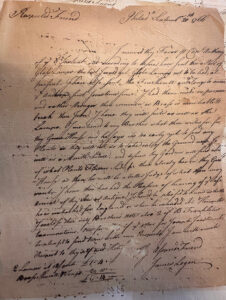
Figure 1: Letter to Abraham Redwood Jr. from James Logan (9/20/1766) taken at the Newport Historical Society.
The Abraham Redwood Family papers hold over 100 correspondence letters, receipts, and other papers to Redwood. Two letters specifically in the collection were from James Logan Jr., son of the famed James Logan, a scientist in Philadelphia who was connected to Benjamin Franklin and John Bartram.[2] The first of these letters puts us in September 1766 with a dialogue Logan had with Redwood about his request for plants for the greenhouse and some glass lamps. Redwood owned a sugar plantation in Antigua, a farm estate in Portsmouth, and a home in Newport, but his farm in Portsmouth was where he grew exotics. Logan informs Redwood that after consulting his brother about sending plants: “it’s too early yet to send any plants as they will not do take out of the ground nor so will as a month hence. And desires thy gardener will send a list of what plants, flowers, seeds, etc, thou already has in thy greenhouse as there he will be a better judge of what thou may want.”[3] Redwood would often have sapodilla trees, figs, cashews, and pomegranates from his plantation in Antigua, where his son stayed, but from his conversation with Logan it seems he is not specific with his requests and was broadly asking for any exotic plant.[4] Unfortunately, we are not able to see Redwood’s response to Logan as it is not within the collection, but this shows the movement of plants within Britain’s colonies and not Britain itself.
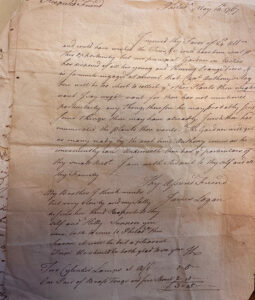
Figure 2: Letter to Abraham Redwood Jr. from James Logan (5/13/1767) taken at the Newport Historical Society.
After the passing of winter, in May 1767, Logan would respond to Redwood again about his plant demands. Logan writes wishing that the trees and other plants Redwood had requested could have been sent with Captain Anthony on his upcoming voyage, but “our principal gardener in exotics has disposed of all his young and thriving orange trees & is so much engaged at present that Captain Anthony’s stay here will be too short to collect your other thou might want. I say might want for thou has not mentioned particularly, therefore he may probably send some things thou may have already. I wish thou had enumerated the plants thou wants.”[5] Logan concludes by saying his gardener will have the plants collected for the next time Captain Anthony embarks to Newport via the Delaware River, but we don’t have access to this record. As an environmental historian working on the history of how artificial climates and environments were created in greenhouses, these letters from Logan don’t show us any tinkering in Redwood’s greenhouse, but they show a different struggle of receiving and moving plants on the periphery.
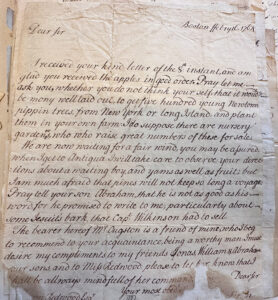
Figure 3: Letter written to Abraham Redwood Jr.(2/16/1764), taken at the Newport Historical Society.
This is confirmed in another letter from February of 1764, which, due to weathering, we cannot confirm who the writer is (one could guess it to be William McKinon, an Antiguan agent who worked under Redwood), but here Redwood is not only a receiver but a sender. The letter opens stating 500 Newton Pippin trees were sent from New York to be planted on Redwood’s farm, which is said to be one of the oldest varieties of apple trees in America, but wains into a second journey from Boston to Antigua. It mentions instructions Redwood gave on fruit transport but also concern “that pines will not keep so long a voyage.”[6] It concludes with a conflict a Captain Wilkinson had with Abraham Redwood’s son selling Jesuit’s Bark (cinchona)
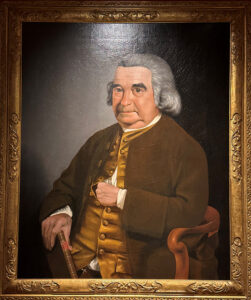
Figure 4: Portrait of Abraham Redwood. Redwood Library & Athenaeum. Photo by author.
As I question what Redwood’s role in the plant trade was, his importance is emphasized with an undated letter from Mrs. E. Maitland Armstrong to Redwood’s Antiguan agents, William McKinnon and Stephen Blissard, requesting exotics. She requested a dozen small China orange trees, roots of pineapple with fruit on them, Sapodilla roots, guava roots, and young fig trees for her greenhouse. Already growing were about fifty young fruit trees in the greenhouse and in the hothouse, strawberries, bush beans, as well as a crownation blossoming.[7] Redwood’s access to plants in Antigua forces historians to consider that maybe Antigua was a plant port for greenhouse and hothouse plants. Redwood’s own greenhouse and hothouse were said to be some of the finest gardens in Rhode Island. It grew “all sorts of West India fruit, viz: oranges, lemons, limes, pineapples, tamarinds” and West India flowers.[8] Soloman Drowne, three years after the construction of the greenhouse, wrote in 1766, “I was told my father by a credible person that the garden was worth £40,000 and that the man (Charles Dunham) that takes care of the garden has above 100 dollars per annum. It has hot houses where things that are tender are put in the winter and hot beds for the West India Fruit; I saw one or two of these gardens in coming from the beach.”
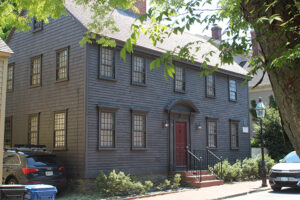
Figure 5: Photo of Redwood House: 74 Spring St, Newport. Photo by author.
Ultimately, Abraham Redwood’s greenhouse and hothouse show that cultivating and trading exotic plants didn’t solely happen in European metropoles, but also in early America. As I continue my NERFC fellowship at the John Hay Library in Providence and at the Boston Athanæum I hope to find more stories like Abraham Redwood’s to thread early America into the conversation of botanical networking and tinkering of plants.
[1] Easterby-Smith, Sarah. Cultivating Commerce : Cultures of Botany in Britain and France, 1760-1815. Cambridge University Press, 2018.
[2] Chaplin, Joyce E. The First Scientific American : Benjamin Franklin and the Pursuit of Genius. Basic Books, 2006. Pgs. 64-65.; Tolles, Frederick B. “Philadelphia’s First Scientist: James Logan.” Isis(Washington, D.C., etc) 47, no. 1 (1956): 20–30. https://doi.org/10.1086/348452.
[3] Logan, James. “Letter to Abraham Redwood Jr..” Redwood Family Papers. Newport, RI: Newport Historical Society, September 20, 1766.
[4] McAllister, Alex. “Letter to Abraham Redwood Jr..” Redwood Family Papers. Newport, RI: Newport Historical Society, May 9, 1766.
[5] Logan, James. “Letter to Abraham Redwood Jr.”. Newport, RI: Newport Historical Society, May 13, 1767.
[6] “Letter to Abraham Redwood Jr.”. Newport, RI: Newport Historical Society, February 16, 1764.
[7] [7] Downing, Antoinette Forrester, and Vincent Scully. The Architectural Heritage of Newport, Rhode Island, 1640-1915. Harvard University Press, 1952. Pg. 38
[8] Drowne, Soloman. “Dr. Soloman Drowne’s Journal.” The Newport Historical Magazine 1, no. 2, October 1880. pgs. 67-68; O’Brien, Thomas. “Letter to Abraham Redwood Jr..” Redwood Family Papers. Newport, RI: Newport Historical Society, July 28, 1764; Downing, Antoinette Forrester, and Vincent Scully. The Architectural Heritage of Newport, Rhode Island, 1640-1915. Harvard University Press, 1952.
The post Making Tropical Newport: The Hot-Houses and Green-Houses of Abraham Redwood Jr. appeared first on Newport Historical Society.