This is a guest blog post by Griffin Gee, a recent graduate of the University of Massachusetts, Amherst where he earned his Bachelor of Arts in History with a minor in Education. Griffin is a 2026 Buchanan Burnham Fellow.

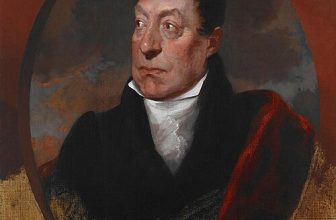
Photograph of Thomas Wentworth Higginson, (1823-1911). New York Public Library Digital Collections. Accessed June 29, 2026. https://digitalcollections.nypl.org/items/dd4a81e0-c616-012f-ea11-58d385a7bc34.
Few 19th century reformers could wield a pen, rifle, and their voice with such authority as Thomas Wentworth Higginson (1823-1911). As an ordained minister, militant abolitionist, suffragist, and member of the “Secret Six,”[1] Higginson was involved in what he called the “Sisterhood of Reforms.”[2] After serving in the Civil War, Higginson retired to Newport, Rhode Island. He served on the Newport School Committee and successfully advocated for the desegregation of the town’s schools alongside his friend and civil rights advocate George T. Downing.[3] Higginson was also a member of the Newport Town and Country Club, a group of intellectuals that countered the town’s wealthy social landscape and shaped its cultural identity. The Newport Historical Society (NHS) holds a collection of Higginson’s correspondence, many of which pertain to an anti-slavery regiment that he was raising in Massachusetts during the Civil War (1861-1865). NHS’s collection of Higginson’s correspondence helps to reveal the determination of a militant abolitionist who refused to support a Civil War fought only to preserve the Union, demanding the total abolition of slavery instead.
He was born in Cambridge in 1823 to Louisa Storrow Higginson and Stephen Higginson, a prominent Boston merchant. Thomas Higginson enrolled at Harvard at just thirteen years old.[4] After graduating in 1841, Higginson taught at a preparatory school in Cambridge for six months and then took a position tutoring his cousin’s three children.[5] He returned to Harvard in 1843 to pursue further studies at the Divinity School where he was drawn to Unitarian philosophy and the antislavery cause.[6] After completing Divinity School, Higginson was ordained to Newburyport’s First Society, a unitarian universalist church. Upon taking up residence in Newburyport he became an active reformer in the town speaking out against nativism, tutoring immigrants, and establishing a night school for mill girls.[7] Higginson consistently preached for the abolition of slavery, alienating conservative members of his congregation. After losing support from his congregation, Higginson resigned in 1849, allowing him to take a more radical public stance in the abolition movement.[8]
Higginson remained at the forefront of Massachusetts’ reform movements during the mid-19th century. Higginson had little patience for William Lloyd Garrison’s abolitionist approach of “moral suasion,” which sought to end slavery through nonviolent persuasion. Higginson took a more militant stance on the issue. The passage of the Fugitive Slave Act in 1850 required the return of escaped enslaved people to their enslavers even in free states. This motivated Higginson to join the Boston Vigilance Committee, an abolitionist organization formed to protect escaped slaves.[9] In 1854, Higginson and other members of the Committee attempted to rescue fugitive Anthony Burns by breaking down the doors of the Old Boston Courthouse where he was being held. The rescue attempt resulted in the death of a deputy marshal and Higginson’s indictment.[10]
After Higginson’s charges were dismissed, he saw no better opportunity to contest slavery than by fighting for freedom in the midwest territories. Higginson supported Kansas “free soilers” who wanted to prevent the expansion of slavery by raising funds and transporting weapons into the territory.[11] Higginson was also a member of the “Secret Six” and sent money to aid John Brown in his raid on the Harper’s Ferry arsenal that aimed to spark a slave rebellion.[12] While Brown was captured, tried, and hanged for the raid, Higginson did consider various plans to rescue Brown before ultimately deeming it too difficult to complete.[13]
The outbreak of the Civil War led Higginson to consider if the Union would fight to end slavery. Higginson proposed the idea of a regiment composed of militant abolitionists to Massachusetts Governor John A. Andrews, who instead offered him the rank of major in another infantry.[14] He declined because he thought “it was then wholly uncertain whether the government would take the anti-slavery attitude.”[15] After the Battle of Bull Run in 1861, Andrews announced the creation of a new Massachusetts regiment, sparking Higginson to begin recruiting. This time, Higginson’s regiment was approved.
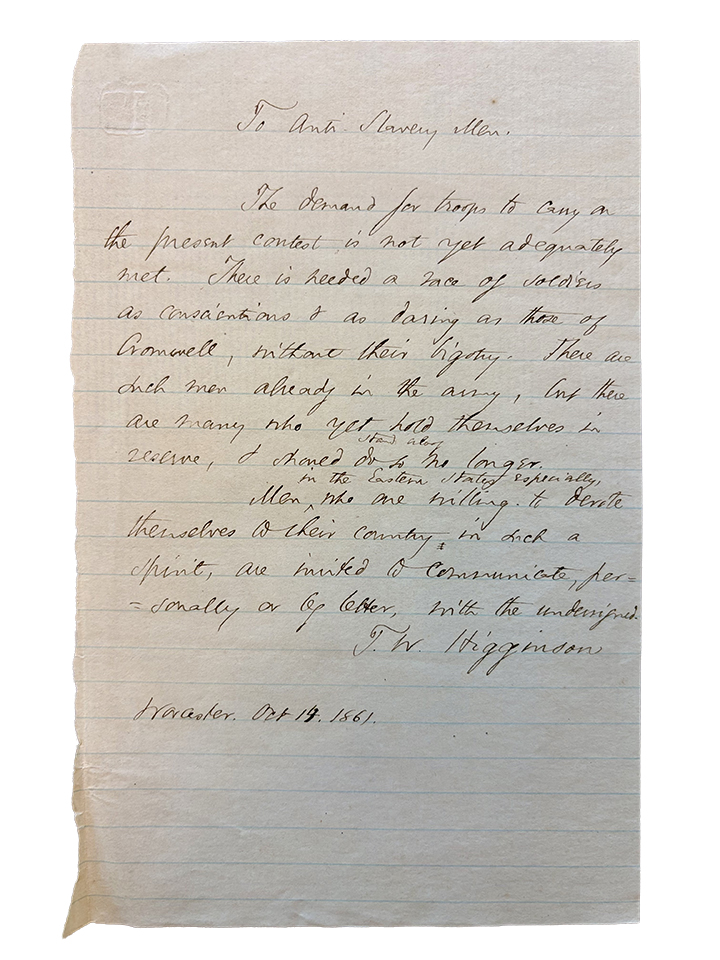
Letter by Thomas Wentworth Higginson, “Anti Slavery Men,” October 14, 1861, Folder 4, Thomas Wentworth Higginson Collection (Ms.145), Newport Historical Society.
The Higginson collection at NHS, consists primarily of correspondence he received from intellectuals, reformers, and state officials including Frederick Douglass, Ralph Waldo Emerson, Lydia Marie Child, and Charles Sumner, dating from 1851 to 1862. Much of the correspondence is about prospective recruits to the anti-slavery regiment he was raising. Interest in Higginson’s regiment extended across many parts of Massachusetts. In one of the few letters in the collection written by Higginson, he addresses “Anti-Slavery Men” broadly, writing: “There is needed a race of soldiers as conscientious and as daring as those of Cromwell, without their bigotry. There are such men already in the army, but there are many who yet hold themselves in reserve & should do so no longer in the Eastern States especially.”[16] Higginson’s desire to form a regiment of anti-slavery men not only demonstrated his commitment to abolish slavery, but his hope that it would influence the Union to officially declare itself for the cause.

Letter by John Freeman Clarke, October 22, 1861, Folder 2, Thomas Wentworth Higginson Collection (Ms.145), Newport Historical Society.
While Higginson believed in his radical regiment, some of his friends were skeptical as to its possibility. James Freeman Clarke, abolitionist and minister of Boston’s King’s Chapel, believed Higginson’s regiment would have to wait since many of the Union’s army officials were still sympathetic towards the South. In a letter from the NHS collection, Freeman urges Higginson that his “time will come, perhaps very soon, when affairs will take a turn much more favorable to some active anti-slavery demonstration.”[17] Unfortunately for Higginson, after having acquired about half of the necessary companies, Governor Andrews ordered him to cease the formation of the regiment in February, 1862. Andrews’ order came following a power struggle with General Benjamin Butler who controlled the New England Department of the Union army.[18]
Higginson’s disappointment did not last long, however, because he was given another chance to lead the 51st Massachusetts Infantry Regiment later that year in August by Governor Andrews. Higginson opened a recruiting office in Worcester and had little difficulty raising another regiment because of his familiarity with the young men in the city’s athletic clubs.[19] Within three months of recruiting, Higginson was presented with an even greater opportunity to serve in the Civil War. In November, he received from General Rufus Saxton in South Carolina offering him the position of colonel in the 1st South Carolina Infantry Regiment. It was one of first Black regiments mustered into the Union army, composed of freed Blacks and refugees.[20] To Higginson, commanding a Black regiment was one of the greatest services he could perform.
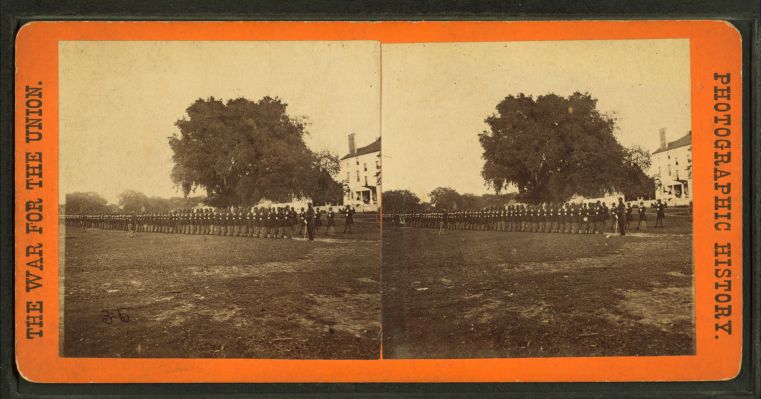
“Two views. Dress parade of the First South Carolina Regiment (Colored), near Beaufort, S.C.” New York Public Library Digital Collections. Accessed June 29, 2026. https://digitalcollections.nypl.org/items/54a64840-c574-012f-fdb8-58d385a7bc34
Higginson passed along his command of the Massachusetts 51st Infantry Regiment and went on to lead the 1st South Carolina Infantry Regiment. During Higginson’s service, he wrote essays for the Atlantic on his service with the 1st Infantry. He fought racist narratives about Black inferiority by recording the soldiers’ courage, discipline, and intelligence. In 1870, he compiled the essays he wrote into a book called Army Life in a Black Regiment, which now serves as a crucial source for 18th century African American history and culture.[21]
Higginson’s contribution to the abolition of slavery extended from his pulpits in Massachusetts, to the battlefield in South Carolina. He never settled for a comfortable path, continuously sacrificing stability in order to form a more just world. The Higginson collection at NHS offers a window into a pivotal moment in Higginson’s life when his militant abolitionist ideas collided with the cautious politics of the Union. His frustrating attempts to raise an anti-slavery regiment reveal not only his personal determination, but the wider struggle between abolitionists and the Union government reluctant to end slavery.
[1] The “Secret Six” were a group of six Northern abolitionists who secretly funded John Brown’s raid on an arsenal in Harper’s Ferry, Virginia (now West Virginia) in 1859. Brown hoped the raid would help spark a slave rebellion, but he was captured and hung. Higginson was the only member of the group who refused to run or deny his involvement.
[2] Douglas R. Egerton, A Man on Fire: The Worlds of Thomas Wentworth Higginson (Oxford University Press, 2025), 2.
[3] Joey La Neve DeFrancesco, “Abolition and Anti-Abolition in Newport, 1835-1866,” Newport History: Journal of the Newport Historical Society, 2020, https://newporthistory.org/abolition-and-anti-abolition-in-newport-1835-1866/.
[4] Egerton, A Man on Fire, 24.
[5] Egerton, A Man on Fire, 33.
[6] Egerton, A Man on Fire, 36.
[7] Egerton, A Man on Fire, 47–48.
[8] Egerton, A Man on Fire, 55–56.
[9] Egerton, A Man on Fire, 65–66.
[10] Egerton, A Man on Fire, 79–80.
[11] Egerton, A Man on Fire, 94.
[12] Egerton, A Man on Fire, 132.
[13] Egerton, A Man on Fire, 150.
[14] Egerton, A Man on Fire, 161.
[15] Thomas Wentworth Higginson, Cheerful Yesterdays (Houghton Mifflin Company, 1898), 246.
[16] Letter by Thomas Wentworth Higginson, “Anti Slavery Men,” October 14, 1861, Folder 4, Thomas Wentworth Higginson Collection, Newport Historical Society.
[17] Letter by John Freeman Clarke, October 22, 1861, Folder 2, Thomas Wentworth Higginson, Newport Historical Society.
[18] Higginson, Cheerful Yesterdays, 247.
[19] Higginson, Cheerful Yesterdays, 247.
[20] Egerton, A Man on Fire, 172–174.
[21] Egerton, A Man on Fire, 230.
Bibliography
Clarke, John Freeman. Letter, October 22, 1861. Folder 2. Thomas Wentworth Higginson. Newport Historical Society.
DeFrancesco, Joey La Neve. “Abolition and Anti-Abolition in Newport, 1835-1866.” Newport History: Journal of the Newport Historical Society, 2020. https://newporthistory.org/abolition-and-anti-abolition-in-newport-1835-1866/.
Egerton, Douglas R. A Man on Fire: The Worlds of Thomas Wentworth Higginson. Oxford University Press, 2025.
Higginson, Thomas Wentworth. Cheerful Yesterdays. Houghton Mifflin Company, 1898.
Higginson, Thomas Wentworth. Letter, “Anti Slavery Men,” October 14, 1861. Folder 4. Thomas Wentworth Higginson Collection. Newport Historical Society.
The post Radical Regiments: Thomas Wentworth Higginson’s Militant Abolitionism appeared first on Newport Historical Society.