By John and Rochelle Ascher –
Has the struggle for defeating slavery, the battle against racism and for civil rights in the Unted States, been whitewashed in Washington DC?
Not at the recently opened Lincoln Memorial Undercroft Museum – the area directly under the Lincoln Memorial.
The impression made on the authors of this post as a result of a recent visit to the new National Park-run facility, which opened on June 27, was that of an inspiring exhibit, accurately portraying the Lincoln Memorial as a central location for the fight for justice for all, in the tradition of Abraham Lincoln who is there honored.[i]
But first, the construction of the Memorial itself.
Brief History of the Memorial
Authorized by the US Congress in 1911, the Lincoln Memorial was constructed between 1914 and 1921 and was dedicated by Supreme Court Chief Justice and Memorial Commission Chairman William H. Taft in 1922.
The main figures in the design of the Memorial were architect Henry Bacon (building designer), who also designed the Reflecting Pool; Daniel Chester French, the well-established sculptor who designed the Lincoln statue; and Jules Geurin, who painted the murals on the interior walls. Both the message of the Memorial and the story of the construction are featured in the exhibits in the modest museum exhibit area.
Bacon designed the monument based upon the Parthenon of Athens, Greece. According to the National Park Service website, Bacon felt that a memorial to the man who defended democracy should echo the birthplace of democracy. (See Andrew Spannaus’ recent article on the impact of the Roman Republic and Greece on the American Founders.) Employing the perspective of the Parthenon using a discovery made by the Greeks, he leaned the columns inwards, guaranteeing the proper perspective when seen from a distance. The towering memorial is 190 feet long, 120 feet wide, 99 feet tall and the exterior façade was constructed with Colorado Yule marble.
There are many ironic notes added to exhibits concerning the construction, which indicate the rather unapologetic and relevant nature of the message conveyed by the museum’s designers. A family of recent Italian immigrants, the Piccirilli brothers, sculpted the statue of Lincoln. (They were from a long-unbroken line of Italian stone cutters whose family craft dates to the Renaissance. They also carved the lions in front of the New York Public Library.) French also broke ground by employing the first nationally acclaimed female sculptor, Evelyn Beatrice Longman, as his top assistant.
The Construction
The Memorial’s erection was the result of the reclamation of the swampland adjacent to the Potomac River on which the monument was to be built. For 35 years prior to the bill in 1911 (while the Congress was endlessly debating the Memorial), the Army Corps of Engineers was draining the swamp. Below you can see The Lincoln Memorial under construction in 1917. The foreground is still drying out from a half-century of Potomac Flats reclamation. (Images: Library of Congress)


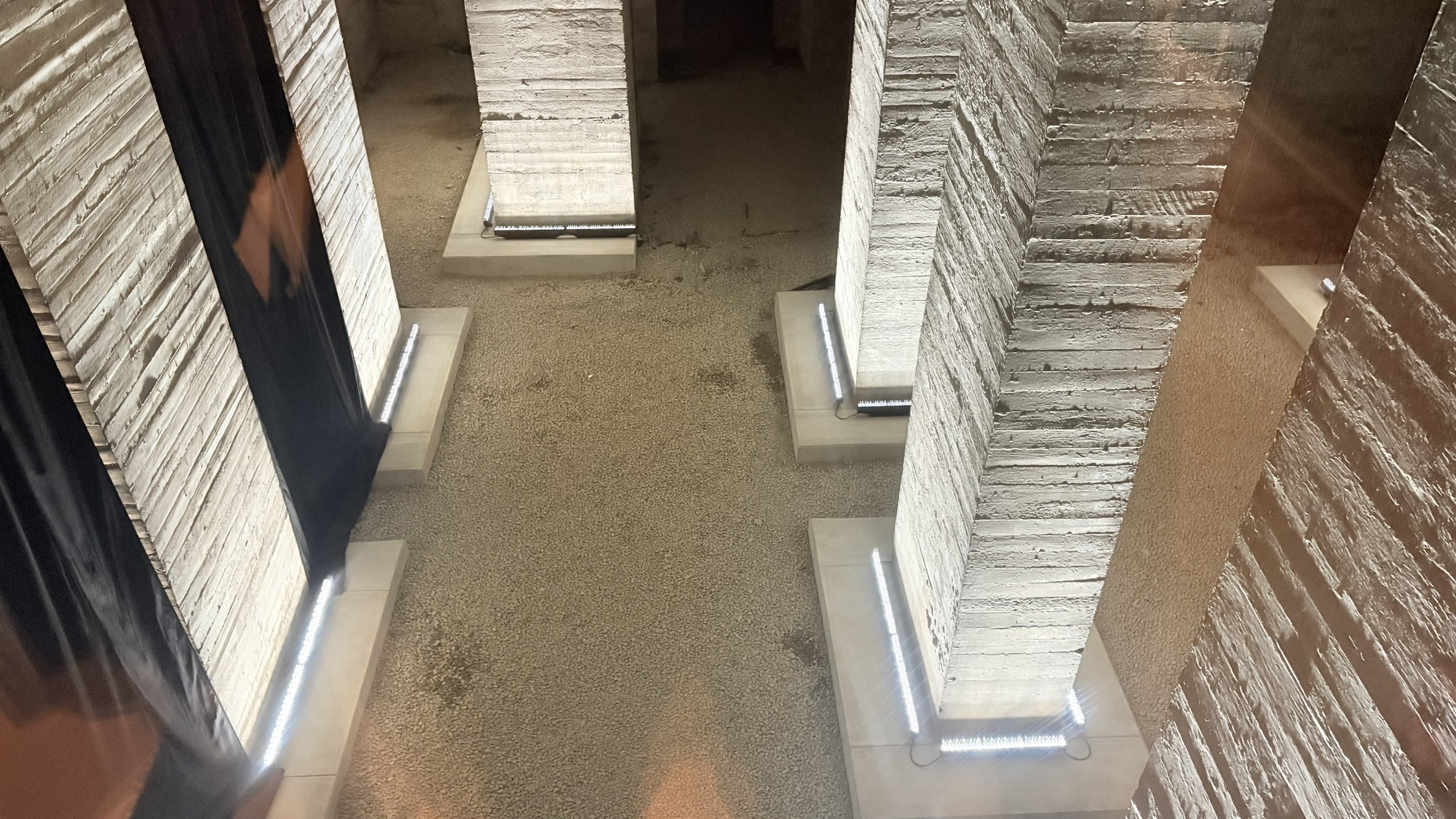
Engineers excavated about 50 feet down to the bedrock, where they poured 120 massive pillars to support the enormous weight above (see above photo.). These pillars were constructed from concrete and steel and were built directly into the bedrock.
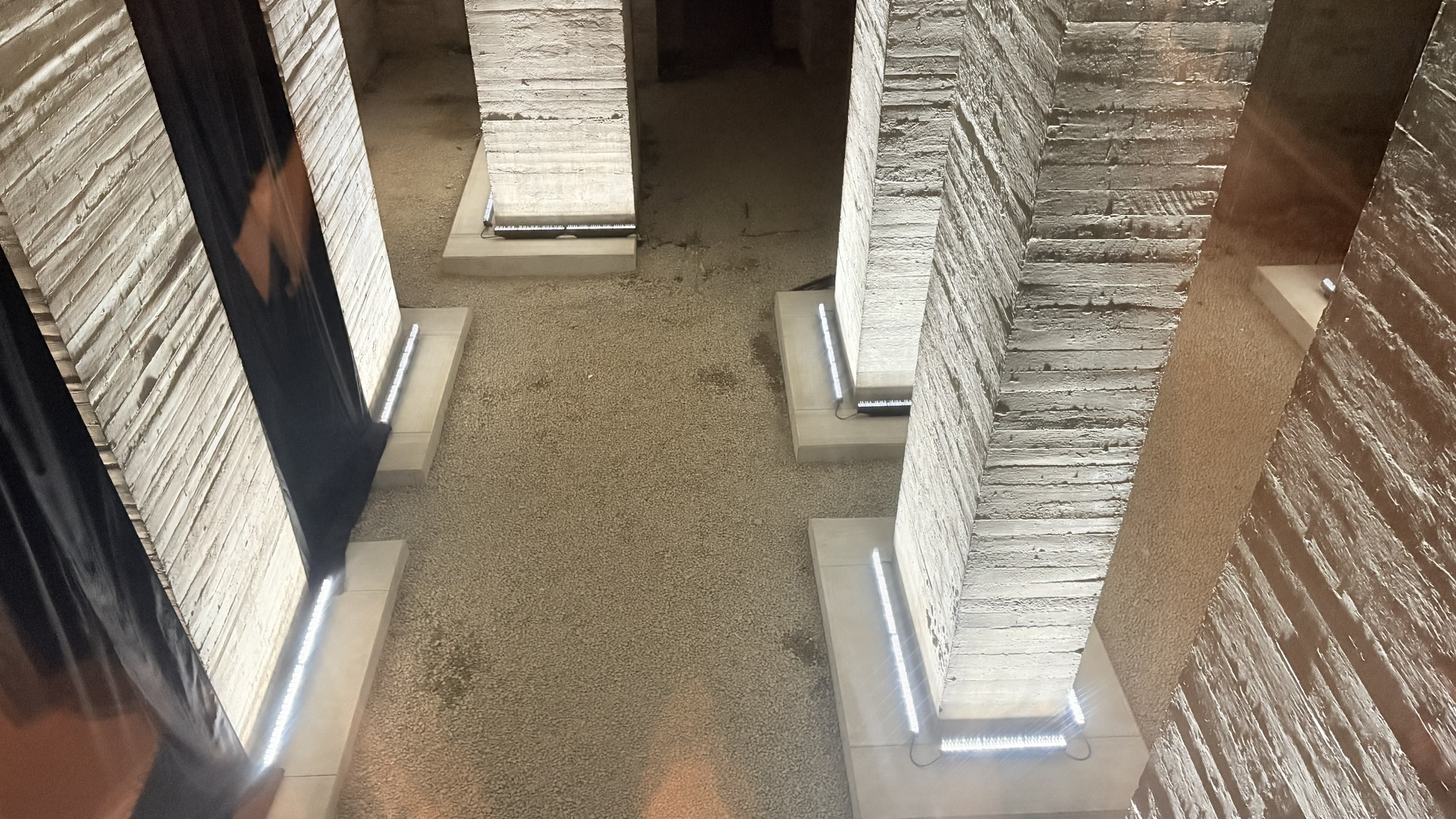
The undercroft area itself is 50,000 square feet, nearly twice as big as the Memorial above, and the glass enclosed new museum occupies 15,000 square feet of that space. The undercroft had been forgotten until 1975, when it was rediscovered. Limited flashlight tours went on in the 1980’s but were stopped after the discovery of asbestos in 1989. The current construction plan was established in 2016, and was launched in 2023 with the objective of opening the new exhibit for the 250th anniversary celebrations.

Architect Henry Bacon and the designers of the memorial made certain that the construction and finished product of the monument represented the hoped- for unity of the nation after the Civil War, reflected in the Second Inaugural on the North Wall. The granite and other materials intentionally came from many states. Lincoln’s statue and the exterior walls were carved from Georgia white marble. The pedestal of the statue was made from Tennessee marble. Other stone came from Indiana, Alabama, Massachusetts, and Colorado.
The 36 columns represented the number of states in the union at the time of Lincoln’s death, and the names of those states are located on the frieze above the columns. The upper frieze contains the names of the 48 states in existence at the time of the building’s dedication in 1922.
The Lincoln Memorial and the Civil Rights Movement
While many from our older generations know or remember the Lincoln Memorial as the location of Martin Luther King’s “I Have a Dream Speech” of 1963, and others may know the history of Marian Anderson being turned away from singing at Constitution Hall by the DAR because she was Black, and, — with the intervention of Eleanor Roosevelt — singing instead at the Lincoln Memorial in 1939, the organizers of the Undercroft have also brought to the public the images and the stories of other, lesser-known though equally important civil rights events famously and appropriately staged there.
Even at the Memorial’s own dedication in 1922, the audience viewing the statue of Lincoln, “the Great Emancipator,” were required to be seated in segregated sections in front of the Memorial.
This is also quite true in terms of the current debate about “DEI” where museums throughout Washington, DC are being ordered to remove items which even mention slavery or race from their collections – including the African American History Museum. For example, the President ordered Friday, July 24th that “warning” signs be placed in front of the Smithsonian’s National Museum of American History to inform visitors of the “inaccurate information presented in the Museum.”
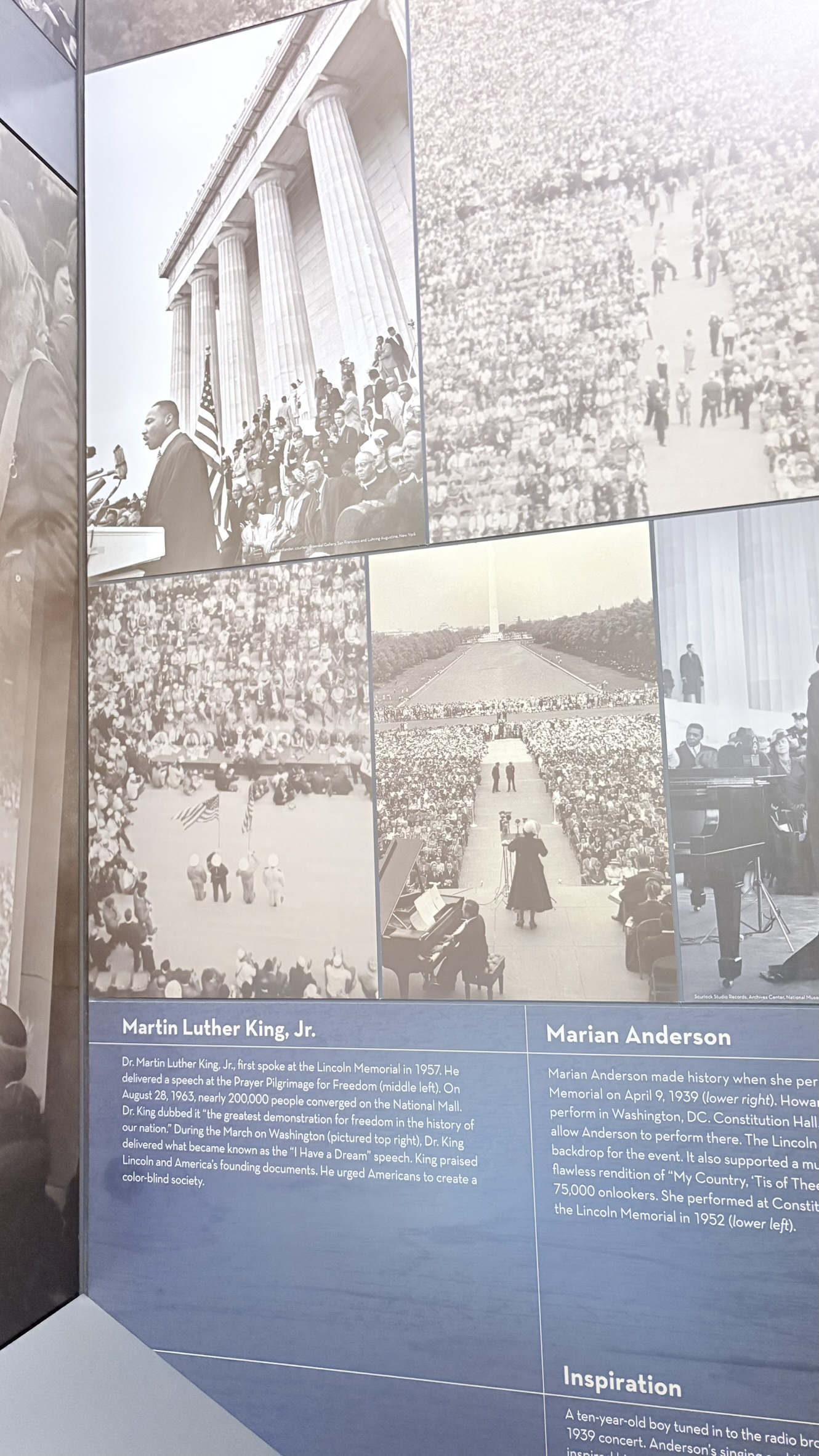
During our recent visit we were fascinated to learn the history of one of these earlier civil rights demonstrations which preceded the more well-known 1963 March on Washington (which is illustrated with wonderful pictures of the 250,000 people gathered to hear Dr. King at that time.) This is the story of the 1957 “Prayer Pilgrimage for Freedom,” pictured and described below.
According to the museum’s curators, on May 17, 1957, 25,000 demonstrators gathered at the Lincoln Memorial for the Prayer Pilgrimage, featuring three hours of spirituals, songs and speeches that urged the federal government to enforce the Brown vs. Board of Education decision, banning segregation in public schools, which the Supreme Court had issued in 1954. The last speech of the day was reserved for Martin Luther King’s “Give us the Ballot” oration, which captured public attention and placed him in the national spotlight as a major leader of the civil rights movement.
King and members of the newly organized Southern Christian Leadership Conference (SCLC) had urged President Eisenhower to publicly condemn segregationists’ unwillingness to comply with the Brown vs. Board of Education decision. In a telegram to President Eisenhower, the organizers of the demonstration told Eisenhower that if he would not maintain law and order in the South, “We shall have to lead our people to you in the Capitol in order to call the nation’s attention to the violence and organized terror directed towards women and children who merely seek freedom.” When the Eisenhower administration failed to make a public stand in favor of desegregation, King and Thomas Kilgore, National Director of the Pilgrimage, solicited contributions from leaders throughout the country, and asked them to attend the Prayer Pilgrimage which was being organized by Bayard Rustin.

One further historical irony is noted in the exhibit featuring the Marian Anderson 1939 concert: A special 7-year -old child in that audience destined to be inspired by that performance — Martin Luther King, Jr.
The Lincoln Memorial Undercroft Museum prominently features original copies of the Emancipation Proclamation and the Thirteenth Amendment, as well as discussion of the significance of the Second Inaugural Address and the Gettysburg Address, both of which are carved onto the North and South Walls of the Memorial above.
Final Note
Perhaps the most appropriate way to encapsulate the ongoing struggle for justice so well portrayed at the Undercroft Museum is to quote from Lincoln’s Second Inaugural Address:
Neither party expected for the war the magnitude or the duration which it has already attained. Neither anticipated that the cause of the conflict might cease with, or even before, the conflict itself should cease. Each looked for an easier triumph, and a result less fundamental and astounding. Both read the same Bible and pray to the same God; and each invokes his aid against the other. It may seem strange that any men should dare to ask a just God’s assistance in wringing their bread from the sweat of other men’s faces; but let us judge not, that we be not judged. The prayers of both could not be answered–that of neither has been answered fully. The Almighty has His own purposes. “Woe unto the world because of offenses; for it must needs be that offenses come; but woe to that man by whom the offense cometh.” If we shall suppose that American slavery is one of those offenses which, in the providence of God, must needs come, but which, having continued through his appointed time, He now wills to remove, and that He gives to both North and South this terrible war, as the woe due to those by whom the offense came, shall we discern therein any departure from those divine attributes which the believers in a living God always ascribe to Him? Fondly do we hope–fervently do we pray–that this mighty scourge of war may speedily pass away. Yet, if God wills that it continue until all the wealth piled by the bondsman’s two hundred and fifty years of unrequited toil shall be sunk, and until every drop of blood drawn by the lash shall be paid by another drawn with the sword, as was said three thousand years ago, so still it must be said, “The judgments of the Lord are true and righteous altogether.”
[i] The authors have not distinguished in this article between material presented in the exhibits, and the fruits of research motivated by their recent visit


Related Posts
Tags: Abraham Lincoln, Lincoln Memorial