By Bill Kleppel
The revelations from working in the Local History Room are limitless. On a seemingly mundane Wednesday morning, my colleague Karen and I were perusing new archival material (to us) about the history of native Poughkeepsie photographer Billy Name. It was donated to Shannon (…Butler, our rock star Historian) after one of her programs at Vassar College.
We talked about Billy Name’s collaborations with Andy Warhol and his “Superstars” during the mid to late 1960s. The conversation led to Billy’s connections to one of my favorite rock bands, the Velvet Underground: their sound, and their influence on many bands that followed them throughout the decades.
Then Karen mentioned she believed one of the members of the Velvet Underground lived in Poughkeepsie for a time.
“Wait… What? Did everyone associated with the Warhol Factory live in Poughkeepsie at some point?”
Karen insisted that this was true. She did some digging and found that, yes; guitarist Sterling Morrison lived in Poughkeepsie.
He lived the six last years of his life here with his family… He died at his home here… He’s buried at Poughkeepsie Rural Cemetery!
Within the hour, I drove the five minutes to the cemetery and said “hello” and “thank you” to this immensely talented and iconic figure in the history of rock music. His grave is on a slope that overlooks a swath of the Hudson River; the perfect spot to reflect upon the beauty of the valley or to take in a passing sloop or tugboat.
While communing with Sterling at the cemetery, the predominant questions at the forefront of my mind were: “How did you end up here?” and “How did your journey end in Poughkeepsie?”
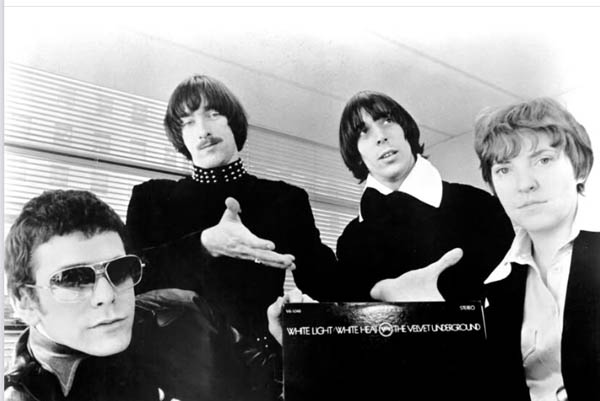
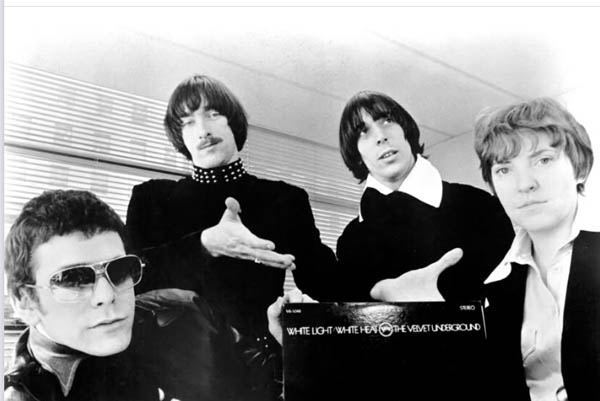
1968: White Light White Heat – Lou Reed, Sterling Morrison, John Cale, Maureen Tucker / photo by Billy Name
He grew up on Long Island and eventually attended Syracuse University, where he met his future Velvet Underground bandmate, Lou Reed. Even though the group never achieved much commercial success during their years together, the history of the Velvet Underground is well established.
The musician Brian Eno summed it up best, saying, “The first Velvet Underground album only sold (initially) 10,000 copies, but everyone who bought it formed a band.” They broke up in 1971. Yet, they laid cornerstones for what would become the origin of most alternative rock genres from punk to new wave and beyond. Bands and musicians such as Yo La Tengo, Galaxie 500, Luna, Jonathan Richman and the Modern Lovers, Iggy Pop, and David Bowie, just to name a few, were inspired by the Velvet Underground.
During my research, I realized not all my Poughkeepsie related questions would be sufficiently resolved, but I was still amazed at what I found regarding Sterling Morrison’s fascinating life.
In the summer of 1971, the Velvets were a dead band walking. Lou Reed had left the group the year before, and any connection to the Manhattan art scene had been obliterated by that point. Unbeknownst to the others, Sterling decided to apply to graduate school at the University of Texas. The band was planning to board a flight from Houston to New York. He literally left the band at the airport and drove back to the campus in Austin.
His girlfriend, Martha Dargan, soon joined him in Austin. They were married in late December of the same year. Martha and Sterling knew each other while growing up in Levittown on Long Island. They began dating when he was 21 and she was 19.
Sterling immersed himself in his studies of Medieval English Literature, eventually getting his Ph.D in the subject. He remained at the school as a teaching assistant, spent most of the 1970s as a serious academic, while also enjoying the early “keep Austin weird” counterculture of his adopted city.
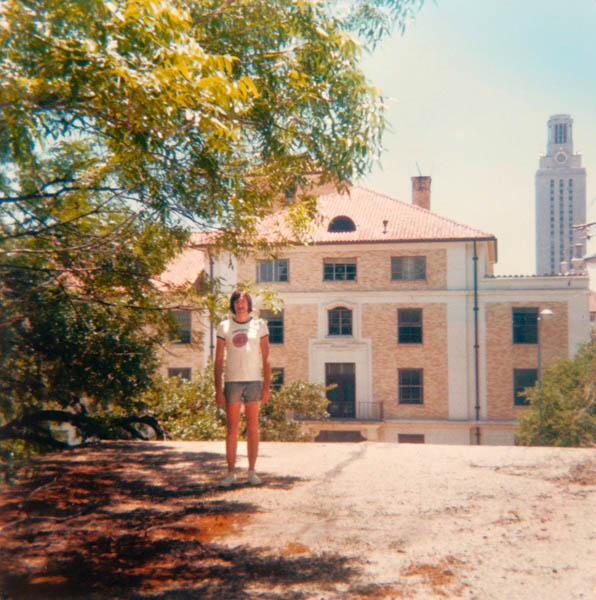
Sterling Morrison on the roof of the English Dept. at the University of Texas – Austin (photo courtesy Martha Morrison)
“It was the perfect musical backwater. That was the main reason I came. It wasn’t the East Coast or the West Coast and since I was going cold turkey music for a while this was the place to do it,” mused Morrison during an interview with the Austin American Statesman in 1978. He’d eventually dip his foot back into the local Austin music scene, performing with a band called the Bizarros while checking out other gigs at bars and clubs that started to flourish there.
Financial strain began to take a toll on Sterling’s lifestyle in Austin. He couldn’t make enough money as a TA, so he decided he would get a job as a deck hand on a tugboat near Houston. He’d soon attain his license as a tugboat captain!
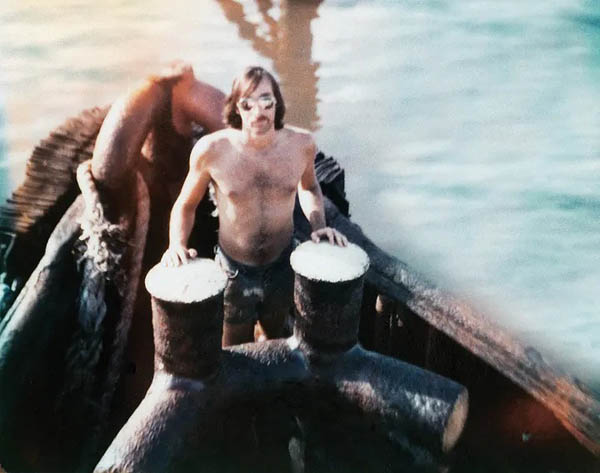
Sterling Morrison working on a tugboat in Houston (photo courtesy Martha Morrison)
Rock Star. PhD student in Medieval Studies. Tugboat captain. When it comes to life trajectories, nothing defines renaissance man quite like this.
Sterling and Martha started a family in Austin (they had two children, Mary Ann and Tom). In 1988, after quite a few years of living in Texas, they made the decision to head north to Poughkeepsie. Martha’s brother had recently moved to this city.
During the late 1980s and into the ‘90s, Sterling would play on recordings for former bandmates Maureen Tucker and John Cale, as well as for the band Luna, led by Dean Wareham.
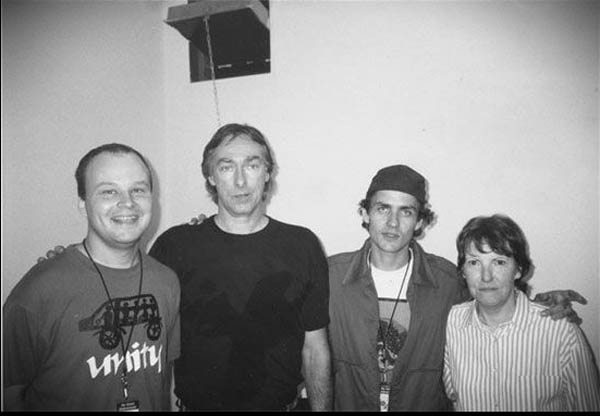
Stanley Demeski – Sterling Morrison – Dean Wareham – Maureen Tucker 1993
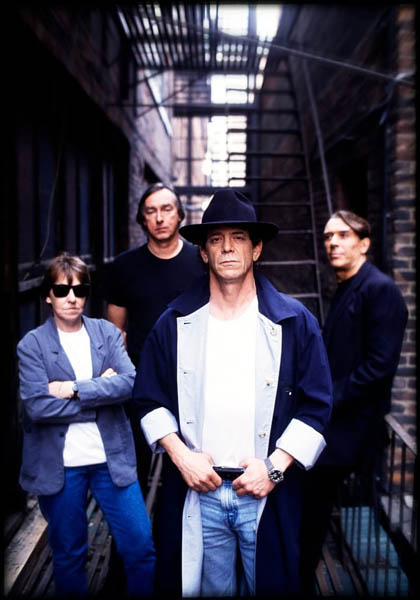
Velvet Underground 1993 – during rehearsals in NYC; Maureen Tucker, Sterling Morrison, Lou Reed, & John Cale (Steve Double photography)
The Velvet Underground did eventually reunite at an Andy Warhol art retrospective in Paris in June of 1990. This sparked an interest with the original members, resulting in a tour of Europe in 1993. While touring progressed, infighting and other issues led to the group scrapping an idea for a possible US tour.
The first appearance, from a research perspective, of Sterling playing music in the Hudson Valley area, is a collaboration with the Hudson Valley Philharmonic. The show was called “The New Wave,” conducted by Randall Craig Fleischer, featuring Sterling Morrison on guitar. Two shows were put on, one at the Bearsville Theater in Woodstock, and the other at the Chance in Poughkeepsie. Both were performed in February of 1994.
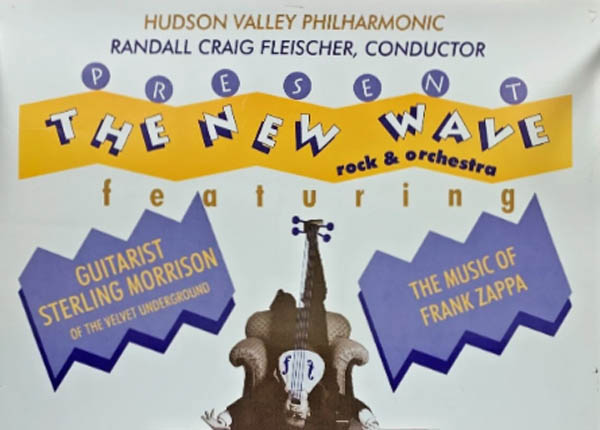
“The New Wave” February 1994
Fleischer, the Music Director of the Hudson Valley Philharmonic, came up with this idea of musical fusion: “Artistically, we are combining the forces that don’t tend to be combined very often – rock and chamber orchestra.” He continued, “We’ve asked composers to write in such a way to combine the two kinds of music in whatever way feels natural.”
The show featured eight pieces of music. It ranged from re-workings of music from Vivaldi, originals by Fleischer, and the music of Frank Zappa, as well as other eclectic works.
Up to the moment of the performance, Morrison had no idea if the endeavor would work: “A rock guitar player never plays within a written score. It’s an effort to read the music and transfer it to the fingers. It requires memory skills.”
Fleischer was happy to have Sterling in the fold. He said there was material in the symphony’s construction where he had lots of room to improvise.
The shows were a success considering the new wave series continued for several more years. Future guests included Natalie Merchant, Richie Havens, Kate Pierson of the B-52’s, Garth Hudson of The Band, and Morrison’s old bandmate, John Cale.
Sadly, around this time, Sterling was diagnosed with non-Hodgkins Lymphoma. His health deteriorated quickly. Friends, including members of the Velvet Underground, visited and spent some time with him in various intervals before he passed.
He died at home in Poughkeepsie, a day after his 53rd birthday, on August 30, 1995. Maureen Tucker had just left from visiting Sterling and was on her way back to New York on Metro North when he passed away.
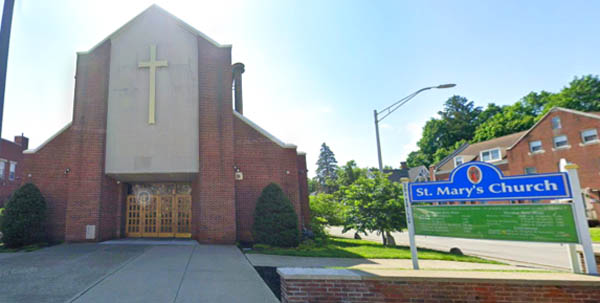
St. Mary’s Church on Church St. in Poughkeepsie
Soon afterward, a memorial service was held at St. Mary’s Church on Church Street in Poughkeepsie. Velvet Underground bandmates John Cale and Tucker were in attendance. Over 100 people turned out for Sterling’s eulogy, conducted by the Reverend John Brinn.
Many of those gathered commented on his originality, inventiveness, intellectual curiosity, and his unpretentious personality. Dean Wareham mentioned how Sterling was equally comfortable discussing “…Ray Charles, St. Thomas Aquinas, Moby Dick, or Moby Grape.” He concluded by telling Sterling that he was “a continuing source of inspiration to me.”
An old college friend spoke of Morrison’s capacity “for absorbing immense amounts of information and making them part of his personality.” He added that Sterling was “totally clueless about the scope of his intellect.”
Music writer David Fricke called him “an interviewers dream. You’d just ask him a question and he was gone, for hours.”
John Cale read the Dylan Thomas poem “Death Shalt Have No Dominion” and called Sterling “a dear friend and collaborator over the years.” His old Velvets cohort praised “the deeply impressive dignity he showed as he struggled through his recent illness.”
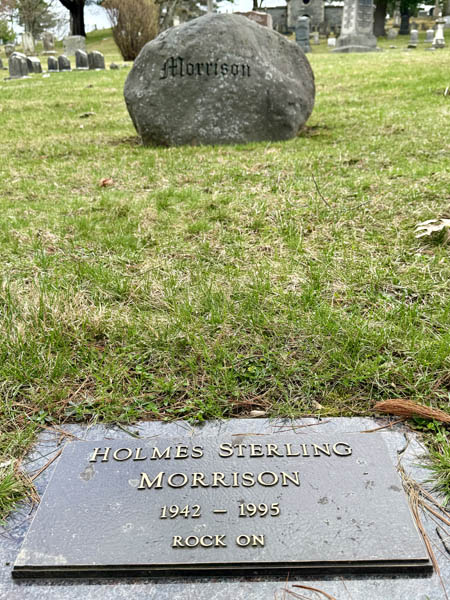
Grave of Holmes Sterling Morrison at Poughkeepsie Rural Cemetery
Sterling Morrison’s life ended not far from where I’m writing this. His story is now as influential to me as his music. He lived an extraordinary life in full, in an unfortunately short period of time. Incredibly brilliant, talented, and so very human.
And he’ll stand as being another part of Poughkeepsie’s rich and vital cultural/historical tapestry.
*Thanks to Karen Moksvold for the inspiration to write this story.