Community is more than a place on a map. It is something people create through shared work, traditions, institutions, celebrations, and everyday efforts to build belonging.
The Johnson County Museum’s special exhibit, Everyday Democracy: Life, Liberty, and the Pursuit of Happiness in Johnson County, explores this process while revealing how local residents have interpreted and pursued the nation’s founding ideals over time. Veterans and farmers, longtime residents and recent arrivals, and women and men have gathered, organized, celebrated, and worked together to meet common needs and make the places they lived feel like home.
Their experiences also remind us that community has not always included everyone equally. The stories below offer just a few examples of how Johnson Countians have built connections, preserved traditions, and worked to improve the communities they shared.
Jeremiah McCanse Builds Community
Jeremiah McCanse – a Black Civil War veteran born enslaved in Missouri – helped shape community life in Johnson County during a time of transition and division. While the Civil War and the 13th Amendment ended slavery, restrictive Jim Crow laws soon brought fresh waves of violence and oppression against African Americans. Segregated communities, like the Fairview neighborhood in Olathe, emerged in towns across Kansas and the nation.

Despite this, McCanse prospered. In 1896, he opened a barbershop in Spring Hill, cutting white patrons’ hair during the day and Black patrons’ hair at night. More than a business, the shop became a gathering place and a source of community pride. As one local newspaper put it, McCanse’s shop was “an ornament… and this city is justly proud of it.”
McCanse formed community in other ways, too. He was active in the Grand Army of the Republic, a fraternal and political organization for Union veterans. He also served on the Spring Hill school board, ensuring quality education for all children in his community.
Farmers Organize Through the Grange
Founded in 1867, the Order of the Patrons of Husbandry – better known as the Grange – was a grassroots movement to improve farmers’ lives through education, cooperation, and political action. Johnson County’s first chapter formed in Gardner in 1873. By 1884, there were over 1,200 members in 36 local chapters. As a membership roster from the Greenwood Grange near Shawnee shows, the Grange permitted both men and women as members. At a time when women had limited opportunities to be heard, membership in the Grange provided an important platform.

The Grange opened cooperative stores and banks, fought for fair railroad rates, and built a strong sense of fraternity. Its motto, “In essentials, unity; in non-essentials, liberty; in all things, charity,” reflected its values. Grangers believed that cooperation, education, and civic participation could strengthen both farming families and the communities they shared.
Preserving Community History
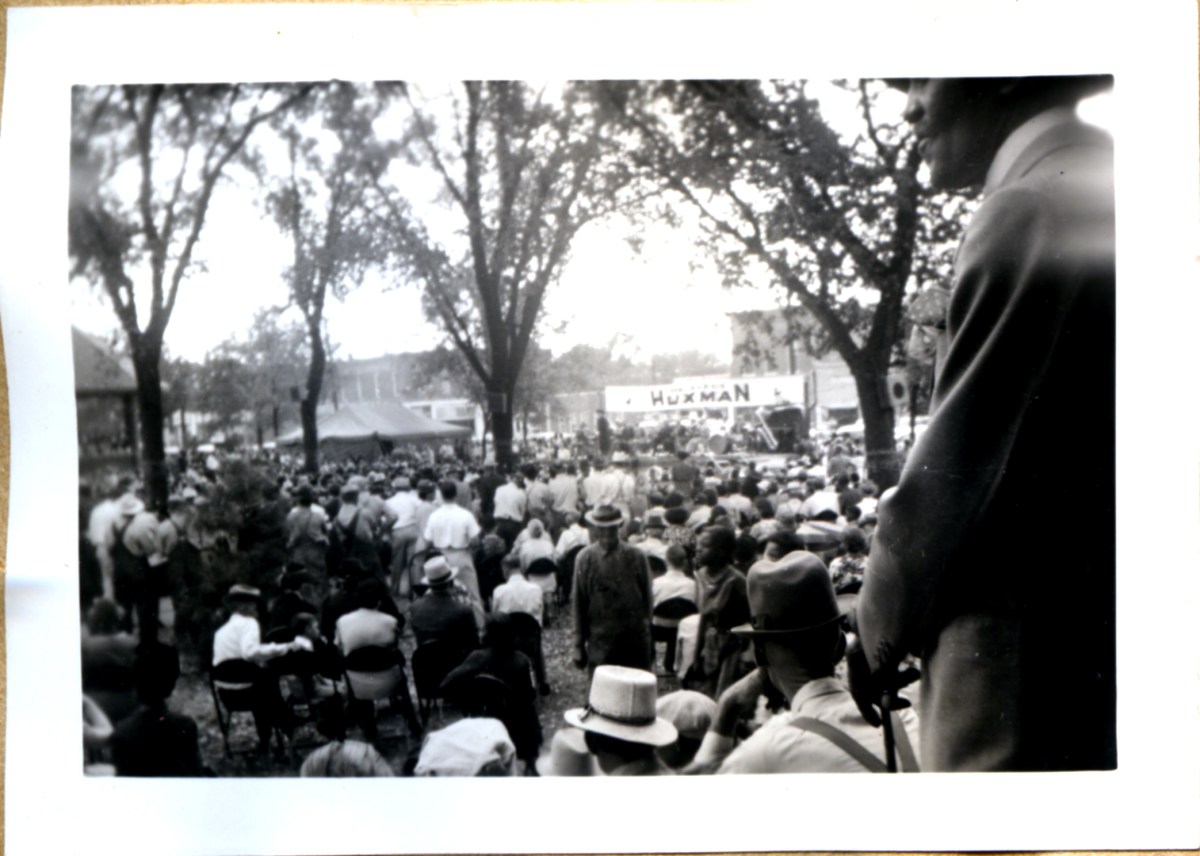
Founded in 1898, the Old Settlers’ Association honors Johnson County’s pioneers and longtime residents with annual gatherings filled with parades, crafts, food, and storytelling – preserving memories even as the county changed. Black and Mexican residents who lived nearby in Olathe were largely absent from or segregated in the event in its early years. The tradition has continued as an annual gathering for the whole community centered on local history and community identity.

Women Gather, Learn, and Lead
Before women could vote (1912 in Kansas, 1920 nationally), local women met to form community and seek improvement, education, and advancement in other ways. Women’s clubs, church groups, and community organizations flourished, shaping civic life.
Many women met in rural farm homes or following church services on Sundays to quilt together. Quilting provided women a chance to socialize and problem solve while producing something practical. Quilting bees were important events, often taking place while men were planting, harvesting, or barn raising.

Some women joined women’s clubs to learn together. For example, the Sigournean Club in Olathe had a large membership. The club was dedicated to “mutual improvement and enlarging our general knowledge.” Members studied literature, philanthropy, history, sociology, archaeology, zoology, anthropology, psychology, astronomy, hygiene, and drama, all in one year of programming. Other similar groups included the Young Women’s Culture Class, whose motto was “Be what you are, become what you can,” and the women’s literary and service organization, the Delphi Club.

Carrying Community Traditions Forward
As Johnson County’s population has grown and become more diverse, cultural celebrations such as quinceañeras have become an increasingly visible part of community life. In November 2023, Kylie Reyes wore a sparkly pink dress, purchased at Oak Park Mall, for her own quinceañera (15th birthday). The festive event united family, friends, and community at the Johnson County Arts & Heritage Center.
For decades, Kylie’s grandparents, Clara and Manuel Reyes, had helped to form community in the Kansas City region. They published the regional bilingual newspaper, Dos Mundos, and later ran the Reyes Media Group in Kansas City, Kansas. Clara founded the paper in her Johnson County home to connect other immigrants like herself, and today it reaches more than 20,000 readers. The Reyes family story illustrates how cultural traditions strengthen community bonds.

Continue the Story at the Museum
These stories represent only a few of the ways Johnson Countians have created belonging, cared for one another, and worked to improve the places they called home. Everyday Democracy invites visitors to consider not only how people in the past pursued Life, Liberty, and the Pursuit of Happiness, but also how each of us contributes to the community we share today.
See these stories and many more at the Johnson County Museum. Everyday Democracy is included with regular Museum admission. The Museum is open Monday through Saturday from 9 a.m. to 4:30 p.m. Bring a friend, relative, or neighbor to learn together and plan your visit at JCPRD.com/Museum!