Elevate your trading with R StocksTrader
Get access to more than 12,000 instruments with a single account!

AUD/USD is one of the key currency pairs in the international foreign exchange market. On 1 February 2024, we examined the primary factors influencing the pair’s exchange rate, analysed its price performance in 2023, and explored expert forecasts for 2024.
You can visit the RoboForex Market Analysis webpage for the latest AUD/USD forecasts.
AUD/USD shows the ratio of the US dollar (USD) to the Australian dollar (AUD). Its quotes indicate the value of one Australian dollar denominated in US dollars. When the pair’s exchange rate rises, the Australian dollar strengthens against the US currency. When the exchange rate drops, this signals that the AUD is on the decline against the USD.
Trading characteristics of the AUD/USD pair
The Reserve Bank of Australia has been tightening its monetary policy to combat inflation since May 2022, raising the key rate from 0.1% in April 2022 to 4.35% in November 2023. Subsequently, the regulator paused to assess the dynamics of inflation rates, keeping the indicator unchanged. In its policy, the central bank aims to reduce the inflation rate to the target range of 2-3%.
The Q4 2023 consumer inflation report released on 31 January 2024 showed a decrease in the indicator to 4.1%. It is worth noting that the reading was 5.3% in Q3. According to the Reserve Bank of Australia’s estimates, the inflation rate is decreasing and is projected to return to the 2-3% target in 2025.
Michele Bullock, the RBA’s governor, states that economic activity in the country is high despite monetary policy tightening. The cash rate will likely remain at 4.35% in the near term.
The US Federal Reserve is also combatting inflation by tightening monetary policy, with the regulator aiming to decrease the indicator to 2%. From the beginning of 2022 to July 2023, the interest rate has gradually risen from 0.25% to 5.5%, significantly impacting the exchange rate of the US dollar, which has strengthened markedly against many world currencies.
The inflation rate is gradually decreasing thanks to monetary tightening, and high interest rates exert pressure on the US economy. Consumer inflation (CPI) was down to 3.4% in January 2024. At its latest meeting on 31 January 2024, the Federal Reserve left the interest rate unchanged at 5.5%, with the regulator’s officials noting that they are ready to cut the rate if inflation steadily slows down.
Experts expect the Federal Reserve to start an interest rate reduction process as early as May 2024 if the inflation rate continues to decrease smoothly. These expectations may exert pressure on the USD, driving up the pair in the medium term.
Despite being relatively young, Australia’s economy holds a prominent position in the global rankings. The country is rich in diverse natural resources, including gold, iron ore, diamonds, minerals, uranium, and coal deposits. The export of these resources plays a pivotal role in bolstering government revenue. Therefore, an upswing in the global prices of commodities like iron ore, industrial metals, gold, silver, and coal contributes to strengthening the Australian dollar exchange rate and fuels the growth of the AUD/USD currency pair.
Conversely, a decline in the prices of natural resources, often triggered by a global economic crisis, results in a decrease in the Australian dollar exchange rate and the AUD/USD quotes. It is worth noting that the AUD/USD currency pair is correlated with the price of gold. Rising gold prices usually contribute to strengthening the Australian dollar and driving up the pair’s exchange rate. In contrast, a decline in gold quotes is commonly followed by a drop in the Australian currency exchange rate and the pair’s quotes.
The AUD/USD pair demonstrated mixed performance in 2023. Starting the year at 0.6820, the quotes moved upwards and reached an annual high of 0.7160. A downtrend followed, with the exchange rate smoothly declining to the yearly low of 0.6280 by October. In November and December, the quotes saw solid growth, ending the year at 0.6810, i.e., nearly the same level where they started the year.
The drop in the pair’s exchange rate was driven by the Federal Reserve’s interest rate hike policy and the related growth in the USD exchange rate against many world currencies. The strengthening of the Australian dollar and a rise in the AUD/USD quotes were propelled by the RBA’s rate hike policy and rising prices for natural resources, including gold.
2023 AUD/USD price market outlook*
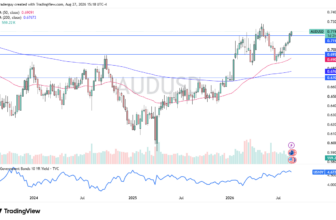
As of writing, the AUD/USD currency pair is undergoing a downward correction on the daily chart following recent growth and a rebound from the resistance level of 0.6870. The Alligator indicator and the 200-day Moving Average support the price’s downward momentum. The quotes presently range between 0.6525 and 0.6625, and the breakout direction from this range may serve as a reference point for near-term prospects of the exchange rate movements.
If the quotes gain a firm foothold below a strong support area at 0.6500-0.6525, aligning with the 61.8% Fibonacci retracement level, then the trend may be projected to reverse into a downtrend, with the price potentially declining to the 2023 low of 0.6280.
If the quotes secure above the resistance level of 0.6625, potentially climbing further to 0.6870, this may support the potential completion of the downward correction and the continuation of the uptrend.
In 2023, AUD/USD quotes demonstrated mixed dynamics, returning by the end of the year to the same levels they started from. The policies of the RBA and the Fed supported the stability of the exchange rate to increase interest rates.
The pair’s future dynamics will likely depend on inflation and the actions of central banks: the regulator that lowers the rate first will exert pressure on its national currency.
A decrease in the Fed’s rate will contribute to strengthening the pair’s exchange rate. Conversely, a reduction in the RBA’s rate will lead to its decline. According to the forecasts above, in 2024–2025, AUD/USD quotes may be in the 0.5850–0.7000 range.
Forecasting is crucial for strategic planning and risk management, helping investors predict the movements of the currency pair.
Commonly employed methods include fundamental analysis, technical analysis, and sentiment analysis.
While forecasting methods have their advantages, they are not entirely reliable. Various factors can affect AUD/USD and trigger unexpected price movements.
The primary risk lies in the unpredictability of global political and economic events that can significantly affect the AUD/USD rate.
The list of potential events is extensive, including shifts in the monetary policies of US and Australian regulators, considerable fluctuations in resource prices, geopolitical changes, natural and human-caused disasters, and crisis developments in national and global economies.
Influenced by various factors, the AUD/USD rate may maintain its volatility.
An increasing interest rate in the US contributes to the pair’s downward movement, whereas an interest rate hike in Australia drives up the AUD/USD quotes.
* – The TradingView platform supplies the charts in this article, offering a versatile set of tools for analyzing financial markets. Serving as a cutting-edge online market data charting service, TradingView allows users to engage in technical analysis, explore financial data, and connect with other traders and investors. Additionally, it provides valuable guidance on how to read forex economic calendar effectively and offers insights into other financial assets.